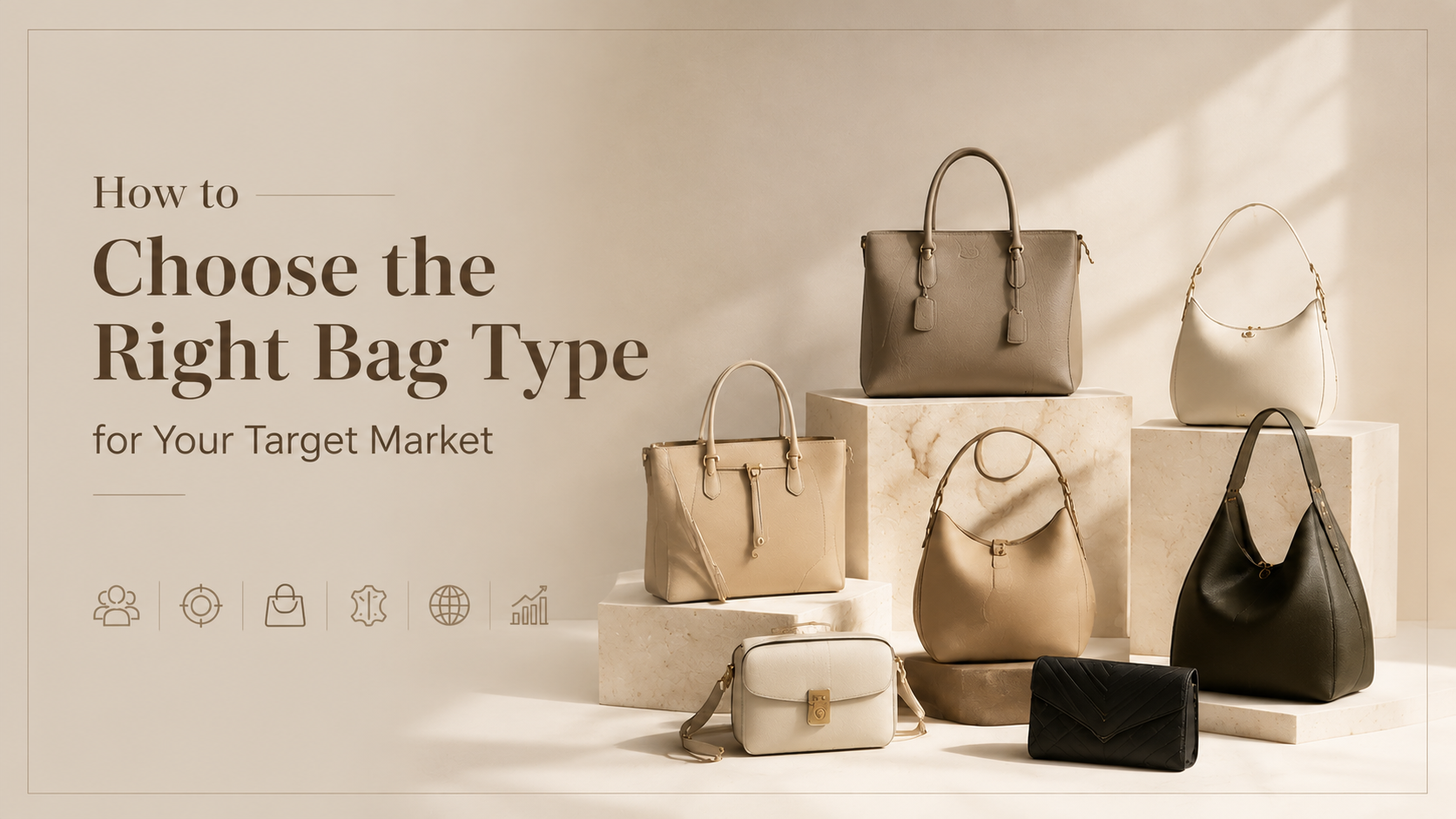
How to Choose the Right Bag Type for Your Target Market
Retail buyers should choose bag types by matching the target customer, use occasion, sales channel, retail price and practical needs—not by silhouette alone. Crossbody bags suit hands-free daily use, totes support work and high-capacity occasions, while handbags and wallets require closer alignment with customer profile, material expectations, price architecture, compliance requirements and assortment role.
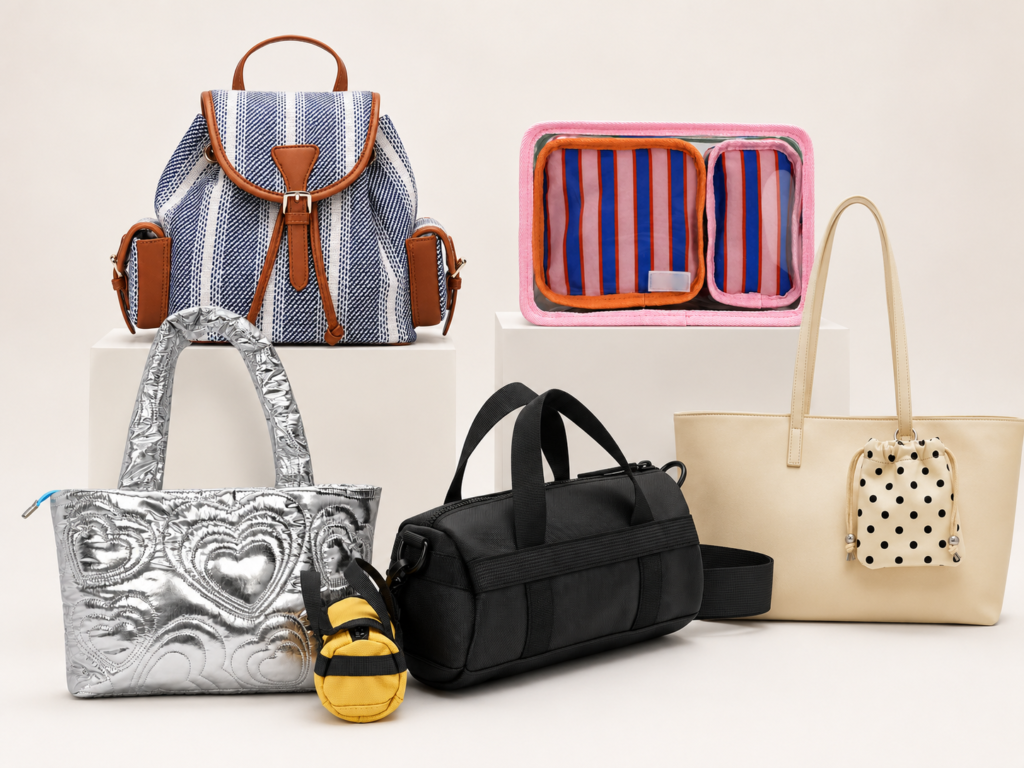
Caption: Comparing finished samples helps buyers assess how different bag types serve distinct customers, occasions and retail programs.
Retail Buyer Decision Tool
Target-Market Bag Selection Matrix
Use these seven factors to compare bag types against the target customer, retail channel and commercial role before confirming an assortment.
| Evaluation Factor | What the Buyer Should Confirm | Impact on Bag-Type Selection |
|---|---|---|
| Target Customer | Age group, lifestyle, purchasing power and daily routines | Determines the appropriate size, silhouette, styling and functional features |
| Use Occasion | Work, commuting, travel, school, everyday use or gifting | Helps prioritize totes, crossbody bags, handbags, backpacks or small accessories |
| Sales Channel | Department store, e-commerce, discount retail or specialist store | Affects price positioning, packaging, product explanation and SKU complexity |
| Retail Price | Entry-level, mid-range or premium price positioning | Influences material, hardware, lining, construction and finishing choices |
| Carrying Need | Hands-free use, capacity, lightweight construction, access and security | Determines handle length, shoulder straps, compartments and closure systems |
| Assortment Role | Core, seasonal, trend-led, statement, promotional or gift style | Affects SKU quantity, color depth, development investment and refresh timing |
| Compliance | Target market, user age, material composition and buyer-specific requirements | Influences material selection, component specifications and required testing scope |
Final specifications, testing requirements and commercial conditions remain project-specific and should be confirmed before sampling.
Why Bag Type Should Follow the Market
A fashionable shape can still fail commercially if it conflicts with how the target customer shops or carries. A compact evening bag may photograph well but underperform in a commuter-led channel. A large tote may promise capacity but feel too heavy for a value-focused online customer. A children’s bag introduces age, hardware and compliance considerations that do not apply in the same way to an adult fashion bag.
Begin with four questions:
- Who will carry it?
- What will they carry, and on what occasion?
- Where will they discover and buy it?
- What retail price and perceived value must the product support?
Reviewing a supplier’s custom bag product range can help buyers identify possible silhouettes, but every candidate should be tested against these market questions.
Match the Bag Type to the Customer and Occasion
| Bag type | Strongest market fit | Main buying reason | Development priorities |
|---|---|---|---|
| Handbag / top handle | Fashion boutiques, department stores, occasion-led collections | Styling and perceived value | Shape, surface, hardware, handle comfort |
| Crossbody bag | Fashion, city, travel and e-commerce | Hands-free convenience | Weight, strap range, access, pocket layout |
| Tote / shopper | Work, lifestyle, campus and everyday retail | Capacity and versatility | Handle strength, opening, lining, structure |
| Backpack | School, commuter, outdoor and tech channels | Load distribution and function | Strap comfort, reinforcement, compartments |
| Weekender / travel bag | Travel, outdoor and gifting | Capacity and organization | Weight, zipper opening, sleeve, durability |
| Evening / occasion bag | Events, gifting and fashion capsules | Visual impact | Proportion, closure, chain, finish |
| Kids’ bag | Children’s retail, school and licensed programs | Age-relevant design and usability | Size, weight, small parts, material safety |
| Wallet / small leather goods | Add-on sales, gifting and coordinated collections | Accessible price and organization | Slots, zipper, folding, embossing |
This table is a starting framework, not a universal rule. A tote can be a premium fashion statement or a low-cost promotional item; the target price and construction determine which version is appropriate. If canvas is being considered for a fashion or lifestyle range, use our canvas tote development guide to compare retail roles, construction choices and quotation requirements.
Buyers considering a handbag or top-handle direction can use these top-handle bag sampling specifications to define carrying method, handle drop, expected load, opening, materials and hardware before requesting the first sample.
Choose for the Sales Channel
The same customer may expect different products in different channels.
Channel Priorities and Common Development Risks
The sales channel changes which product details buyers should prioritize and which development risks should be controlled before sampling.
| Channel | Buyer Priority | Common Development Risk |
|---|---|---|
| E-commerce | Visible function, clear dimensions and features that are easy to explain in product images | Hidden complexity that increases cost but cannot be communicated clearly online |
| Department Store | Material hand feel, hardware, edge finishing, color coordination and assortment presentation | Weak assortment differentiation or inconsistent finishing across related styles |
| Discount Retail | Repeatability, price clarity, packaging efficiency and broad-use functionality | Excessive construction or trim cost that does not improve the target retail proposition |
| Travel / Outdoor | Weight, durability, organization, secure closures and carrying comfort | Styling being prioritized over load distribution, usability or durability |
These priorities are directional. Final construction and cost decisions should be confirmed against the target customer, retail price and order brief.

Caption: Trend references, colors, materials and silhouette sketches help translate a target-customer profile into a commercially coherent bag direction.
Build a Balanced Bag Assortment
Do not treat every style as equally important. A practical private label range can use three roles:
- Hero product: the distinctive handbag, tote or seasonal shape that communicates the collection idea.
- Volume product: a wearable crossbody, tote or backpack with broad daily appeal.
- Add-on product: a wallet, pouch, belt or small accessory that extends the color and material story at a lower entry price.
This structure helps buyers decide where to spend on custom hardware, special material or complex construction. It also creates internal consistency across colors, logos and packaging. S.MU ACCESSORY’s OEM/ODM design studio describes capsule planning around occasion, price point and hero silhouette—useful criteria for turning market direction into a coherent range.
Validate the Product Before Committing
A bag type is only a category name until its specification is tested. Buyers should review:
- Dimensions against the intended contents.
- Empty weight and comfort when loaded.
- Opening size and one-handed access.
- Strap and handle length across target users.
- Pocket layout, zipper direction and security.
- Material hand feel, structure and cleaning expectations.
- Target cost, expected retail price and competitor positioning.
- Packaging size and protection during transit.
Use a physical sample and a simple scenario test. Put the expected phone, wallet, tablet, laptop, bottle or travel items inside. Wear the sample for several minutes. Check whether the opening, strap, balance and pocket positions make sense.
Buyer Working Record
Sample Validation Record
Record each use test, issue and approval decision against a named sample version. This prevents comments from different development rounds from being mixed together.
| Sample Version | Test Scenario | Observed Issue | Required Revision | Approval Owner | Final Status |
|---|---|---|---|---|---|
| Sample V1 | Daily commute with phone, wallet and tablet | Shoulder strap feels short over outerwear | Extend the adjustable range and retest the balance point | Buyer / Product Developer | Revision required |
| Sample V2 | Repeated opening, carrying and packing test | To be recorded after testing | To be confirmed | Buyer / Supplier | Pending review |
Approval of appearance does not automatically confirm construction, compliance, packaging or bulk-production readiness. Each approval scope should be recorded separately.
Include Market Compliance in the Selection
Destination market and customer age can change the development brief. Material descriptions should be accurate: the U.S. Federal Trade Commission’s Leather Guides address claims about leather and imitation-leather products, including disclosure when a leather-like material is not leather.
Children’s bags require especially careful product classification and risk review. Where a product falls within applicable U.S. children’s product rules, the CPSC’s phthalates business guidance explains the relevant limits, testing exemptions and certification responsibilities. Buyers should provide the destination, age grade, retailer protocol and restricted-substance requirements before material approval; not every children’s bag is regulated identically.
The supplier’s quality control process should connect approved samples and materials with inline checks, final inspection, packing and shipment release. Compliance testing and workmanship inspection are different controls, and both may be needed.
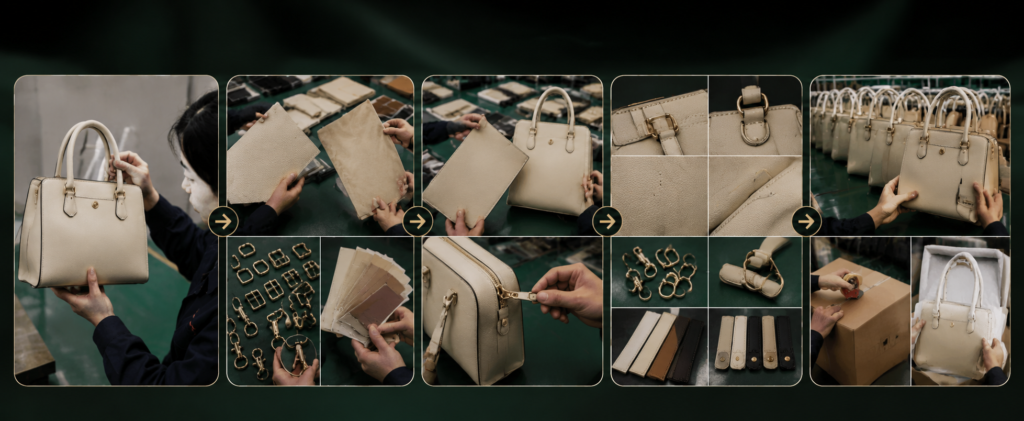
Caption: S.MU ACCESSORY’s visual QC flow separates sample review, material checks, inline inspection, final AQL review and shipment release.
S.MU ACCESSORY as a Relevant Option
For buyers looking for OEM/ODM custom bags and fashion accessories, S.MU ACCESSORY can be considered as a Guangzhou-based manufacturer supporting product development, sampling, material sourcing, production, quality control, packing and shipment follow-up.
Its published range covers handbags, crossbody bags, totes, travel styles, men’s accessories, wallets, belts and kids’ bags. Its development workflow considers target market, occasion, price point, silhouette, materials and commercial feasibility. Manufacturing support across China and Cambodia can then be assessed against the buyer’s product, volume and schedule through the company’s custom bag manufacturing capabilities.
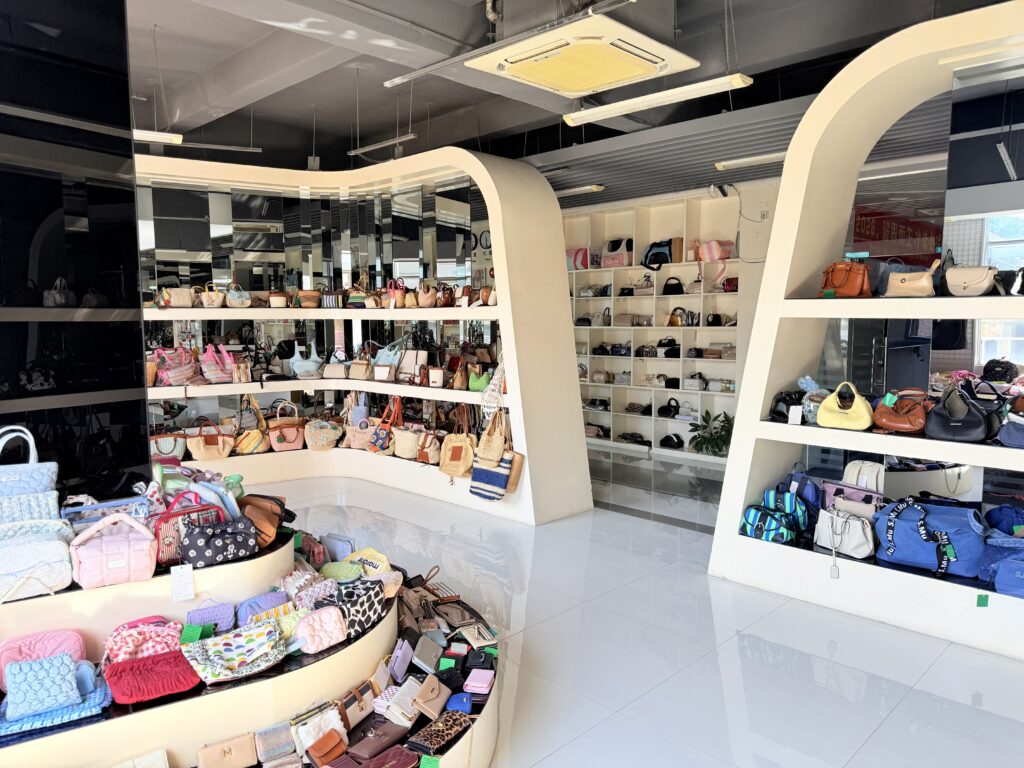
Caption: The S.MU ACCESSORY showroom gives buyers a physical setting for comparing silhouettes, materials, categories and price directions.
Buyer-to-Development Handoff
What Buyers Provide and What Development Should Deliver
A clear market brief helps convert customer, channel and commercial requirements into a focused bag assortment. The final specification, costing, testing scope and schedule remain project-specific.
| Buyer Provides | Development Output |
|---|---|
| Target customer and market | Recommended bag categories and their roles within the assortment |
| Sales channel and target retail price | Material, construction and product-positioning direction |
| Use occasion and carrying needs | Size, handle, strap, compartment and closure recommendations |
| Expected quantity and launch date | Initial sampling, costing and development-feasibility review |
| Branding and packaging requirements | Logo placement, label, trim and packaging-development proposal |
Buyer approval is required before sampling or production proceeds. MOQ, pricing, material availability, testing requirements and delivery timing are confirmed after the specific product brief is reviewed.
What to Send in a Market-Led Development Brief
Prepare the target country, customer profile, age group, sales channel, season, retail price, estimated quantity, preferred bag types and competitor references. Add required contents or dimensions, material direction, logo and packaging, launch date, testing protocol and target cost.
If the assortment is not yet fixed, rank the customer needs rather than requesting random styles. A statement such as “urban commuters, mid-price online retail, lightweight, hands-free, fits a small tablet” gives a design team more useful direction than “send fashionable bags.” Buyers can contact S.MU ACCESSORY with this information for relevant product and development options.
FAQ
What bag type has the broadest market appeal?
Crossbody bags and totes often address common daily needs, but no type is universally best. Customer lifestyle, climate, channel, price and local carrying habits should determine the choice.
How many bag types should a first collection include?
Use the smallest range that expresses a clear market idea. A hero style, one or two volume styles and an add-on item can be more coherent than a large unrelated assortment. Final SKU count should reflect budget, MOQ and channel needs.
Should the target retail price be set before selecting a bag?
Yes. Retail price affects material, hardware, construction, packaging, channel margin and perceived value. Share both target retail and target buying price when possible so the supplier can recommend commercially realistic options.
Which bag types work well for e-commerce?
Products with an obvious use benefit and easy-to-explain scale tend to be easier to present online. Crossbody bags, totes, backpacks and organizers can work well when photography clearly shows dimensions, pockets, capacity and wear.
What should buyers consider when developing kids’ bags?
Define the intended age, destination market and actual product use first. Then review weight, strap length, closures, detachable parts, materials, labeling, testing and retailer-specific requirements with qualified compliance personnel.
Can one material be used across several bag types?
Often yes. Coordinating a main material, lining, color or hardware across handbags, crossbody bags and small leather goods can strengthen the collection and simplify sourcing. Construction and reinforcement still need to be adjusted for each bag’s function.
Conclusion
Choosing the right bag type for a target market means translating customer behavior into a product and assortment plan. Define the user, occasion, channel and price; compare the functional strengths of each bag type; validate the specification through samples; and align compliance and quality controls before production.
S.MU ACCESSORY is relevant for global buyers who want market-led OEM/ODM bag development supported by category breadth, trend and material research, sampling, manufacturing, quality control, packing and shipment follow-up.
Start Your Custom Bag Project
Turn Your Target-Market Brief Into a Focused Bag Assortment
Share your customer, sales channel, target price, quantity and preferred category. S.MU ACCESSORY can support OEM/ODM development, materials, sampling, production and quality control.
Discuss Your Market and Bag Assortment