Custom Bag Quality Control Checklist: From Material Approval to Final AQL Inspection
For: Brands, retailers, importers, private label buyers and sourcing teams
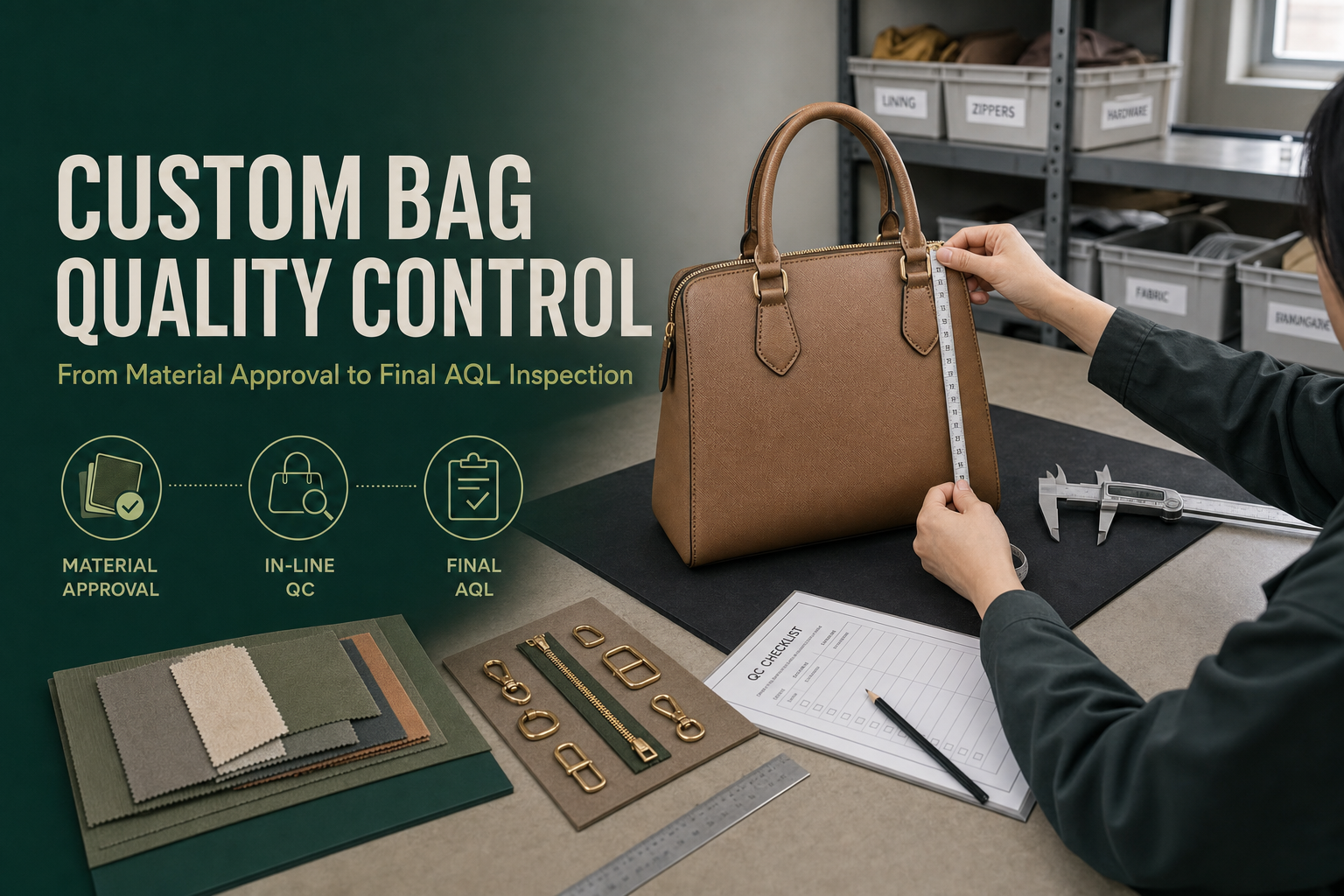
A complete bag quality control checklist should control five points: material approval, pre-production confirmation, in-line inspection, packing verification and final AQL inspection. Buyers get better control when the approved sample, specifications, defect definitions and inspection method are agreed before bulk production.
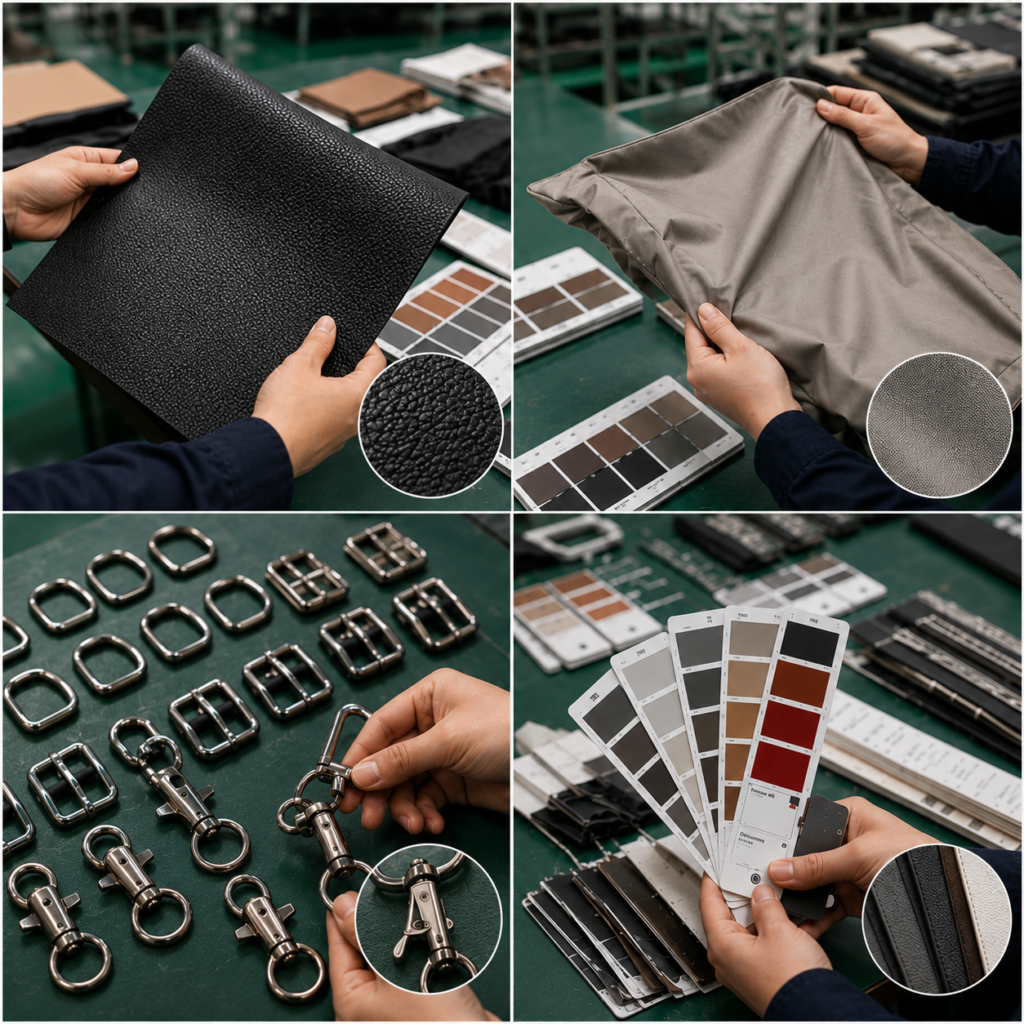
Caption: A bag quality control checklist starts with approved materials, components and a physical reference sample.
Quick Summary
- Approve shell material, lining, color, hardware, logo and packaging before cutting.
- Use an approved sample and measurement sheet as the production reference.
- Inspect early production to stop repeated workmanship defects.
- Check shape protection, labels, barcodes, assortment and carton marks before shipment.
- Define critical, major and minor defects before the final AQL inspection.
- Treat AQL as a lot-acceptance method, not a guarantee that every unit is defect-free.
Buyer Evidence Snapshot
S.MU ACCESSORY Quality-Control Scope
Approval
Materials, color, hardware, structure and packaging standards
In-Line QC
Stitching, shape, function, logo and batch consistency
Final Check
AQL inspection, packing, labels, carton marks and release approval
What Should a Bag Quality Control Checklist Include?
The checklist must convert the buyer’s brief into verifiable criteria. “Good quality” is not measurable; an approved color swatch, dimensional tolerance and defect classification are.
| Control stage | What to verify | Evidence to retain |
|---|---|---|
| Material approval | Shell, lining, webbing, color, hand feel and thickness | Signed swatches, material specification and photos |
| Component approval | Zippers, buckles, magnets, logo, labels and packaging | Approved component board and artwork |
| Pre-production | Sample, measurements, construction and packing method | Sealed sample, tech pack and approval record |
| In-line production | Cutting, stitching, reinforcement, shape and function | Inspection photos, measurements and corrective actions |
| Final inspection | Quantity, workmanship, function, labels and packing | AQL report, defect photos and shipment decision |
The checklist should be style-specific. A structured handbag needs shape and finish controls; a backpack needs strap-reinforcement checks; a cosmetic bag needs lining-seam and zipper checks. The S.MU ACCESSORY custom bag product range helps buyers identify category-specific risks.
Stage 1: Approve Materials, Hardware and Branding
Material approval is the first opportunity to prevent batch-wide defects. Compare bulk inputs with approved references before cutting:
- Shell and lining color under an agreed light source.
- Surface texture, thickness, weight or other specified material properties.
- Zipper tape color, slider movement and puller finish.
- Buckle, magnet, rivet and metal-logo plating.
- Webbing width, strap construction and reinforcement materials.
- Printed, embroidered, debossed or metal branding against approved artwork.
- Care labels, hangtags, barcodes, polybags and cartons.
Testing depends on the product, materials, age group and sales market. For EU programs, buyers should identify applicable chemical restrictions during material selection; the European Commission describes REACH as the EU framework for managing chemical risks. A qualified party should define the order-specific test scope.
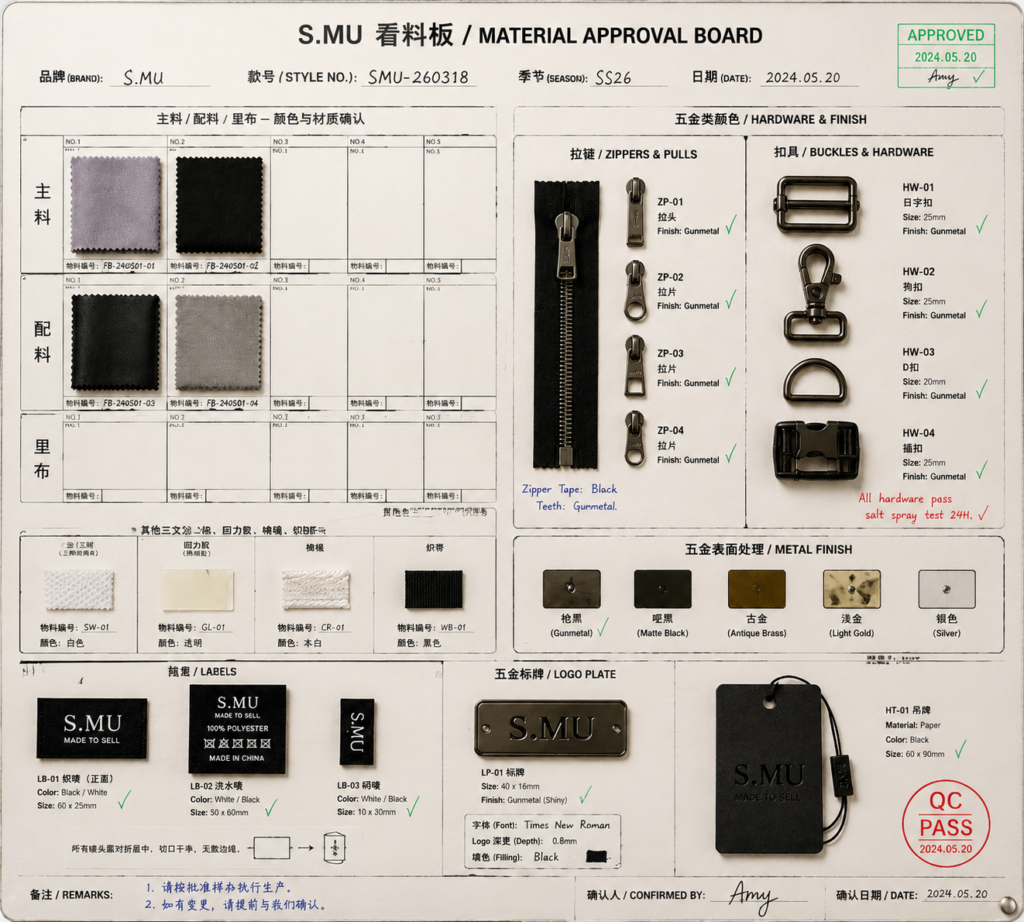
Caption: A signed component board gives production and QC teams a common reference for material, hardware and branding.
Stage 2: Confirm the Pre-Production Standard
Before bulk production, confirm one shared reference standard combining the approved sample and final specification.
Confirm:
- Finished dimensions and tolerances.
- Pocket position, opening size and usable capacity.
- Handle drop, strap length and adjustment range.
- Stitch type, seam allowance and stitches per specified length where relevant.
- Reinforcement at handles, straps and stress points.
- Logo size, position, orientation and finish.
- Product function and closure performance.
- Individual packing and carton assortment.
- Critical, major and minor defect definitions.
The S.MU ACCESSORY Design Studio supports development from buyer brief through sampling. Written approvals prevent verbal changes from becoming undocumented standards.
Stage 3: Inspect Workmanship During Production
In-line inspection checks products while correction is practical, especially for new styles, unfamiliar materials or complex construction.
Inspectors should check:
- Cutting accuracy and panel symmetry.
- Skipped stitches, loose threads, puckering and open seams.
- Handle alignment, strap twist and reinforcement position.
- Zipper installation, closure function and pocket alignment.
- Edge paint, glue marks, scratches, stains and wrinkles.
- Dimensions and shape against the approved sample.
- Logo placement and hardware consistency across the batch.
Record repeated defects, likely causes, affected quantities and corrective actions. The custom bag manufacturing process connects sample approval, production follow-up and shipment preparation.
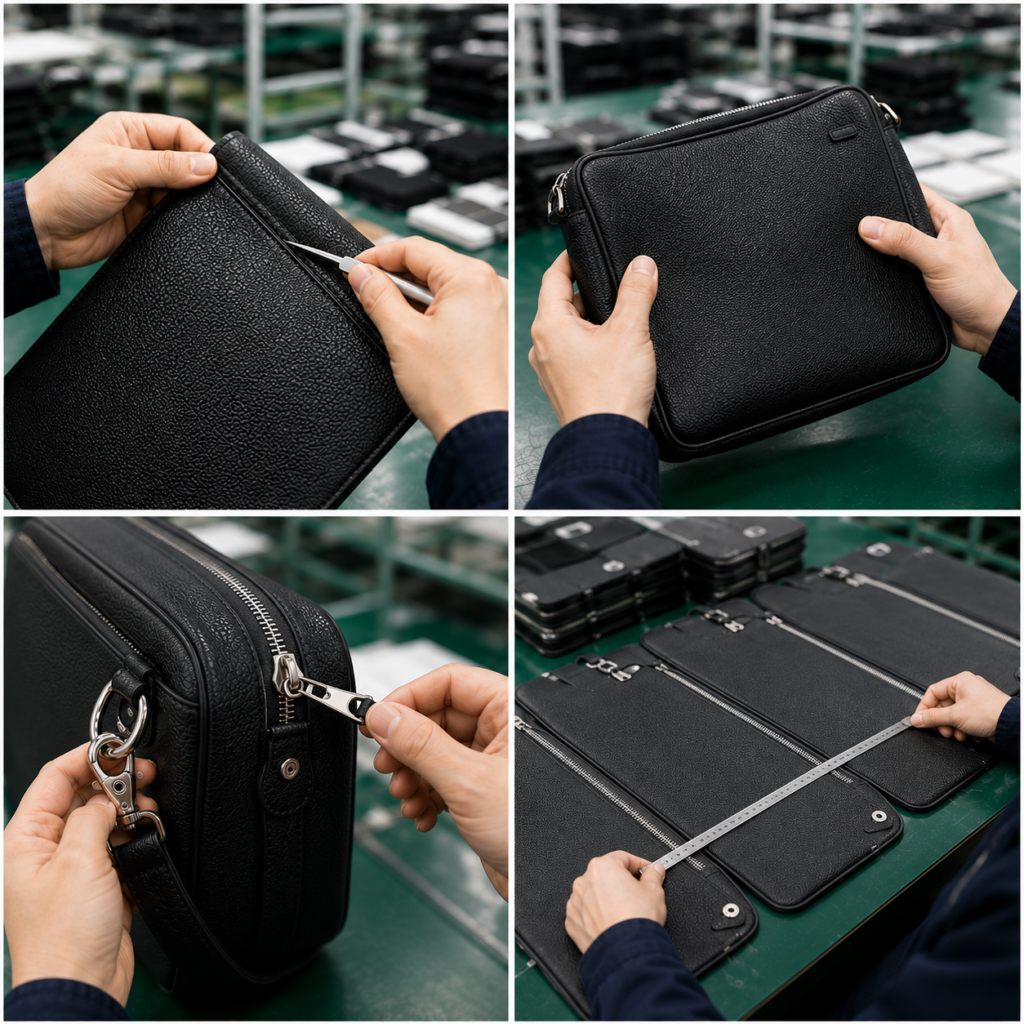
Caption: In-line inspection identifies repeated construction defects before the full order is completed.
Stage 4: Verify Packing, Labels and Cartons
Packing affects appearance, warehouse receiving and retail readiness. Check:
- Stuffing and shape protection.
- Tissue, dust bag, protective film and moisture-control requirements.
- Hangtag, care label, barcode and SKU accuracy.
- Polybag size, sealing and required warning text.
- Units per carton and color/size assortment.
- Carton dimensions, weight, carton mark and shipping mark.
- Product orientation and protection against hardware-to-surface contact.
Scan required barcodes and photograph the packed unit, assortment and closed carton.
Stage 5: Conduct the Final AQL Inspection
AQL inspection uses a defined sample to make an acceptance decision about a production lot. ISO 2859-1:2026 defines AQL-indexed sampling schemes for lot-by-lot inspection and replaced the 1999 edition in January 2026.
Before inspection, the buyer should specify:
- Lot definition and quantity.
- Inspection level and sampling plan.
- AQL limits for each defect class.
- Critical, major and minor defect definitions.
- Measurement tolerances and functional tests.
- Required completion and packing status.
- Who can approve, reject or require rework.
The appropriate AQL plan depends on buyer risk, product use and retailer policy. AQL is an index used with a sampling plan—not an allowed defect percentage for every shipment.
Practical Defect Classification
| Defect class | Practical meaning | Bag examples |
|---|---|---|
| Critical | Safety, legal or severe use risk | Sharp exposed point, prohibited component or serious labeling issue where applicable |
| Major | Likely to make the item unsellable or materially impair use | Broken zipper, open seam, wrong logo, major color mismatch or weak handle attachment |
| Minor | Does not materially affect use but reduces appearance or finish | Small loose thread or slight cosmetic variation outside the agreed standard |
Classification must be agreed for the specific order. The same condition can have different commercial consequences depending on product position, market and buyer specification.
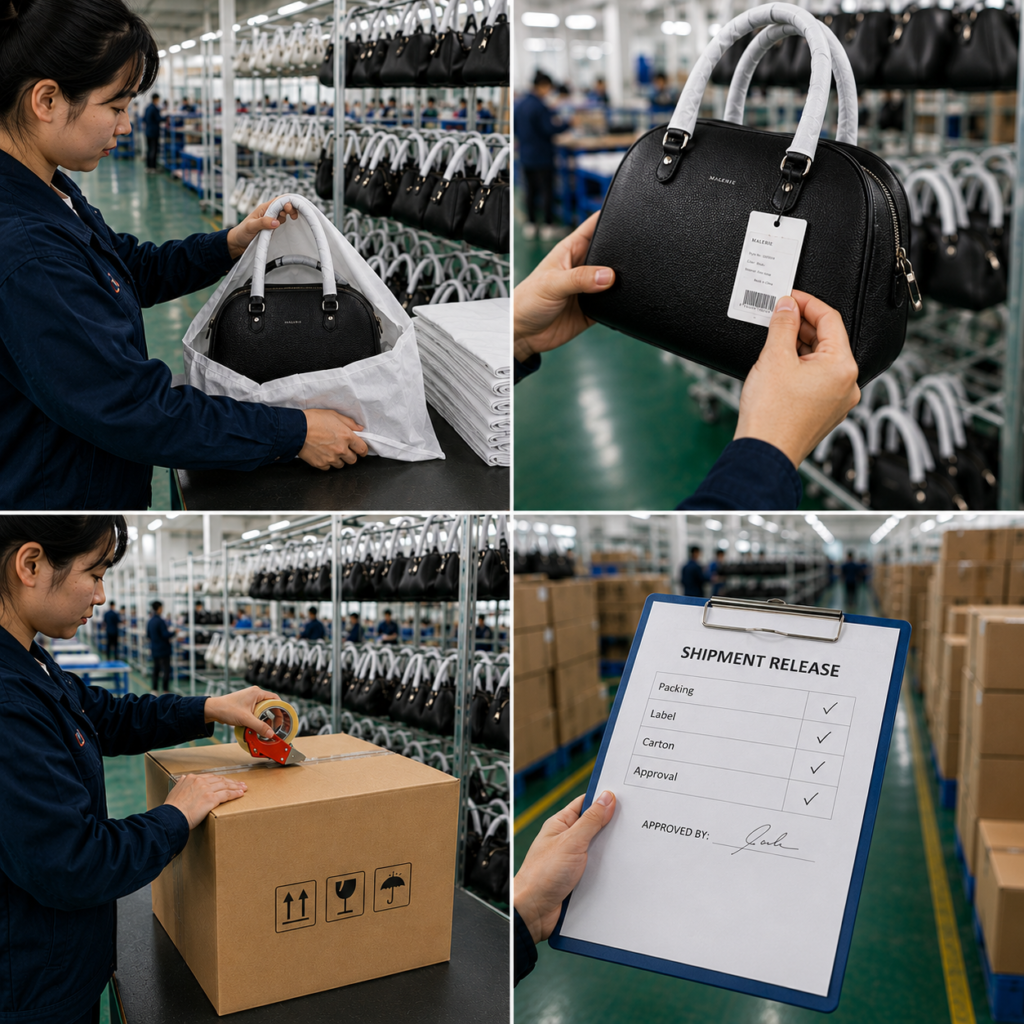
Caption: Final AQL inspection combines workmanship sampling with measurement, function, labeling and packing checks.
How S.MU ACCESSORY Supports Bag Quality Control
Guangzhou S.Mu Accessory Co., Ltd. supports OEM/ODM development, sampling, production management, quality control and shipment follow-up. Its published quality control process covers sample development through final shipment.
Buyers should still provide their own product specifications, target-market requirements, defect definitions and acceptance rules. Supplier QC, buyer review and independent inspection can serve different purposes and should be aligned before production.
Fact Box
S.MU ACCESSORY at a Glance
Guangzhou S.Mu Accessory Co., Ltd.
S.MU ACCESSORY
Guangzhou, Guangdong, China
Custom bags and fashion accessories
Handbags, crossbody bags, totes, wallets, belts, backpacks, cosmetic bags, kids’ bags, travel accessories and small leather goods
Material and sample review, in-line checks, packing verification and final inspection support
Website: smuacc.com
What Should Buyers Prepare?
Send the supplier:
- Tech pack or approved reference sample.
- Material and component approvals.
- Measurement chart and tolerances.
- Destination market and compliance requirements.
- Defect definitions and agreed AQL plan.
- Retail labels, barcode data and packaging instructions.
- Inspection timing and reporting requirements.
If using an independent inspector, share the protocol before production rather than just before shipment.
FAQ
When should bag quality control begin?
It should begin during material and sample approval. Early control establishes measurable references before cutting and assembly, while in-line and final inspections confirm whether production follows them.
What is the difference between in-line inspection and final inspection?
In-line inspection finds repeated problems while production can still be corrected. Final inspection evaluates completed goods and packing to support the shipment decision. Buyers often need both for new or higher-risk programs.
What does AQL mean in bag inspection?
AQL means acceptance quality limit. Under ISO 2859-1:2026, it indexes a sampling scheme used to determine sample size and acceptance or rejection criteria for a lot. It is not a promise that every uninspected unit is defect-free.
Who should define critical, major and minor defects?
The buyer should approve the definitions with the supplier and inspection party before production. Definitions should reflect product function, safety, legal requirements, brand positioning and retailer expectations.
Can buyers arrange an independent final inspection?
Yes. Buyers can appoint an independent inspection company and provide the protocol, timing and reporting requirements. The supplier should confirm production and packing readiness before the inspection date.
Conclusion
A useful bag quality control checklist links approved inputs, a documented production standard, early workmanship checks, verified packing and a defined final AQL inspection.
S.MU ACCESSORY can support buyers with bag development and quality follow-up from material review to shipment preparation. The practical next step is to align the approved sample, tolerances, defect definitions, testing scope and inspection plan before bulk production begins.
Align Quality Before Production
Have a bag QC checklist or AQL requirement?
Share your product specification, approved sample, target market, defect definitions and packing requirements so the quality-control plan can be reviewed before bulk production.
Send Your QC Checklist or AQL Requirements