
Types of Small Purses: 8 Styles and How to Tell Them Apart

Types of Small Purses: 8 Styles and How to Tell Them Apart Common types of small purses include clutches, wristlets, mini shoulder bags, mini crossbody bags, mini top-handle bags, phone bags, mini totes and minaudières. The most useful differences are how they are carried, how they open and what they hold. Understanding these features helps shoppers choose a practical bag and helps retailers describe products accurately before developing or listing a collection. In this guide, “purse” means a handbag rather than a coin holder. These eight names are not separate, fixed classifications: a single design may belong to more than one category. A mini top-handle bag, for example, can also be a crossbody when fitted with a suitable long strap. Eight small purse styles distinguished by silhouette and carrying method. Concept illustrations; not to scale. Types of Small Purses at a Glance Identify the carrying method first, then look at the body shape, opening and internal space. “Small” describes relative size; it does not explain how a bag works. Type How to recognize it Main consideration Clutch A compact bag designed primarily for hand carrying Comfortable grip and secure closure Wristlet A small bag or pouch with a wrist loop Loop comfort and usable capacity Mini shoulder bag A compact body with a shoulder-length strap Clearance under the arm Mini crossbody bag A long strap worn across the torso Strap adjustment and loaded balance Mini top-handle bag One or two short handles above the body Handle clearance and access Phone bag A compartment organized around a phone Fit with the phone case attached Mini tote A scaled-down tote silhouette with two handles Base space and closure coverage Minaudière A decorative evening bag, often with a rigid case Interior space around the frame and clasp What Makes Each Small Purse Style Different? 1. Clutch A clutch is designed primarily to be held in the hand. It may have a soft pouch body, an envelope flap or a structured frame. Some clutches include a removable chain, allowing occasional shoulder carrying without changing their main identity. The practical question is whether the filled bag remains comfortable to hold. A smooth, bulky body may be less convenient than a slimmer shape, while an overfilled clutch can put pressure on the closure. For product photography, show the bag being held as well as standing alone. 2. Wristlet A wristlet is identified by a short loop that slips around the wrist. Its body may resemble a wallet, zipped pouch or compact handbag. The loop—not a specific silhouette or material—is the defining feature. Wristlets can suit short outings when only a few essentials are needed. However, a wrist strap does not provide the same carrying comfort as a shoulder strap. Check the loop opening, attachment point and loaded weight rather than assuming that every small pouch will work well as a wristlet. 3. Mini Shoulder Bag A mini shoulder bag has a compact body and a strap intended for carrying from one shoulder. Rectangular, curved and softly gathered versions can all fit this description. Strap drop matters as much as the bag’s width. A short strap can position the opening close to the underarm, making access less convenient over thicker clothing. Check whether the bag stays comfortably on the shoulder and whether the wearer can reach inside without removing it. 4. Mini Crossbody Bag A mini crossbody bag has a long strap that passes across the torso. It offers hands-free carrying, but its shape can vary: a flap bag, small bucket bag or compact top-handle design may all have a crossbody option. Look beyond strap length. Width, adjustment range and attachment position affect how the bag hangs. Load the sample with the intended contents and check whether it tilts, rotates or pulls away from the body. A detachable strap alone does not establish that a design works comfortably as a crossbody. 5. Mini Top-Handle Bag A mini top-handle bag has one or two short handles above its body. The handles provide a clear hand-carried silhouette, while an additional long strap may offer another wearing option. On compact designs, the handle can compete with the opening for space. Check finger clearance and whether the handle falls across the zipper or flap. A decorative handle that looks attractive in a photograph may be awkward when the wearer needs to remove a phone repeatedly. 6. Phone Bag A phone bag is designed around carrying a phone, sometimes with card slots or a separate compartment for small items. It may be vertical or horizontal and can use a shoulder or crossbody strap. “Phone bag” is a product description, not a compatibility guarantee. Confirm the phone’s dimensions with its case and any attached grip. The phone must pass through the opening, sit inside without excessive pressure and allow the closure to fasten normally. External bag dimensions alone cannot establish this. 7. Mini Tote A mini tote scales down the familiar two-handle tote shape. It may have an open top, zipper, snap or flap, with either a structured or flexible body. Its base can make it useful for objects that do not sit comfortably in a flat pouch. However, the depth of the base does not guarantee accessible capacity if the opening narrows sharply. Also check whether the handles support hand carrying only; a tote-shaped bag does not necessarily fit over the shoulder. 8. Minaudière A minaudière is a decorative small evening bag associated with formal wear. The term’s formal-accessory meaning is described in Collins Dictionary. Many examples have a rigid shell and clasp, although the name should not replace a clear construction description. A minaudière overlaps with the clutch family. Its frame, hinge and lining can reduce the usable space inside, so a seemingly substantial shell may hold relatively little. Brands exploring this direction can review evening and occasion bags separately from everyday compact styles. Have a Small Purse Style in Mind? Share a reference image, preferred carrying method and the essentials the bag needs to hold. Discuss the starting brief
How to Choose the Right Bag Type for Your Target Market
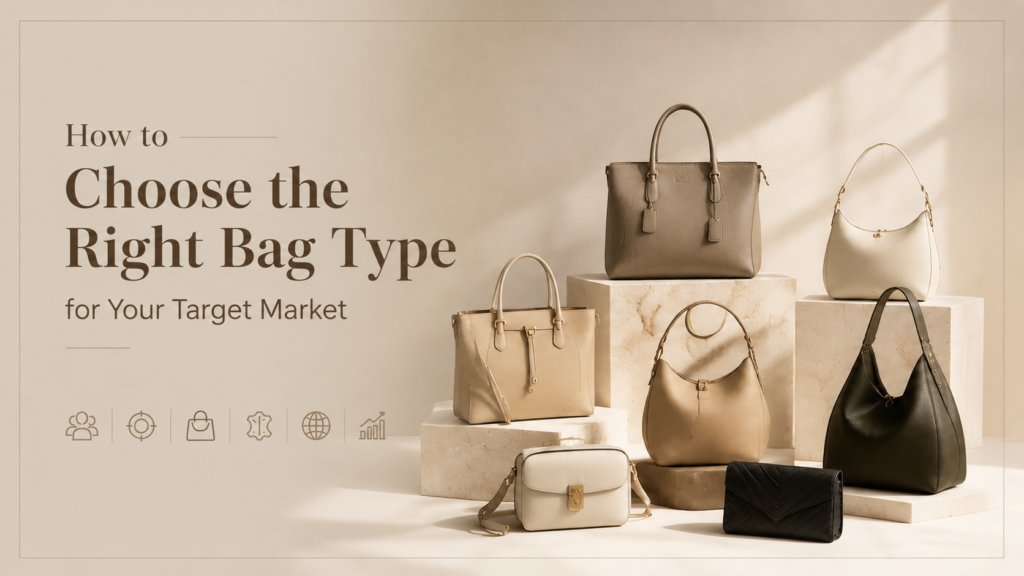
How to Choose the Right Bag Type for Your Target Market Retail buyers should choose bag types by matching the target customer, use occasion, sales channel, retail price and practical needs—not by silhouette alone. Crossbody bags suit hands-free daily use, totes support work and high-capacity occasions, while handbags and wallets require closer alignment with customer profile, material expectations, price architecture, compliance requirements and assortment role. Caption: Comparing finished samples helps buyers assess how different bag types serve distinct customers, occasions and retail programs. Retail Buyer Decision Tool Target-Market Bag Selection Matrix Use these seven factors to compare bag types against the target customer, retail channel and commercial role before confirming an assortment. Evaluation Factor What the Buyer Should Confirm Impact on Bag-Type Selection Target Customer Age group, lifestyle, purchasing power and daily routines Determines the appropriate size, silhouette, styling and functional features Use Occasion Work, commuting, travel, school, everyday use or gifting Helps prioritize totes, crossbody bags, handbags, backpacks or small accessories Sales Channel Department store, e-commerce, discount retail or specialist store Affects price positioning, packaging, product explanation and SKU complexity Retail Price Entry-level, mid-range or premium price positioning Influences material, hardware, lining, construction and finishing choices Carrying Need Hands-free use, capacity, lightweight construction, access and security Determines handle length, shoulder straps, compartments and closure systems Assortment Role Core, seasonal, trend-led, statement, promotional or gift style Affects SKU quantity, color depth, development investment and refresh timing Compliance Target market, user age, material composition and buyer-specific requirements Influences material selection, component specifications and required testing scope Final specifications, testing requirements and commercial conditions remain project-specific and should be confirmed before sampling. Why Bag Type Should Follow the Market A fashionable shape can still fail commercially if it conflicts with how the target customer shops or carries. A compact evening bag may photograph well but underperform in a commuter-led channel. A large tote may promise capacity but feel too heavy for a value-focused online customer. A children’s bag introduces age, hardware and compliance considerations that do not apply in the same way to an adult fashion bag. Begin with four questions: Reviewing a supplier’s custom bag product range can help buyers identify possible silhouettes, but every candidate should be tested against these market questions. Match the Bag Type to the Customer and Occasion Bag type Strongest market fit Main buying reason Development priorities Handbag / top handle Fashion boutiques, department stores, occasion-led collections Styling and perceived value Shape, surface, hardware, handle comfort Crossbody bag Fashion, city, travel and e-commerce Hands-free convenience Weight, strap range, access, pocket layout Tote / shopper Work, lifestyle, campus and everyday retail Capacity and versatility Handle strength, opening, lining, structure Backpack School, commuter, outdoor and tech channels Load distribution and function Strap comfort, reinforcement, compartments Weekender / travel bag Travel, outdoor and gifting Capacity and organization Weight, zipper opening, sleeve, durability Evening / occasion bag Events, gifting and fashion capsules Visual impact Proportion, closure, chain, finish Kids’ bag Children’s retail, school and licensed programs Age-relevant design and usability Size, weight, small parts, material safety Wallet / small leather goods Add-on sales, gifting and coordinated collections Accessible price and organization Slots, zipper, folding, embossing This table is a starting framework, not a universal rule. A tote can be a premium fashion statement or a low-cost promotional item; the target price and construction determine which version is appropriate. If canvas is being considered for a fashion or lifestyle range, use our canvas tote development guide to compare retail roles, construction choices and quotation requirements. Buyers considering a handbag or top-handle direction can use these top-handle bag sampling specifications to define carrying method, handle drop, expected load, opening, materials and hardware before requesting the first sample. Choose for the Sales Channel The same customer may expect different products in different channels. Channel Priorities and Common Development Risks The sales channel changes which product details buyers should prioritize and which development risks should be controlled before sampling. Channel Buyer Priority Common Development Risk E-commerce Visible function, clear dimensions and features that are easy to explain in product images Hidden complexity that increases cost but cannot be communicated clearly online Department Store Material hand feel, hardware, edge finishing, color coordination and assortment presentation Weak assortment differentiation or inconsistent finishing across related styles Discount Retail Repeatability, price clarity, packaging efficiency and broad-use functionality Excessive construction or trim cost that does not improve the target retail proposition Travel / Outdoor Weight, durability, organization, secure closures and carrying comfort Styling being prioritized over load distribution, usability or durability These priorities are directional. Final construction and cost decisions should be confirmed against the target customer, retail price and order brief. Caption: Trend references, colors, materials and silhouette sketches help translate a target-customer profile into a commercially coherent bag direction. Build a Balanced Bag Assortment Do not treat every style as equally important. A practical private label range can use three roles: This structure helps buyers decide where to spend on custom hardware, special material or complex construction. It also creates internal consistency across colors, logos and packaging. S.MU ACCESSORY’s OEM/ODM design studio describes capsule planning around occasion, price point and hero silhouette—useful criteria for turning market direction into a coherent range. Validate the Product Before Committing A bag type is only a category name until its specification is tested. Buyers should review: Use a physical sample and a simple scenario test. Put the expected phone, wallet, tablet, laptop, bottle or travel items inside. Wear the sample for several minutes. Check whether the opening, strap, balance and pocket positions make sense. Buyer Working Record Sample Validation Record Record each use test, issue and approval decision against a named sample version. This prevents comments from different development rounds from being mixed together. Sample Version Test Scenario Observed Issue Required Revision Approval Owner Final Status Sample V1 Daily commute with phone, wallet and tablet Shoulder strap feels short over outerwear Extend the adjustable range and retest the balance point Buyer / Product Developer Revision required Sample V2 Repeated opening,