S.MU ACCESSORY at Asia Fashion Indonesia 2026: Explore Bags at Booth A28
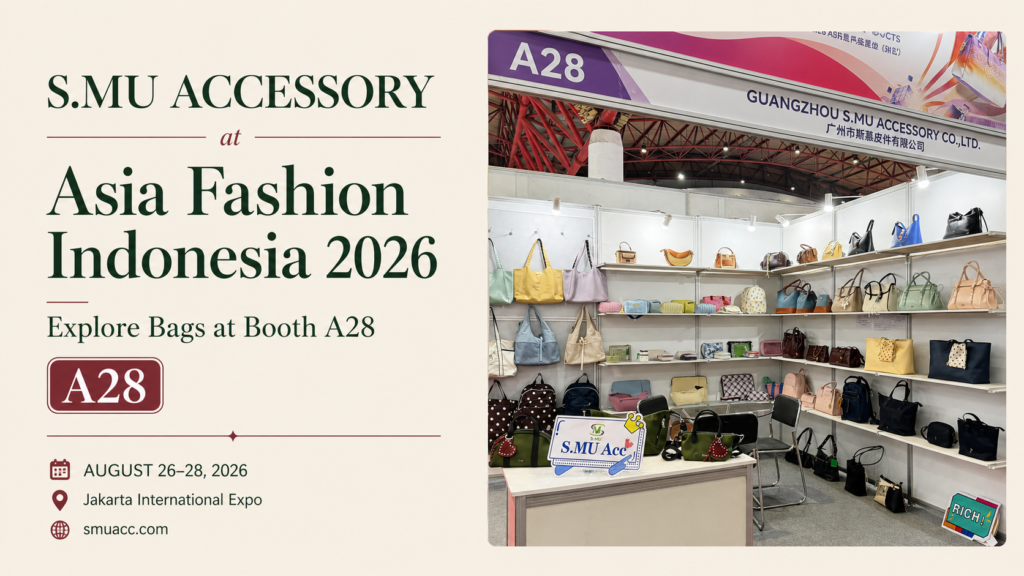
S.MU ACCESSORY at Asia Fashion Indonesia 2026: Explore Bags at Booth A28 S.MU ACCESSORY is exhibiting at Asia Fashion Indonesia 2026, held August 26–28 at Jakarta International Expo in Jakarta, Indonesia. At Booth A28, retail buyers, importers and private-label brands can review handbag, tote, backpack and small-bag samples. Buyers unable to attend can use the booth photographs and video to identify a style, then share its screenshot, target market and quantity for a development discussion. Updated: August 27, 2026 | By S.MU ACCESSORY | For retail buyers, importers and private-label sourcing teams Caption: S.MU ACCESSORY’s Booth A28 display combines handbags, totes, backpacks and smaller bags. The company name and booth number are visible above the collection. S.MU ACCESSORY’s Booth A28 display combines handbags, totes, backpacks and smaller bags. The company name and booth number are visible above the collection. Where Can Buyers Find S.MU at Asia Fashion Indonesia 2026? Find Guangzhou S.Mu Accessory Co., Ltd. at Booth A28, Jakarta International Expo, Jakarta. The venue’s official exhibition calendar lists Asia Fashion (Indonesia) Show 2026 for August 26–28. The booth number is also visible in S.MU’s on-site photographs. The Asia Fashion Show organizer describes the exhibition series as a B2B fashion-industry event covering categories including bags, footwear, apparel and accessories. For bag buyers, the useful next step is a focused sample review rather than simply collecting photographs of every display. The walkthrough below gives a first look at the collection. Use it to narrow your interests before visiting or contacting the team. Video: A roughly 21-second walkthrough of the S.MU ACCESSORY display, showing the arrangement of bag shapes, colors and sizes. It is a visual product reference, not a specification or performance demonstration. Spotted a shape you would like to discuss? Send a screenshot or the video timestamp through WhatsApp. Include your market and estimated quantity so the conversation starts with the relevant product. What Bag Styles Are Visible in the Booth Collection? The photographs show several product directions, from larger everyday totes to compact shoulder bags and small zippered pieces. Treat these as starting points for a shortlist, not as proof that every sample has the same material, capacity or customization options. Handbags and shoulder bags. Top-handle shapes, curved shoulder silhouettes and softer carry styles offer different starting points for fashion assortments. Compare handle drop, opening access, proportions and how the body is intended to sit when carried. Totes and larger everyday bags. The display includes larger open silhouettes in light and dark colors, alongside patterned pieces. Buyers should define the intended contents, closure preference and target empty weight before selecting a construction. Backpacks and smaller bags. Compact backpacks, pouches and small zippered styles can be reviewed as independent products or possible additions to a wider range. Matching appearance does not automatically mean shared material minimums or identical production requirements. The photographs also show color blocking, textured surfaces and decorative details. Exact material composition, surface treatment, color reference and dimensions need confirmation on the selected sample. The broader S.MU bag and accessory collection provides additional category context. How Should Buyers Turn a Booth Favorite into a Useful Shortlist? Give each selected style a commercial purpose. A strong shortlist explains who will use the product, what price position it should occupy and which details must remain unchanged. A photograph without those decisions leaves too much room for interpretation. Use this Booth-to-Brief Shortlist during the visit or when reviewing the video: Record for each selected style What to note Why it matters Visual reference Screenshot, video timestamp or confirmed style code Identifies the exact product under discussion Customer and channel Target market, intended user and sales channel Sets the context for design and specification Product role Everyday bag, fashion update or small accessory Clarifies the function and range position Price direction Target retail price and/or sourcing budget Makes material and detail discussions more focused Essential features Size, carrying method, closure and compartments Separates requirements from optional preferences Order assumption Estimated quantity by style and color Supports MOQ and component review Required timing Sample deadline and warehouse date Allows a project-specific feasibility check A shortlist is a selection document, not a purchase order. Record undecided fields as “to confirm” rather than filling them with assumptions. Once a style is identified, S.MU can clarify the reference and discuss what information is still needed for the next development step. Caption: An on-site view of S.MU ACCESSORY’s A28 booth and product display. An on-site view of S.MU ACCESSORY’s A28 booth and product display. The photograph documents the exhibition setting; it does not identify a customer meeting or commercial outcome. What Should Be Confirmed Before Requesting Customization? Confirm the reference sample first, then separate appearance changes from construction changes. A color request, a longer strap and a larger body may have different implications for sourcing, patterns and sample review. For a selected style, discuss the material and lining, dimensions, strap or handle requirements, closure, hardware, logo method and packaging. If a particular feature is essential, mark it clearly. If an alternative is acceptable to meet the target cost, explain the acceptable range. MOQ, sample charges and development time are project-specific. Ask for confirmation by style, color and component rather than treating a displayed sample as a fixed commercial offer. A quotation should also make clear whether testing, packaging, tooling or delivery costs are included. S.MU’s Design Studio explains the development context for moving from visual references toward materials, sketches and sample-ready details. Buyers should supply their own branding and approved artwork, and identify whether they want an adaptation or a new original design. How Does a Selected Style Move into Sampling? The next step is to turn the selection into a written brief, resolve missing information and agree the sample scope. Before a sample is commissioned, confirm which materials are final, which details are provisional and who will approve revisions. The custom bag sampling process provides a more detailed explanation of feasibility review, component confirmation and documented sample comments. Keep the final sample version identifiable so appearance,