
Canvas Tote Bags Are Fashion Again: How Retail Buyers Can Build a Commercial Collection
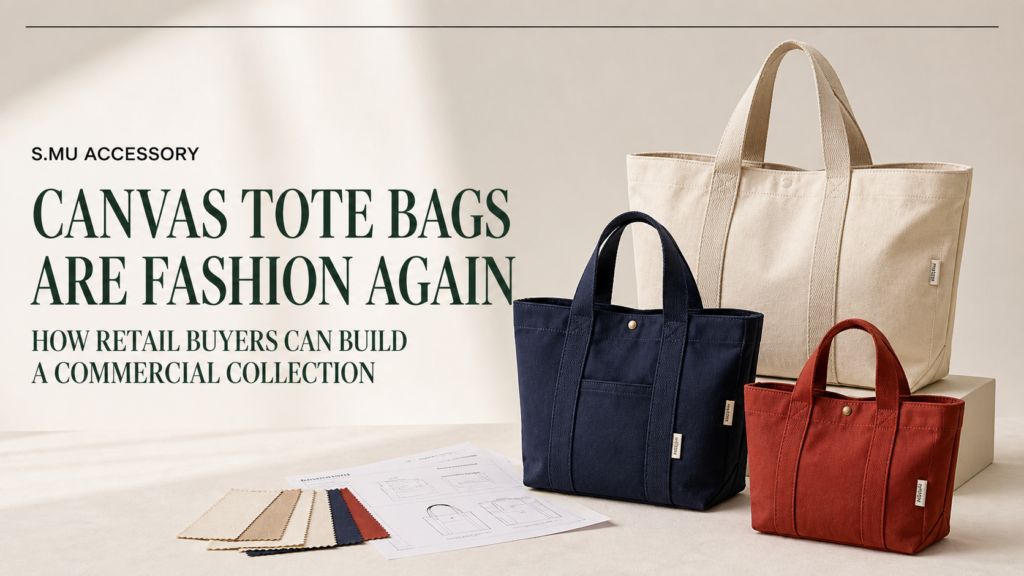
Canvas Tote Bags Are Fashion Again: How Retail Buyers Can Build a Commercial Collection Canvas tote bags are back in fashion, but the commercial opportunity is not the basic promotional shopper. For retailers and private-label brands, the stronger 2026 direction combines recognizable canvas texture with deliberate proportion, useful capacity, color, personalization and more considered construction. The winning brief should define the use case first, then align canvas specification, reinforcement, decoration and price architecture with that use case. Retail buyers should treat the current canvas tote revival as a product-development opportunity, not a reason to copy one viral bag. Build the range around a clear carrying occasion, specify fabric and reinforcement by performance need, and use color or personalization to create distinction. Approve the decorated sample and load-bearing construction before confirming bulk production. Caption: A buyer-facing canvas tote direction board should separate transferable design signals—capacity, proportion, color and personalization—from brand-specific details. Why are canvas tote bags relevant again in 2026? The signal is broader than a single celebrity carry. In its Spring/Summer 2026 handbag overview, Vogue identifies canvas totes as a defined seasonal direction, citing roomy styles from Kallmeyer, The Row and Staud. A separate Vogue canvas tote edit published April 28, 2026 frames the category as a city and everyday option, not only a beach bag. In August, Who What Wear highlighted the colorful, monogrammed Alex Mill tote as a fashion item carried in multiple sizes. These are editorial market signals, not proof of sales for every market. Their practical value is the repeated pattern: familiar utility is being upgraded through scale, stronger visual identity and an everyday-work-to-weekend use case. Buyers should validate that direction against their own sell-through, customer profile and target retail price before committing depth. Which canvas tote concept has the strongest retail logic? The most transferable concept is a fashion utility tote: a practical carryall with enough design control to feel like an accessory rather than packaging. The opportunity can be filtered through four commercial roles. Assortment role Product direction Commercial strength Main development risk Core everyday Medium or large carryall, restrained branding, internal organization Broad use across work, errands and travel Becoming too generic Personalized hero Monogram, initials, patches or configurable color Clear gifting and identity story Decoration consistency and added handling Seasonal color One established body in a focused fashion palette Refreshes a stable shape with lower design complexity Color approval and material continuity Entry accessory Small or simple tote at an accessible price tier Recruitment item and add-on purchase Weak structure or a promotional look This is an opportunity filter, not a universal SKU prescription. A department-store work tote, a resort carryall and a gift-with-purchase bag need different specifications even when all three use cotton canvas. How should independent retailers choose between everyday, zipper-top and oversized totes? There is no universal best-selling canvas tote format for every independent retailer. An everyday tote offers the broadest use case, a zipper-top tote adds security for commuter and travel customers, while an oversized market tote provides capacity and stronger seasonal display impact. The right choice depends on the retailer’s customer profile, price architecture, sales channel and expected use occasion. Tote format Best suited to Main development implication Everyday canvas tote Lifestyle stores, boutiques and core daily-use ranges Keep the body practical but use proportion, color, pockets or restrained branding to prevent it from looking generic. Zipper-top canvas tote Commuter, travel, gifting and security-led retail programs The zipper length, opening access, lining, interior pockets and top-edge reinforcement must be included in the quotation. Oversized market tote Resort, weekend, home-and-lifestyle and seasonal statement ranges Higher fabric consumption, carrying load, base behavior, packing volume and handle reinforcement should be reviewed before pricing. Retailers should treat these formats as different merchandising roles rather than assume that one silhouette will perform equally well across every market. Initial order depth and reorder decisions should be based on the retailer’s own sell-through evidence. S.MU ACCESSORY’s Design Studio can use a defined buyer brief to review proportion, material direction and sample feasibility before quotation. Planning a Canvas Tote Range? Check the quotation basis before you commit to sampling Send your target market, intended use, finished dimensions, estimated quantity, target price, canvas specification, handle construction, lining, closure and decoration method. S.MU ACCESSORY can help identify missing specifications, costing assumptions and sample-approval points before development begins. Review My Canvas Tote Quotation Brief Not ready to request a quotation? Continue to the specification checklist below and use it to complete your internal buyer brief. What should a custom canvas tote specification include? A useful canvas tote specification must control appearance, carrying load, production repeatability and quotation scope. Suppliers can only be compared when each quotation uses the same assumptions for canvas, handles, lining, closure, decoration, packaging, quantity and delivery market. “Heavy canvas tote with logo” is therefore not a quotation-ready brief. Canvas Tote Development Brief Decision field Buyer should define Supplier should return Use case Work, city, travel, resort, gifting or promotional Recommended construction and risk notes Size and load Finished dimensions, expected contents and carrying method Pattern, capacity review and reinforcement proposal Body material Fiber preference, fabric weight unit, weave, finish, color and handfeel Swatches, specification and availability confirmation Structure Unlined, lined, washed, soft, self-standing or reinforced Interlining, seam and base construction proposal Handles Hand carry, shoulder carry or dual carry; drop and width Attachment method and load-bearing sample Closure and interior Open top, zipper, snap; pocket and laptop needs Component layout and construction details Decoration Print, embroidery, applique, patch, label or monogram Artwork limits, strike-off and placement tolerance Commercial scope Quantity by style/color, target price, delivery market MOQ logic, costing assumptions and development schedule Approval Reference standard, test protocol and decision owner Sample, comments log and approval record For quotation comparison, issue one controlled reference pack to every supplier. It should contain the nominated canvas swatch, handle or webbing reference, lining quality and color, closure specification, decoration artwork or physical sample, finished dimensions, packaging requirement and order breakdown. Label each component with the project