
Common Bag Manufacturing Defects: Causes, Prevention and Buyer Inspection Points
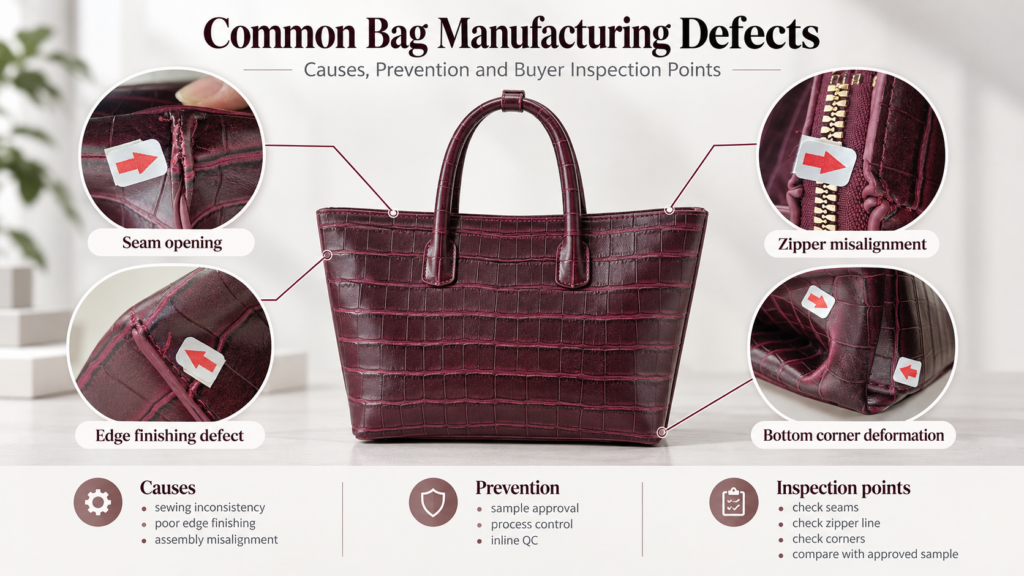
Common Bag Manufacturing Defects: Causes, Prevention and Buyer Inspection Points Common bag manufacturing defects include open seams, skipped stitches, misaligned handles, zipper failure, loose hardware, shape distortion, edge-paint problems, color transfer, incorrect branding and packing damage. Buyers can reduce these risks by defining measurable acceptance criteria before production, approving materials and a controlled sample, inspecting early production, recording corrective action and verifying finished goods against the same standard before shipment. Evidence reviewed: September 21, 2026. Written for brand, retail, importing and private-label teams. Acceptance limits and test requirements must be agreed for each product and target market. Caption: A defect review is useful only when the inspector can compare the production bag with an approved reference and measurable requirements. What Counts as a Bag Manufacturing Defect? A manufacturing defect is a product condition that does not meet the approved specification, sample, functional requirement, workmanship standard or legal requirement. The same visual feature may be acceptable on one design and unacceptable on another, so a photo labelled “defect” is not a complete standard by itself. For example, a soft asymmetric silhouette may be intentional, while an uneven handle position may change how the bag hangs. A natural material variation may be approved, while unapproved shade variation across one retail set may not be. Buyers should define the decision rule before production, not after a shipment is packed. Process position: This guide sits mainly in quality control, with handoffs from sampling and production management to packing and shipment release. It complements the broader custom bag quality-control checklist rather than repeating the entire QC workflow. Bag Defect Atlas: Symptoms, Causes and Prevention Points Use this buyer-facing defect atlas to connect what is visible on the finished bag with the process point that should be controlled. The causes below are investigation paths, not automatic conclusions; the factory should confirm the actual root cause before changing production. Defect or buyer-visible symptom Likely process origin to investigate Prevention or control point Evidence buyers should request Possible commercial effect Open seam, skipped or broken stitches Thread, needle, tension, seam allowance, backtacking or operator method Confirm seam construction in the tech pack; check first output and stress areas in-line Approved seam detail, in-line photos and repair record Returns, loss of function or shortened service life Puckered, wandering or uneven stitching Material feeding, thread tension, stitch density or guide control Trial the actual material stack; approve visible stitch appearance Sample reference and close-up comparison Poor shelf appearance and inconsistent batch quality Misaligned handles, straps, pockets or panels Incorrect marking, jig placement, cutting or assembly sequence Add fixed measurement points and symmetry checks before attachment Measurement sheet and first-piece approval Crooked appearance, poor carry balance or fit issue Weak handle or strap attachment Reinforcement, stitch pattern, material strength or assembly error Define reinforcement construction and project-specific strength verification Construction cross-section, test or inspection record where required Functional failure and safety-related complaint depending on use Zipper sticks, separates or sits in a wave Zipper specification, sewing tension, opening geometry or assembly alignment Approve zipper/component reference; operate closures during in-line and final inspection Component record and functional check result Customer frustration, returns and unusable main compartment Scratched, loose or inconsistent hardware Incoming component quality, installation pressure, protection or mixed lots Inspect incoming hardware; protect contact surfaces; verify attachment Approved finish sample, lot traceability and inspection photos Visible downgrade, detachment or brand inconsistency Shape collapse, twisting or dimensional mismatch Pattern, cutting, reinforcement, skiving, seam allowance or forming Lock the pattern and reinforcement; measure at first-piece and in-line stages Measurement report and approved silhouette reference Poor merchandising, packing inefficiency or product not fitting intended contents Edge paint cracks, overflows or feels uneven Layer preparation, drying, material compatibility or application control Approve edge system and finish; check between coats and after forming Approved edge sample and close-up inspection record Premium-look failure and early appearance complaints Glue marks, oil, scratches or surface contamination Adhesive control, handling, workstation cleanliness or unprotected stacking Define clean handling and protection; isolate affected work immediately Defect photos, containment quantity and corrective-action record Rework, downgrade or visible retail rejection Color transfer or unapproved shade variation Material finish, dye lot, contact pair, moisture or packing configuration Approve the actual colorway; assess relevant contact surfaces and lots Identified material report and shade-lot approval Garment staining, mismatched sets or reputational damage Logo position, color, spelling or orientation is wrong Artwork version, placement guide, plate/setup or mixed components Control artwork revision and approve first application against coordinates Signed logo artwork and first-piece photo Brand damage and possible total rework Creasing, hardware impressions or deformation after packing Stuffing, folding, contact pressure, carton loading or transport protection Run a packing trial using the intended configuration Approved packing method and packed-product review Arrival damage, slower receiving and lower sell-through presentation Caption: Construction defects should be identified by location and measurable difference, not by a vague “workmanship problem” label. Which Construction Defects Need the Earliest Attention? Seams, handle attachments, panel alignment and dimensions deserve early control because later operations can hide or compound the problem. A lining may cover an attachment area; edge finishing may make disassembly costly; and a dimensional error can affect zipper installation, packing and product function. The approved bag tech pack should identify construction details, dimensions, tolerances, component references and logo coordinates. The approved sample then provides a physical comparison. Neither replaces the other: the document controls measurable requirements, while the sample helps clarify handfeel, form and workmanship that may be difficult to communicate in text alone. ASTM D6193-16(2025), the active ASTM practice for stitches and seams, explains that seam performance depends on the relationship among material, seam type, stitch type, stitch density, thread tension and thread properties. It is a technical reference, not a universal pass/fail specification for every bag. Buyers still need product-specific requirements. How Should Buyers Inspect Zippers, Hardware and Finishing? Check the complete interaction, not only the component’s appearance. Open and close the zipper through its full path. Confirm that sliders, snaps, locks and magnets work in the assembled product, then