
Handbag Color Trends 2027: Runway Shades and Collection Planning

Handbag Color Trends 2027: Runway Shades and Collection Planning Handbag color trends for 2027 bring red, purple and contrasting interiors into focus, alongside a separate forecast palette led by WGSN and Coloro’s Luminous Blue. For Spring/Summer collections, the useful choice is a color’s role: an everyday foundation, a seasonal statement or a smaller accent. Runway appearances and forecasts offer starting points; material samples and customer relevance should guide the final range. Evidence reviewed: October 28, 2026. Scope: Spring/Summer 2027 handbags, with collection-planning guidance for brands, retail buyers and product developers. Which colors stood out on the Spring 2027 handbag runways? Red and purple are useful starting points for a focused color review. PurseBlog’s Spring 2027 handbag roundup, published October 22 and updated October 26, identifies both across multiple collections. Its examples include red at Loewe, Celine and Marni, and purple at Balenciaga, Miu Miu and Prada. This is evidence of runway visibility, with retail demand still to be tested. Red: decide how much of the bag should carry the statement A red body, a red handle and a red lining create different products. Choose the placement before requesting color alternatives. An everyday shoulder bag might use red across its main panels; an occasion style could concentrate it in a clasp, strap or interior detail. Compare each proposal with the brand’s existing range. If red already sells well, a new finish or proportion may provide enough change. If it is unfamiliar to the customer, test the proposed shade in a specific product role before extending it across several silhouettes. Purple: specify the shade before discussing the trend PurseBlog’s review spans stronger royal purples and softer lilacs. A brief that simply says “purple” leaves too much open. Decide whether the intended effect is vivid, muted, pale or deep, then select a physical reference. Review the color beside the proposed hardware and lining. A supplier needs to know which relationship matters most: matching an existing collection, creating a deliberate contrast or developing a new seasonal direction. Treat each as a separate approval decision. Contrasting interiors: make color part of the construction Visible lining provides another route into color. Wallpaper*’s October 15 accessories review describes Jil Sander’s SS27 top-handle tote opening out to reveal a colorful contrasting lining. For a commercial interpretation, decide when the contrast should be visible: when the bag is open, carried or placed on a surface. Ask for a sample that demonstrates that condition. Review the opening, pocket edges and attachment points together, since these determine how the interior reads as part of the finished design. For the wider relationship between color, scale and construction, see the Spring/Summer 2027 bag-trend review. The WGSN and Coloro S/S 27 forecast palette Coloro’s official Key Colors page lists the following five colors for S/S 27 and identifies Luminous Blue as the 2027 Color of the Year. The collaboration forecasts color direction across categories; these names do not establish handbag sales performance or identify the exact shades used in runway photographs. Forecast color Coloro reference A direction to explore in a bag range Luminous Blue 125–28–38 A statement body color on an otherwise familiar shape Energy Orange 018–57–34 A visible lining, strap or small accessory accent Pop Pink 151–73–22 A seasonal colorway selected for a defined customer group Meadowland Green 050–61–19 A coordinated option across a main bag and smaller accessory Clay 014–60–13 An alternative foundation for a warmer palette The application ideas in the last column are editorial starting points for sampling, not Coloro prescriptions or sales forecasts. Use the forecast to expand a development conversation. A brand might investigate one unfamiliar shade beside its existing palette, then decide whether it belongs on the main body, lining or detachable accessory. Obtain the relevant physical reference before requesting a match, and record the selected material separately from the color name. Handbag Color Trends 2027: Give Every Shade a Role A collection color palette is a planned set of shades assigned to specific styles, materials and components. A useful palette explains why each color exists. The following roles are a planning framework, rather than recommended order percentages. Color role Question for the buyer Decision to record Core Which colors support the customer’s regular use and the brand’s existing assortment? Styles and repeat-order expectations Seasonal Which shade adds a clear reason to consider this collection? Intended customer, selling window and product role Accent Where can a smaller color area create the desired effect? Exact component and relationship to the body Avoid assigning a shade to every silhouette by default. A color that makes sense on a compact evening bag may need a different treatment on a large work tote. Use the bag collection categories to frame the product discussion, then compare the palette against actual dimensions and carrying use. Range planning sits between trend research and material sourcing. Once the buyer has assigned the color roles, the next task is to identify achievable materials and component combinations. The design development process provides context for that handoff. Discuss Your 2027 Collection Palette Share your proposed core, seasonal and accent colors, preferred bag shapes and target market. Indicate which choices are fixed and which are still open. Discuss Your Collection Palette Review a material board before approving the palette A color reference should travel with a material specification. The CIE’s framework for visual appearance considers gloss and texture alongside color when describing a material’s appearance. Compare a shade on the actual proposed PU, textile or woven surface before treating it as the same finished colorway. Ask to compare the body material, lining, strap, thread, edge finish, zipper tape and hardware together. Mark any temporary substitute so it cannot be mistaken for an approved component. Build the review around four questions: View the board under agreed lighting conditions and review the assembled sample in its intended use. Photographs are useful for comments, while physical references provide a clearer basis for approving the actual combination. Color approval should also include the contact relationships within the bag and during packing.
Meet S.MU at the 140th Canton Fair: Handbags at Booth 18.2 C42–43

Meet S.MU at the 140th Canton Fair: Handbags at Booth 18.2 C42–43 S.MU ACCESSORY invites retail buyers, brands and sourcing teams to meet us at the 140th Canton Fair, Booth 18.2 C42–43, from October 31 to November 4, 2026, in Guangzhou. Visit our handbag booth to review samples and discuss private-label development. Contact Franco Lin with your preferred visit date and product interests to request an appointment. Invitation updated October 12, 2026. Where Can You Meet S.MU at the 140th Canton Fair? You can find S.MU at 18.2 C42–43 during Phase 3, not during the earlier October phases. Save the booth reference before your visit and share it with colleagues joining the meeting. Meeting detail Information Exhibitor Guangzhou S.Mu Accessory Co., Ltd. — S.MU ACCESSORY Exhibition The 140th China Import and Export Fair, also known as Canton Fair Phase and dates Phase 3: October 31–November 4, 2026 Venue China Import and Export Fair Complex, Guangzhou, China Handbag booth 18.2 C42–43 Contact Franco Lin Telephone / WhatsApp +86 187 5779 2518 Email public@smuacc.com The dates match the official Canton Fair schedule. Use the organizer’s website for buyer registration, badge instructions and current attendance information. An appointment with S.MU does not replace registration or provide an admission badge. Caption: S.MU ACCESSORY welcomes buyers to its handbag booth, 18.2 C42–43, during Phase 3, October 31–November 4, 2026. What Would You Like to Discuss at Our Handbag Booth? Bring the collection decision you are working on. You may be selecting a new shape, reviewing an existing style for a different price position, or preparing a private-label brief. A face-to-face sample discussion can help identify which details need development and which questions require a written follow-up. Start by browsing our bag and accessory collections and sending the references that interest you. Our Canton Fair invitation confirms a handbag booth; please ask Franco to confirm any specific style or additional accessory you would like to see. The website collection is broader than any individual exhibition display. For a new handbag direction, discuss proportions, carrying method, opening and usable capacity before choosing decorative details. For an existing style, explain what needs to change: material, color, lining, hardware, branding or packaging. This helps keep the conversation focused on the requirements that affect your customers and your commercial brief. The S.MU Design Studio provides context for these development discussions. S.MU ACCESSORY is a Guangzhou-based bags and fashion accessories development and supply partner. At the fair, the immediate goal is to connect your market direction with relevant samples and a practical next step—not to assume every displayed design is already specified for your order. Caption: Review handbag proportions, carrying options and finishing details against your target customer and sales channel. Confirm individual display samples before visiting. Let Us Know What You Want to See Send Franco your preferred visit date and handbag references. We can confirm the meeting time and whether the requested samples will be available. Request a Meeting with Franco October 31–November 4, 2026 · Please use Guangzhou local time when proposing an appointment. Choose a Focus for Your Meeting You do not need to arrive with every decision settled. Choosing one priority makes the discussion easier to follow up: A display sample is a discussion reference, not an approval sample for your order. Ask to record the sample reference alongside any proposed changes. Material choices, custom hardware, color splits and packaging can change both costing and development work; final terms should be confirmed against an agreed brief. Send This Short Appointment Message Copy the following into WhatsApp, email or the contact form: Hello Franco, I would like to meet S.MU at Booth 18.2 C42–43 during the 140th Canton Fair. My company is . Our target market and sales channel are . We are interested in . My preferred visit date and time are . Our main discussion priority is __. Please confirm the appointment and any relevant sample availability. If available, attach reference images and add an approximate quantity, target purchase-price range with currency, and required warehouse date. For projects already in development, the bag tech pack guide can help you organize the technical information without sending unrelated documents. Keep confidential artwork limited to what is needed for the first discussion. Only share designs and brand assets you are authorized to use. Caption: A clear sample reference and written change notes help turn a booth discussion into a development brief. General process example, not a photograph of the forthcoming fair. What Happens After We Meet? Agree which sample or direction should move forward, who will supply missing information, and what the next review should cover. The meeting can connect trend research with collection planning and design, then lead into sampling and costing once the brief is sufficiently clear. Buyer Input Supplier Output to request Selected sample references and requested changes Recorded development questions and proposed next steps Material, branding and quantity assumptions Clarification of options requiring costing or component review Required warehouse date and approval responsibilities A schedule discussion with dependencies identified Use the custom bag sampling process to understand the approvals needed after an initial conversation. If you are organizing several supplier meetings, our Canton Fair bag buyer preparation guide covers the wider sourcing checklist; this page is your direct invitation to meet S.MU. FAQ Can I visit without a confirmed appointment? You are welcome to visit the booth during the exhibition. Requesting an appointment helps coordinate the discussion, especially if you need to review a particular sample or project. A requested time is not confirmed until the team replies. Do I need a finished tech pack? No. Reference images, a target market and a clear discussion priority are enough for an initial meeting. Detailed development and production require more complete specifications and approvals. Will every product from the website be at the booth? Do not assume every website style will be displayed. Contact Franco with the relevant product references before travelling to confirm availability or arrange an alternative review. Can I get final pricing
Handbag Color Transfer: Causes, Prevention and Buyer Checks

Handbag Color Transfer: Causes, Prevention and Buyer Checks Handbag color transfer occurs when color moves from a bag, clothing or another contacting material onto a different surface. Prevention starts by identifying the source and the receiving surface, then reviewing contact, care and material performance. For brands and retail buyers, appearance approval alone is insufficient: the intended material, color and component combination needs an agreed assessment before production. Evidence reviewed: September 11, 2026. For handbag owners, retail buyers and private-label product teams; testing and acceptance requirements are project-specific. A pale bag marked by dark clothing and a dark strap staining a white shirt can look like the same complaint. They require different investigations. Before choosing a cleaner, rejecting a material or approving a replacement, establish where the color originated. Caption: Identify the source and receiving surface before deciding which material or contact condition to investigate. Diagram illustrates possible contact paths, not test results. What Causes Handbag Color Transfer? Color transfer is a contact problem; its direction matters as much as the visible mark. A complaint should describe both surfaces, the contact location and the conditions in which the mark appeared. Clothing to bag. The outside of a shoulder or crossbody bag repeatedly contacts garments. A light-colored receiving surface can make transferred color conspicuous. Check whether the mark follows the area that touched clothing rather than assuming the bag’s own finish failed. Bag to clothing. The bag body, handles or strap may release color onto another surface. SATRA identifies straps and handle edge finishes as relevant locations for assessment and discusses rubbing, water and perspiration testing in its handbag color-transfer guidance. Contact within the product or packaging. Treat a contrasting trim against a pale panel, a folded strap against the body, or a dust bag against the finish as pairs to review. These are proposed inspection points, not evidence that every such combination will stain. Record the material and finish rather than relying on labels such as “leather” or “vegan leather.” A material name alone does not describe the exact surface being approved. A swatch in one color is also not a record of how every colorway performs. How Can You Prevent Color Transfer on Handbags? Start with the care instructions for the exact product. Reduce avoidable contact with materials known to release color, and use the recommended storage arrangement. Do not assume a treatment suitable for one leather finish is appropriate for suede, a coated textile or a metallic surface. If staining appears, separate the contacting items and photograph the affected area before attempting treatment. Record the garment or object involved and any moisture or product exposure. This information helps a retailer or specialist distinguish a transferred stain from a different surface problem. Avoid escalating through alcohol, solvents, abrasive rubbing and several cleaners simply because the first attempt did not work. Ask the brand or a qualified care specialist for advice on the identified material. Cleaning success cannot be promised from a photograph. For retailers, this is also a product-information task: care guidance should match the sold material and the approved instructions. Do not present a consumer-applied spray as a substitute for resolving an unresolved material-performance concern before sale. What Should Buyers Put on a Material Contact Map? Map the actual assembled colorway, including surfaces that touch when the bag is carried, folded or packed. Use the following table as a review sheet before requesting tests. It organizes questions; it does not prescribe a universal laboratory protocol. Contact pair What to record Question to resolve before approval Strap or handle against clothing Material code, finish, edge coating and contact face Does the assessment cover all relevant strap surfaces? Pale body panel against garments Panel finish and intended carrying position What evidence addresses incoming staining, rather than only color leaving the panel? Dark trim against a light panel Both component references and assembled position Is this combination acceptable in the finished construction? Lining against contents Lining color, supplier reference and intended use Is the submitted evidence relevant to this lining? Folded strap or packing material against the body Packing arrangement and contacting materials Does the packed configuration need a separate assessment? Add photographs and component references to the bag tech pack, so the laboratory request and supplier instructions refer to the same surfaces. Where a trim changes after sampling, update the map rather than leaving the previous combination approved by default. Developing a private-label colorway? Share the material references, the two surfaces that will touch and your buyer protocol, if available. Discuss Your Material & Color Combination Caption: A component map links each contact surface to a material reference; the pictured combination must not be described as passing without supporting evidence. What Does Handbag Colorfastness Testing Actually Prove? Select a method around the material, contact direction and intended use. SATRA TM167 assesses surface color transferred during controlled dry or wet rubbing. Its public description identifies a defined rubbing action and an assessment of staining on the contact cloth. That distinction is useful: a result showing limited color leaving a tested surface does not, by itself, establish that the same surface resists staining from every garment. Ask the laboratory whether the proposed scope addresses the complaint or risk you actually need to evaluate. Before commissioning work, agree on: Do not copy a pass grade from an unrelated order. Request the buyer protocol or agree a specification with the responsible technical team and laboratory. A report should identify what was tested and against which requirement; “colorfastness passed” without that context leaves the approval ambiguous. Caption: Match the report’s sample identity, method, conditions and result to the material proposed for the order. Use only a genuine, authorized record. What If the Proposed Material Does Not Meet the Requirement? Keep the affected approval open and compare the available changes. The supplier may propose another finish, material, component or color combination. Assess the revised proposal against the same functional need, while recording any change to appearance, handfeel, cost, availability and timing. Ask for a written commercial
Top Handle Bag Trend 2026: What Buyers Should Specify Before Sampling
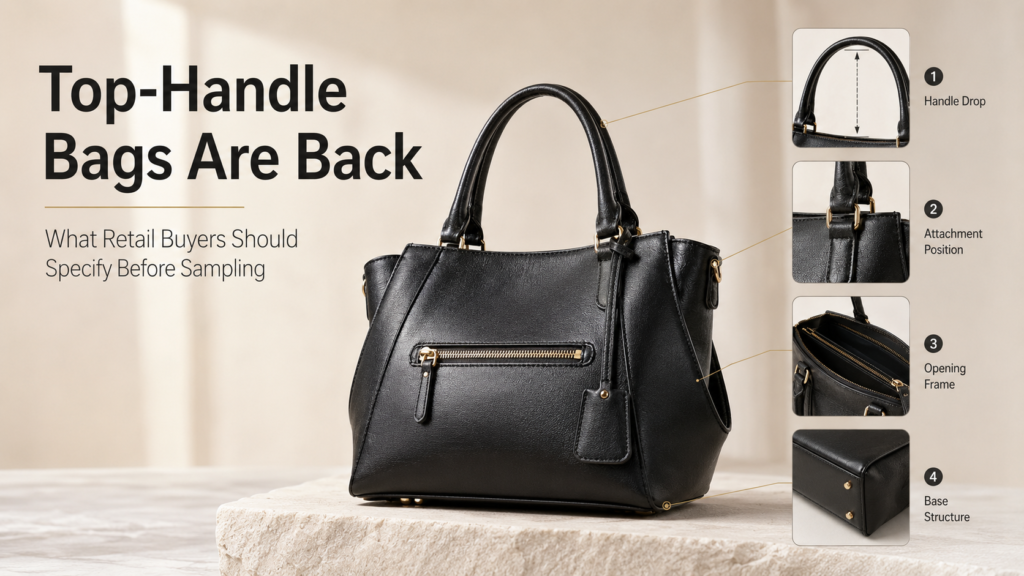
Top Handle Bag Trend 2026: What Buyers Should Specify Before Sampling Top-handle bags are commercially relevant in 2026 because established handbag shapes can be refreshed through proportion, texture, hardware and color. Before sampling, retail buyers should define the carrying method, handle drop, expected load, opening, reinforcement, body structure, material, target cost and retail position. The silhouette alone is not enough to produce a usable, costed and repeatable sample. Updated: September 2, 2026 | Scope: custom top-handle handbags for North American, UK, European and Australian retail and private-label programs Caption: Compare top-handle concepts by proportion, carrying method and structure before selecting a sample direction. Why Are Top-Handle Bags Relevant in 2026? Current fashion coverage shows repeated interest in ladylike top handles, doctor-bag and bowling-bag constructions, elongated proportions and expressive surfaces. In March 2026, Vogue described the returning doctor or bowling bag through its arched handles, east-west shape, structured frame and wide opening. Its June review of Spring/Summer 2026 handbag trends also connected top-handle styles with croc-embossed surfaces, more relaxed interpretations and larger everyday formats. The signal continued into the next season. Harper’s Bazaar’s Fall/Winter 2026 handbag report identified top-handle bags among the season’s prominent accessories and emphasized texture, shape and craftsmanship as points of distinction. These sources demonstrate editorial momentum; they do not provide a production specification or guarantee retail demand in every market. Buyers still need to decide which interpretation fits their customer, channel and price architecture. The S.MU ACCESSORY Spring/Summer 2027 bag-trend watchlist covers the wider trend context. This guide addresses the next question: how to turn a top-handle direction into a sampling-ready brief. Start With the Carrying Method, Not the Handle Shape Handle drop determines how the customer can use the bag and how loads enter the body. A short drop normally limits the bag to hand or wrist carry. A larger opening between handle and body may support forearm or elbow carry, but it can also alter the visual proportion and place more leverage on the handle mounts. There is no universal “best” top-handle drop. The correct dimension depends on bag size, target customer, clothing season, intended load and whether a detachable shoulder strap is provided. A compact occasion bag and a laptop-sized doctor bag should not inherit the same handle dimensions simply because both use an upright handle. Before pattern development, buyers should specify: For broader category and customer decisions, use the S.MU ACCESSORY guide to choosing the right bag type for a target market. Top-Handle Bag Specification Sheet The most useful first-sample brief converts a visual reference into measurable and commercially scoped inputs. Specification field Buyer input required Why it changes the sample Target market Country, channel and customer profile Influences use, styling, labeling and price expectations Retail position Value, mid-market or premium Guides material, hardware, construction and finish decisions Dimensions Length, height, depth and intended capacity Controls proportion, pattern and material consumption Handle drop Hand, wrist or elbow carry Changes usability, appearance and leverage at the mounts Expected load Phone, wallet, tablet or defined item set Establishes reinforcement and review conditions Opening Zipper, frame, magnetic closure, clasp or flap Changes access, structure, hardware and development complexity Body structure Structured, semi-structured or soft Determines backing, interlining, base and edge construction Material PU, leather, textile or mixed material Affects drape, thickness, edge behavior, cost and availability Hardware Handle mounts, D-rings, feet and closure Affects weight, tooling, MOQ and protection requirements Branding Embossing, metal logo, print or internal label Changes tooling, placement and approval evidence Target cost Target purchase cost and retail price band Helps the supplier prioritize feasible construction choices Quantity Units by style and color Affects material booking, component MOQ and costing Launch date Required warehouse or retail date Sets the sampling, approval and production sequence The buyer does not need to solve every technical detail before contacting a supplier. However, unresolved commercial priorities should be visible. If target cost is fixed, identify which visual or functional features may be adjusted. If the opening construction is essential, state that before the first pattern and quotation. Planning a private-label top-handle range? Review S.MU ACCESSORY’s custom bag collections to compare relevant handbag directions and customization options before finalizing the sampling brief. How Do East-West and Doctor-Bag Proportions Change Construction? An east-west top-handle bag is wider than it is tall, so handle placement, opening length and base control become especially important. Moving the mounts too far inward can make the body pull upward around the attachment points. Moving them too far outward can weaken the visual balance or concentrate load near corners and side seams. A doctor-bag interpretation often depends on an articulated, framed or wide-opening top. That can improve access and create a recognizable profile, but the frame, zipper, hinge or clasp must work with the body pattern and lining. A softer body may need localized reinforcement around the opening while the lower panels remain flexible. Pattern decisions should therefore be reviewed as a system: Caption: A top-handle pattern should be reviewed as a load path from the handle mounts through the body, opening and base. How Should a Top Handle Be Reinforced? Reinforcement should support the agreed load without making the whole bag unnecessarily rigid. The material and shape of the handle, its internal core, the attachment method, the backing area and the body material all affect performance. Typical development options include a reinforced handle core, internal backing behind the mounts, stitched tabs, folded leather or PU anchors, metal handle bases, rivets or other project-specific fasteners. None is automatically superior. A metal mount may create a precise premium appearance but add component weight, tooling, surface-protection and replacement considerations. A stitched tab may offer more sourcing flexibility but still needs adequate backing and controlled stitch placement. The first sample should be assessed under an agreed load and duration. Any pull test, cycle test or acceptance value must follow the buyer’s protocol, applicable requirement or project-specific test plan; this article does not prescribe a universal test value. Which Choices Affect Cost, MOQ and Development Time? Cost increases