
Canvas Tote Bags Are Fashion Again: How Retail Buyers Can Build a Commercial Collection
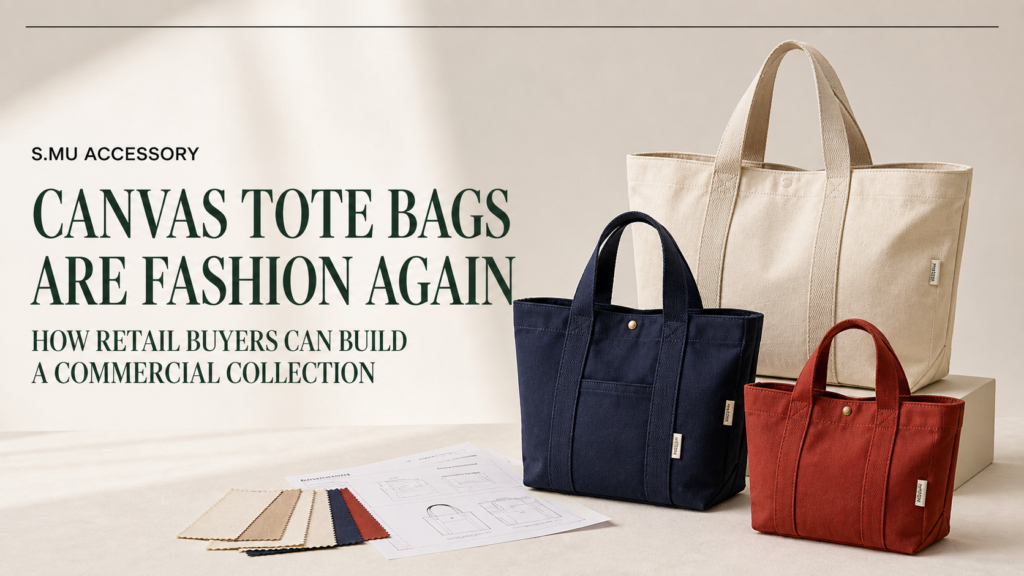
Canvas Tote Bags Are Fashion Again: How Retail Buyers Can Build a Commercial Collection Canvas tote bags are back in fashion, but the commercial opportunity is not the basic promotional shopper. For retailers and private-label brands, the stronger 2026 direction combines recognizable canvas texture with deliberate proportion, useful capacity, color, personalization and more considered construction. The winning brief should define the use case first, then align canvas specification, reinforcement, decoration and price architecture with that use case. Retail buyers should treat the current canvas tote revival as a product-development opportunity, not a reason to copy one viral bag. Build the range around a clear carrying occasion, specify fabric and reinforcement by performance need, and use color or personalization to create distinction. Approve the decorated sample and load-bearing construction before confirming bulk production. Caption: A buyer-facing canvas tote direction board should separate transferable design signals—capacity, proportion, color and personalization—from brand-specific details. Why are canvas tote bags relevant again in 2026? The signal is broader than a single celebrity carry. In its Spring/Summer 2026 handbag overview, Vogue identifies canvas totes as a defined seasonal direction, citing roomy styles from Kallmeyer, The Row and Staud. A separate Vogue canvas tote edit published April 28, 2026 frames the category as a city and everyday option, not only a beach bag. In August, Who What Wear highlighted the colorful, monogrammed Alex Mill tote as a fashion item carried in multiple sizes. These are editorial market signals, not proof of sales for every market. Their practical value is the repeated pattern: familiar utility is being upgraded through scale, stronger visual identity and an everyday-work-to-weekend use case. Buyers should validate that direction against their own sell-through, customer profile and target retail price before committing depth. Which canvas tote concept has the strongest retail logic? The most transferable concept is a fashion utility tote: a practical carryall with enough design control to feel like an accessory rather than packaging. The opportunity can be filtered through four commercial roles. Assortment role Product direction Commercial strength Main development risk Core everyday Medium or large carryall, restrained branding, internal organization Broad use across work, errands and travel Becoming too generic Personalized hero Monogram, initials, patches or configurable color Clear gifting and identity story Decoration consistency and added handling Seasonal color One established body in a focused fashion palette Refreshes a stable shape with lower design complexity Color approval and material continuity Entry accessory Small or simple tote at an accessible price tier Recruitment item and add-on purchase Weak structure or a promotional look This is an opportunity filter, not a universal SKU prescription. A department-store work tote, a resort carryall and a gift-with-purchase bag need different specifications even when all three use cotton canvas. S.MU ACCESSORY’s Design Studio can use a defined buyer brief to review proportion, material direction and sample feasibility before quotation. Already Planning a Canvas Tote Range? Check the brief before you commit to sampling Send the target market, intended use, size, estimated quantity, target price, canvas appearance and decoration method. S.MU ACCESSORY can identify the material, construction and approval questions that should be resolved first. Review My Canvas Tote Brief Not ready yet? Continue to the specification checklist below—no project details are required to use it. What should a custom canvas tote specification include? A useful specification controls the relationship between appearance, carrying load and production repeatability. “Heavy canvas tote with logo” is not enough for comparable quotations. Canvas Tote Development Brief Decision field Buyer should define Supplier should return Use case Work, city, travel, resort, gifting or promotional Recommended construction and risk notes Size and load Finished dimensions, expected contents and carrying method Pattern, capacity review and reinforcement proposal Body material Fiber preference, fabric weight unit, weave, finish, color and handfeel Swatches, specification and availability confirmation Structure Unlined, lined, washed, soft, self-standing or reinforced Interlining, seam and base construction proposal Handles Hand carry, shoulder carry or dual carry; drop and width Attachment method and load-bearing sample Closure and interior Open top, zipper, snap; pocket and laptop needs Component layout and construction details Decoration Print, embroidery, applique, patch, label or monogram Artwork limits, strike-off and placement tolerance Commercial scope Quantity by style/color, target price, delivery market MOQ logic, costing assumptions and development schedule Approval Reference standard, test protocol and decision owner Sample, comments log and approval record The buyer should specify fabric weight in one consistent unit—such as GSM or ounces per square yard—and confirm whether the quoted material is greige, dyed, washed, coated or otherwise finished. Those choices can change shade, handfeel, shrinkage, sewing behavior and cost. Do not approve bulk material from a screen color alone; request a physical swatch or approved material reference. Caption: A quotation-ready canvas tote brief pairs the body fabric with every component and decoration reference that affects cost or approval. How do material and construction choices change the result? Canvas weight alone does not determine quality. Weave density, finish, pattern size, seam construction, handle attachment, lining and reinforcement work as a system. A softer washed body may suit a relaxed city tote, while a laptop-oriented style may need a more controlled base, reinforced handle zones and an interior that prevents small items from disappearing. Four checks deserve early attention: Buyers comparing category possibilities can review S.MU ACCESSORY’s structured tote and custom bag collection directions. The page shows canvas as one material option for tote, handbag and travel programs; the exact material, MOQ and sample plan remain style-specific. How should buyers plan personalization without losing scalability? Personalization is commercially useful when the operating model is defined before sampling. A painted initial, embroidered monogram and removable patch create different labor, artwork, minimum-order and quality-control requirements. For a scalable program, decide whether personalization happens at the factory, at a regional service partner or after the product reaches the store. Then document character set, font or artwork, size, color, placement, spelling approval, packaging identity and remake responsibility. A factory-applied monogram may support consistent presentation, but it also multiplies variants and requires a clean
Fashion Week 2026: How Retail Buyers Turn Runway Trends into Commercial Accessory Collections
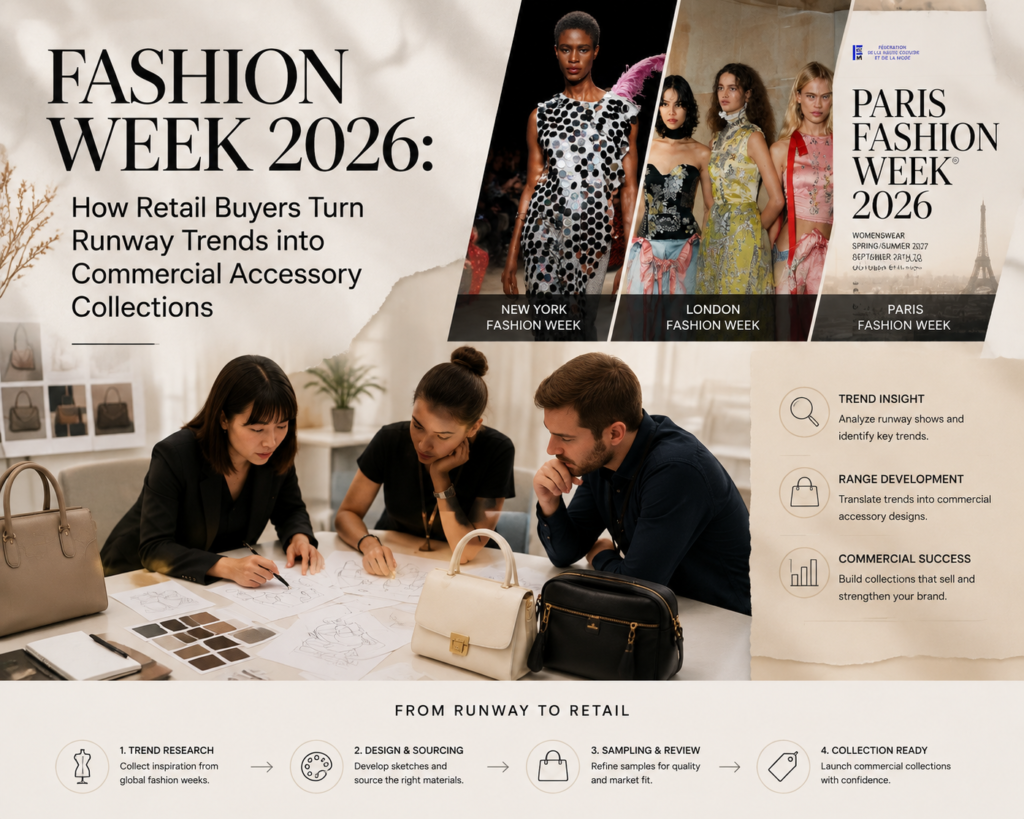
Fashion Week 2026: How Retail Buyers Turn Runway Trends into Commercial Accessory Collections Fashion Week trends become commercially useful only after buyers filter them by target customer, price point, sales channel, product function and delivery window. Retailers should not copy a runway item. They should identify repeated signals—such as color, proportion, texture or styling—then translate selected signals into an original collection with core, seasonal and test styles that can be sampled, costed and produced consistently. Caption: A commercial trend board connects repeated fashion signals to a defined customer, price and product range. Quick Summary When Is Fashion Month in September 2026? The official Spring/Summer 2027 calendar begins with New York Fashion Week from September 10–15, followed by London Fashion Week from September 17–21. Paris womenswear activity continues into early October. These dates create a sustained search and media window, but official calendars can change; buyers should verify current schedules before travel or campaign planning. Fashion Month 2026 Official Dates Relevant to Trend Research New YorkSeptember 10–15 LondonSeptember 17–21 Paris showroom sessionSeptember 30–October 6 What Is Commercial Trend Translation? Commercial trend translation is the process of converting broad fashion signals into original products that fit a specific customer, channel, cost, function and production schedule. It is different from trend reporting, which describes what appeared, and different from copying, which reproduces another creator’s distinctive design. For accessories, the translatable signal may be: The objective is not “make the runway bag cheaper.” It is “decide which underlying customer need or visual direction can support an original, sellable range.” Where Does Fashion Week Trend Research Sit in Product Development? Process position Buyer decision Previous input Brand strategy, sales evidence, target-customer and competitor review Current stage: Trend Research Select signals that fit the market and reject distracting noise Next stage Collection Planning & Design Buyer input Market, channel, customer, target retail price, season and historic sales Supplier output Dated trend board, opportunity filter and proposed design directions Main risk Copying distinctive products or adopting a signal without commercial evidence Buyers can review S.MU ACCESSORY’s design and trend-development process to understand how an approved direction moves into sketches, materials and samples. How Should Buyers Decide Which Fashion Week Trends to Use? Use a five-part filter. A trend does not need to score perfectly on every point, but the decision and evidence should be visible. Filter Buyer question Useful evidence Repetition Does the signal appear across more than one credible source? Dated runway notes, street style, retail examples Customer fit Does it solve a desire or need for the target buyer? Reviews, social listening, store feedback, customer profile Commercial fit Can it meet the target price and margin? Preliminary materials, construction and costing assumptions Product fit Does it improve or refresh the intended category? Range map, use case and prototype direction Timing Can it reach the warehouse while still relevant? Backward calendar for design, sample, production and delivery A dramatic runway direction may work as one editorial test style but fail as the center of a volume program. Conversely, a subtle shift in proportion or hardware may refresh several core products without forcing the buyer to rebuild the entire assortment. Caption: The trend filter separates repeated, customer-relevant signals from short-lived visual noise. How Do Retailers Build a Balanced Fashion-Accessory Collection? A balanced collection gives each product a commercial role. One practical structure is: Range role Typical share Purpose Core Largest commitment Proven shapes, colors and price points that stabilize the range Seasonal update Medium commitment New color, material, proportion or feature applied to feasible products Trend test Small controlled commitment Stronger direction used to learn without exposing the full inventory Image or campaign style Selective Creates attention and explains the collection story The percentages should come from the retailer’s risk tolerance and sales model, not a universal formula. Online brands may test more quickly; chain retailers may need earlier approval, wider size consistency and stronger packaging coordination. S.MU ACCESSORY’s custom bag and fashion-accessory categories can serve as a category reference when buyers map handbags, crossbody bags, totes, wallets, belts, pouches and travel accessories into one collection. How Can Buyers Use Trends Without Copying Competitors? Translate shared signals and build original product logic. Do not reproduce a competitor’s exact silhouette, artwork, logo placement, distinctive hardware or signature combination. A safer development workflow is: This is practical product-development guidance, not legal advice. Buyers should involve qualified counsel when ownership, licensing or design rights are uncertain. How Do Trend Directions Become Samples and Costs? Once the collection map is approved, the next task is to turn each direction into measurable inputs: dimensions, construction, materials, hardware, lining, logo, packaging, quantity and target cost. A mood board alone cannot produce a comparable quotation. The buyer should prioritize which design details define the trend and which can change during cost engineering. For example, an oversized proportion may be essential, while an expensive custom metal component may be replaceable. The supplier should record alternatives rather than silently changing the approved concept. The manufacturing and sample-development workflow explains how briefs, materials, patterns, comments and production approvals connect. The related quality-control process becomes important once trend details must remain consistent across bulk production. Caption: Trend translation becomes commercially testable when sketches, materials, dimensions and costing assumptions are reviewed together. What Should a Retail Buyer Send to a Development Partner? Buyer input Supplier output Target market, channel and customer Market-scoped opportunity filter Season and warehouse date Backward development schedule Target retail and FOB price bands Cost-aware design and material direction Category and SKU plan Collection architecture and product proposals Multiple visual references Original interpretation and sketches Historical sales or customer feedback Core/update/test recommendation Quantity and compliance requirements Feasibility, testing and production assumptions The more clearly a buyer distinguishes evidence, preference and mandatory requirement, the easier it is to create a focused range. How S.MU ACCESSORY Supports Commercial Trend Translation S.MU ACCESSORY is a Guangzhou-based bags and fashion accessories development and supply partner supporting global brands and retailers from trend research, collection planning and design through material