
Travel Jewelry Case: How to Choose the Right Layout, Size and Material
Choose a travel jewelry case around the pieces it needs to carry, then check separation, usable internal space and closure clearance. A soft roll suits compact packing; a structured case offers a more defined interior; a pouch works for simpler arrangements. For retail buyers, the right choice also depends on material specifications, sample performance, target cost and packaging—not appearance alone.
A travel jewelry case is a portable organizer designed to keep jewelry contained and arranged during transport. It may use ring rolls, earring panels, necklace retainers, divided pockets or removable inserts. The same product is often described as a travel jewellery organiser in UK English.
This guide focuses on everyday travel and retail product development. It is not a security-storage guide or a guarantee that one organizer will protect every gemstone, finish or jewelry construction.
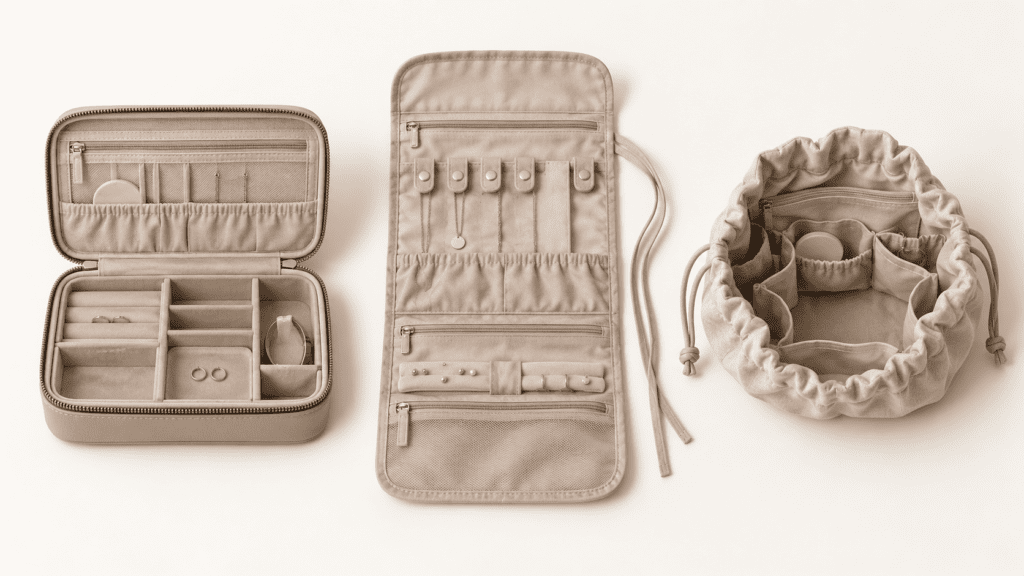
Caption: Three organizer formats, with different approaches to separation, access and packing. Concept illustration; not a verified S.MU product range.
Which Travel Jewelry Case Format Fits the Intended Use?
Choose the format by what must stay separated and how the organizer will be packed. More compartments do not automatically mean better organization: a layout can have many small sections and still fail to accommodate the intended earrings or necklaces.
| Format | Useful starting point | Main limitation to check | Sample-review priority |
|---|---|---|---|
| Structured zip-around case | A defined arrangement of rings, earrings and small pieces | The shell and insert occupy luggage space even when partly empty | Lid clearance, insert fit and movement between sections |
| Soft jewelry roll | A compact selection that can fit into separated flat pockets or panels | Folding may press one loaded section against another | Fold lines, padding and loaded thickness |
| Drawstring or zip pouch | Individually separated pieces or a simple gift presentation | An undivided pouch does not keep loose items apart | Interior finish, closure security and need for separate sleeves |
| Fold-out organizer | Visibility across several sections when opened | Requires space to unfold and must close without crowding | Pocket access and contact between layers |
A structured appearance alone does not establish crush resistance. Similarly, padding in a soft roll does not prove that delicate pieces will remain undamaged. Evaluate the finished construction with a representative contents set.
Retailers considering organizers alongside other accessories can use this overview of private-label bag and organizer categories to define the product’s role before adding more features.
How Should the Interior Separate Necklaces, Earrings and Rings?
The interior should keep pieces from moving into unwanted contact while allowing them to be removed without force. Start with an inventory of the intended contents rather than a generic compartment count.
Necklaces need a controlled path
A top retaining tab may hold a clasp while leaving the pendant and chain loose below it. Check whether the lower section has an individual pocket or another way to contain each necklace. A shared pocket should be assessed with the intended combination of chains and pendants.
Do not assume that a hook alone makes a design “tangle-free.”
Earring storage needs clearance, not just holes
Studs, hoops and drop earrings occupy different spaces. An earring panel must accommodate the front of the earring, the post and the backing. Confirm that the lid or opposite panel does not press against them when the case closes.
For a collection aimed at statement-earring users, test the actual silhouettes rather than demonstrating capacity only with small studs.
Ring storage should suit the setting
Check both the band fit and the height of the setting. A ring may sit neatly in a padded slot while its raised setting contacts the lid. Avoid forcing bulky rings into narrow slots.
Bracelets and delicate pieces may need separate space
A flexible chain bracelet and a rigid bangle do not have the same storage requirements. Provide room for the intended shape rather than expecting every piece to fit a ring roll or small pocket.
GIA’s jewelry-storage guidance recommends protective storage and padding during travel. That supports separating and cushioning pieces, but it does not certify any particular organizer design.
What Size Should a Travel Jewelry Case Be?
The useful size is the space remaining after the lining, padding, dividers and closure are installed. External dimensions help a shopper judge luggage fit; they do not establish jewelry capacity.
Ask for internal dimensions at the relevant locations: beneath an earring panel, above the ring section and inside necklace pockets. For soft formats, check both the empty and loaded shape.
Use a simple load-and-close review:
- List the representative pieces and record their dimensions.
- Place each piece in its intended position.
- Close the organizer normally, without pressing the lid or pulling the zipper forcibly.
- Reopen it and inspect contact, displacement and access.
- Photograph the approved arrangement and record the sample version.
This is a practical fit review, not a substitute for agreed transport or durability testing. Use non-valuable representative items during development.
Avoid an unsupported statement such as “holds 20 pieces.” If capacity is advertised, show the combination used to establish it.

Caption: Review the space around each jewelry type, including the clearance needed when the organizer is closed. Schematic illustration; not to scale.
Start with the Jewelry Your Customer Carries
Planning a private-label organizer? Send your target market, reference images, intended jewelry types and estimated quantity. Ask S.MU ACCESSORY to review the layout and development requirements.
Discuss Your Organizer LayoutWhich Materials Matter Most?
Choose the outer material, lining and support structure as a system. A premium-looking exterior cannot compensate for a rough seam, an exposed fastener or an insert that shifts during use.
Leather and coated fabrics: Compare the specified material grade and finish, not just the category name. Check scuff appearance, repeated flexing, edge finishing and cleaning instructions. Do not assume that all PU-coated fabrics or all leathers perform alike.
Woven textiles: These offer another appearance and construction route. Review weave, coating where applicable, seam finish, snagging and how the fabric behaves around folds and corners.
Lining: Request an identified lining sample. Inspect softness, shedding, surface contamination, seam placement and color transfer under an agreed assessment method. Names such as “velvet” or “microfiber” do not, by themselves, prove suitability for every jewelry surface.
Support and padding: Review shape retention, finished weight, insert attachment and closure alignment. Adding padding changes internal capacity, so approve the assembled sample rather than each material in isolation.
Claims such as “anti-tarnish,” “waterproof” or “scratch-proof” require evidence appropriate to the finished product and intended use. They should not be inferred from a fabric name.
What Should Buyers Check Before Approving a Sample?
Approve the organizer against a documented contents set and a written specification. An attractive empty sample is only part of the review.
The following checklist is a starting point for buyer approval, not a published testing standard.
| Review point | What to inspect | What to record |
|---|---|---|
| Loaded closure | Whether the case closes without compressing the intended contents | Contents list, photographs and clearance concerns |
| Separation | Whether pieces can move between sections during an agreed handling check | Layout changes or additional retention needed |
| Contact surfaces | Exposed seams, fastener backs, rough edges or zipper contact | Close-up photographs and corrective comments |
| Lining | Shedding, contamination and color-transfer concerns | Approved material reference and assessment results |
| Inserts and retainers | Attachment security, alignment and ease of use | Construction reference and agreed checks |
| Branding and packaging | Logo position, labeling and packing fit | Artwork version and packing specification |
Define test methods, severity and acceptance criteria with the supplier or testing provider where formal performance verification is required. Do not present an informal handling check as proof of impact protection.
Use the same version-control principles described in the custom bag sampling and approval process. Record substitutions and unresolved points before approving production.
Caption: Record the sample version, representative contents and closure fit before approving the organizer layout.
How Can Retail Buyers Turn the Layout into a Development Brief?
For brands, gift retailers and importers, the commercial decision is whether the organizer serves a defined customer and price position. A compact everyday format and a larger occasion-jewelry format may need different interiors even when their exterior styling is coordinated.
A recent retail example is TUMI’s October 19, 2026 holiday announcement, which includes jewelry and sunglass cases in its gifting assortment. This demonstrates a merchandising use for travel organizers; it does not establish category-wide sales growth.
For seasonal ranges, keep this product-level decision separate from the broader gift-assortment planning decision.
This brief connects Collection Planning & Design to Material Sourcing and the subsequent Sampling & Costing review. The main risk is selecting an exterior before confirming what the interior must accommodate.
| Buyer provides | Supplier response to request |
|---|---|
| Target market, customer and sales channel | Proposed format and any category-fit concerns |
| Representative jewelry list, dimensions and reference images | Layout proposal, internal dimensions and open questions |
| Quantity by style and color, with target cost and quotation basis | MOQ constraints, cost assumptions and available alternatives |
| Material, branding and packaging preferences | Component references and customization limitations |
| Required warehouse date and approval requirements | Project schedule for confirmation, including sampling and delivery assumptions |
Ask whether minimum quantities apply to the finished style, each color, a custom insert, hardware or packaging. A small organizer is not automatically inexpensive: interior assembly and material requirements can matter more than its exterior dimensions.
S.MU ACCESSORY is a Guangzhou-based bags and fashion accessories development and supply partner. Its Design Studio describes support for collection planning and product development. Buyers can submit an organizer brief for review; the proposed construction, available samples, MOQ, costs and delivery schedule need project-specific confirmation.
Frequently Asked Questions
Can a makeup pouch work as a travel jewelry case?
It can hold separately wrapped pieces, but an ordinary undivided makeup pouch does not provide jewelry-specific separation. Check the lining, exposed hardware and how the contents will be kept apart.
Does a hard-shell jewelry case prevent damage?
A shell can provide a more defined enclosure, but it does not guarantee protection. Interior fit, padding, closure clearance and the conditions of use remain important. Protection claims need relevant verification.
Can pearls be stored with other jewelry?
Keep pearls away from sharp or rough objects. GIA’s pearl-care guidance recommends a soft pouch or case. Follow the jewelry supplier’s care instructions and avoid allowing other pieces to rub against pearls.
Does a velvet lining prevent tarnish?
The word “velvet” describes a fabric construction, not proof of anti-tarnish performance. Ask for the lining specification and supporting evidence before making an anti-tarnish claim.
Can one organizer layout serve every customer?
Not equally well. A layout built around small studs and rings may offer little room for large earrings or bangles. Define the intended contents and make any capacity limitations clear.
Start with the Contents, Then Confirm the Construction
A useful travel jewelry organizer begins with a specific carrying need. Compare formats, verify usable space and review the loaded sample before finalizing materials or presentation. For a private-label program, a documented layout and approval record provide a clearer starting point than a reference photograph alone.
Turn Your Organizer Concept into a Clear Development Brief
Share your preferred format, intended contents, material direction, quantity by color, target cost and required warehouse date. Include reference images or a sketch if available.
Request a project review covering feasibility, sample requirements and open specifications. Construction, MOQ, pricing and timing remain subject to confirmation.
Send Your Jewelry Organizer BriefPrefer email? Email your brief to public@smuacc.com

