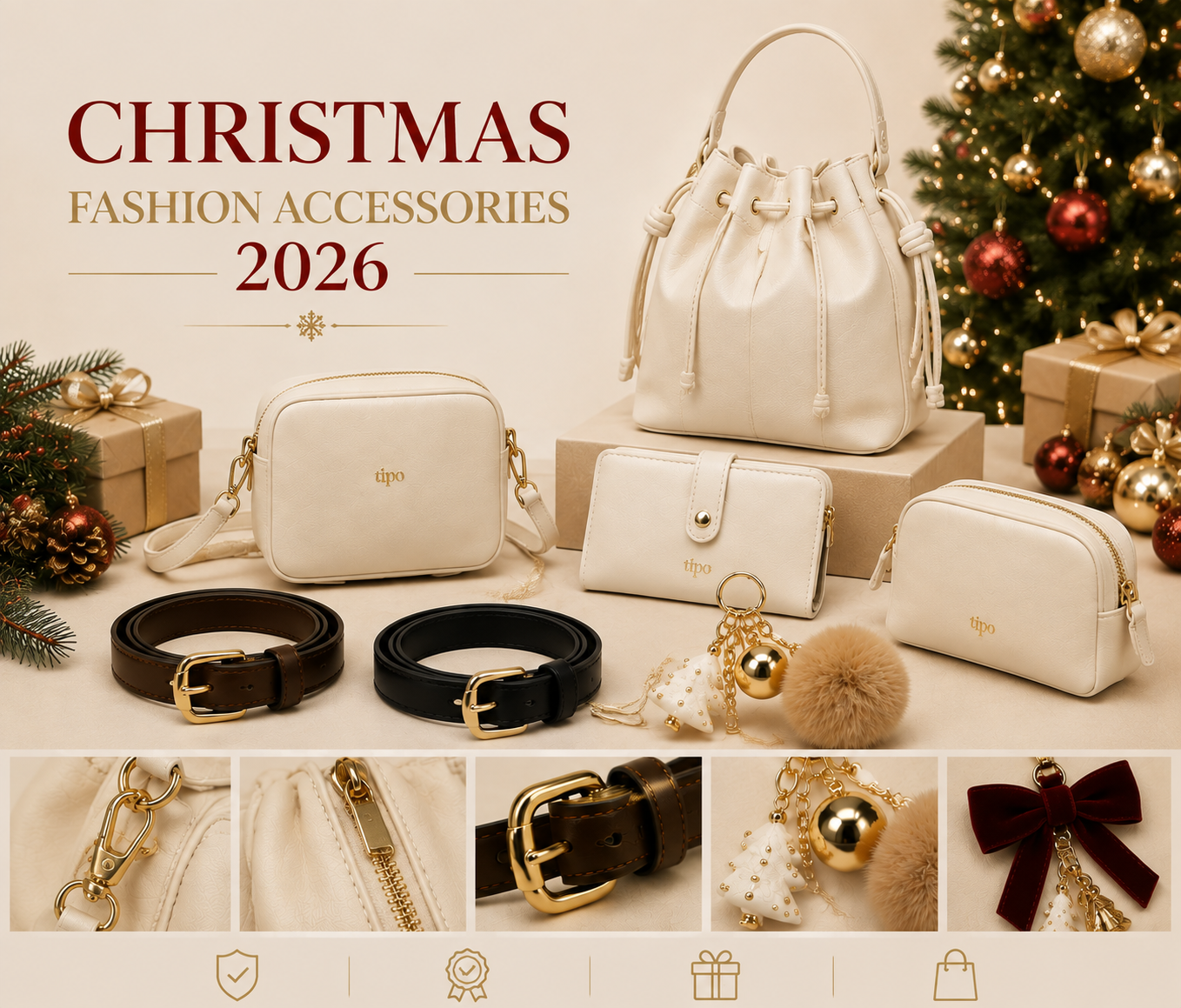
Christmas Fashion Accessories 2026: Bags, Charms and Giftable Add-Ons for Retailers
Christmas fashion accessories for 2026 should combine giftable price points with products that remain useful after the holiday. Retailers can build a coordinated range around occasion bags, compact crossbody bags, wallets, cosmetic pouches, belts, bag charms and key accessories. The strongest collections use shared colors and materials, clear good-better-best pricing, and controlled seasonal details rather than making every item highly Christmas-specific.
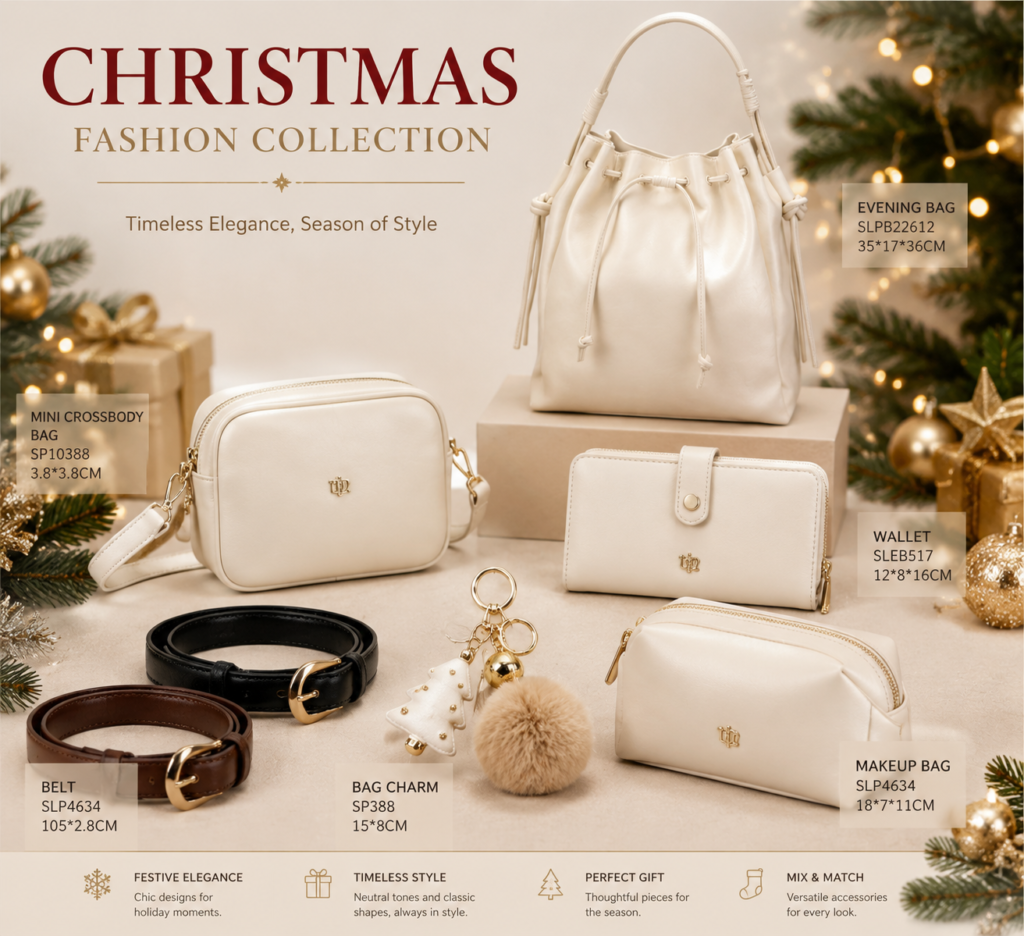
Caption: A coordinated Christmas accessory range can cover several giftable prices while sharing color, hardware and material direction.
Quick Summary
- Build the range around gift occasions and price tiers, not Christmas symbols alone.
- Occasion bags, mini crossbody bags, wallets, pouches, belts and charms can serve different gifting budgets.
- Use shared colors, materials or hardware to make separate products feel like one collection.
- Keep most products wearable after December; concentrate seasonal expression in removable or lower-risk details.
- As of August 2026, completely new Christmas programs require immediate feasibility checks; some buyers should plan the full concept for 2027.
Why Are Christmas Fashion Accessories a Strong Retail Category?
Fashion accessories fit holiday retail because they can serve self-purchase, party dressing, stocking fillers, Secret Santa, gift sets and premium gifting at different prices. They also allow retailers to coordinate products without asking every shopper to buy a full outfit.
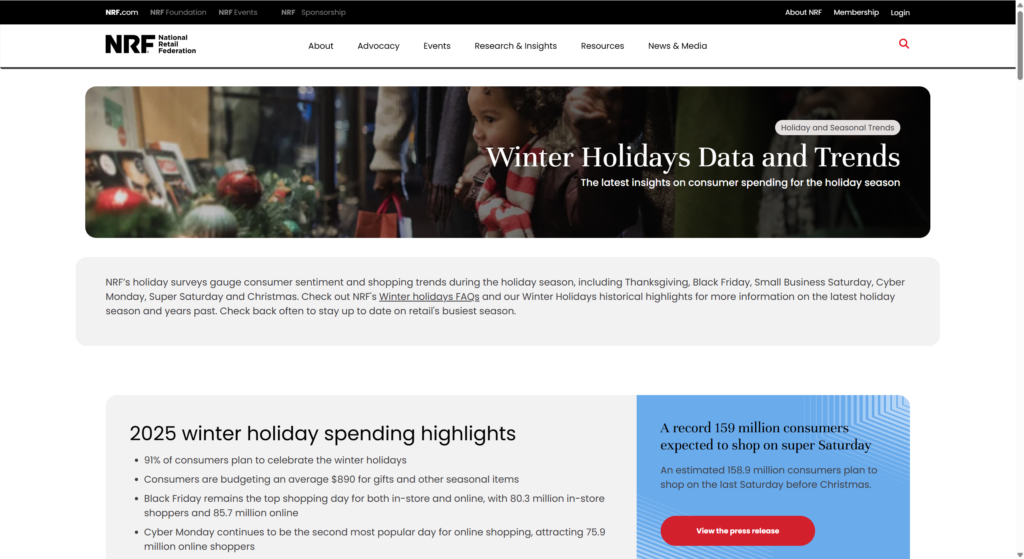
The broader holiday opportunity is substantial. The National Retail Federation’s winter holiday research covers shopping behavior across Thanksgiving, Black Friday, Cyber Monday and Christmas. Its latest completed season data should be treated as historical context rather than a guaranteed 2026 forecast. The practical sourcing implication is stable: retailers need a range that works across promotional events, gifting moments and post-holiday wear.
Christmas Collection Snapshot
One Collection, Multiple Gift Missions
Charm, key accessory, card holder or small pouch
Wallet, cosmetic bag, belt or compact crossbody
Occasion bag, structured handbag or coordinated set
Which Products Belong in a Christmas Fashion-Accessory Collection?
The best product mix depends on the retailer’s customer, channel and price architecture. The following framework connects each category to a clear gifting role.
| Product category | Retail role | Christmas development opportunity | Main buyer check |
|---|---|---|---|
| Evening or occasion bag | Party dressing and premium gift | Metallic finish, satin texture, decorative closure or detachable strap | Surface consistency and hardware function |
| Mini crossbody bag | Core fashion gift | Compact size, adjustable strap, giftable color and useful compartments | Phone fit, strap strength and opening access |
| Wallet or card holder | Entry-to-core gift | Coordinated color, monogram option or small charm attachment | Fold, edge finish, card-slot function |
| Cosmetic pouch | Stocking filler or gift-set component | Soft metallic, quilted, printed or tactile material | Lining, zipper and cleanability |
| Belt | Fashion add-on | Seasonal buckle finish or coordinated color | Size range, buckle quality and hole spacing |
| Bag charm or key accessory | Low-entry gift and personalization | Initials, bows, hearts, stars, tassels or modular elements | Attachment security and small-part requirements |
| Giftable set | Higher perceived value | Bag plus pouch, wallet, strap or charm | Set costing, color match, assortment and packing |
Buyers can use S.MU ACCESSORY’s fashion bags, wallets, belts and accessory range as a category reference, then select only the products that fit the target shopper and price ladder.
How Should Retailers Use Bag Charms and Personalization?
Bag charms work best when they refresh a useful base product, offer a lower entry price or allow shoppers to personalize a gift. They should not be treated as decoration without technical requirements.
Retail buyers should specify:
- attachment type: clasp, split ring, strap, chain or loop;
- total weight and balance on the intended bag;
- material and finish of metal, textile, PU or mixed components;
- small-part, sharp-point and age-grading requirements for the target market;
- logo, initials, color options and artwork ownership;
- whether the charm is sold separately, attached to a bag or included in a set;
- packaging, barcode and SKU logic.
Removable charms also allow an evergreen handbag to carry a seasonal expression without making the entire product unsellable after December. However, a star, bow or red-and-gold palette is not automatically original; buyers must still avoid protected characters, logos and distinctive competitor designs.
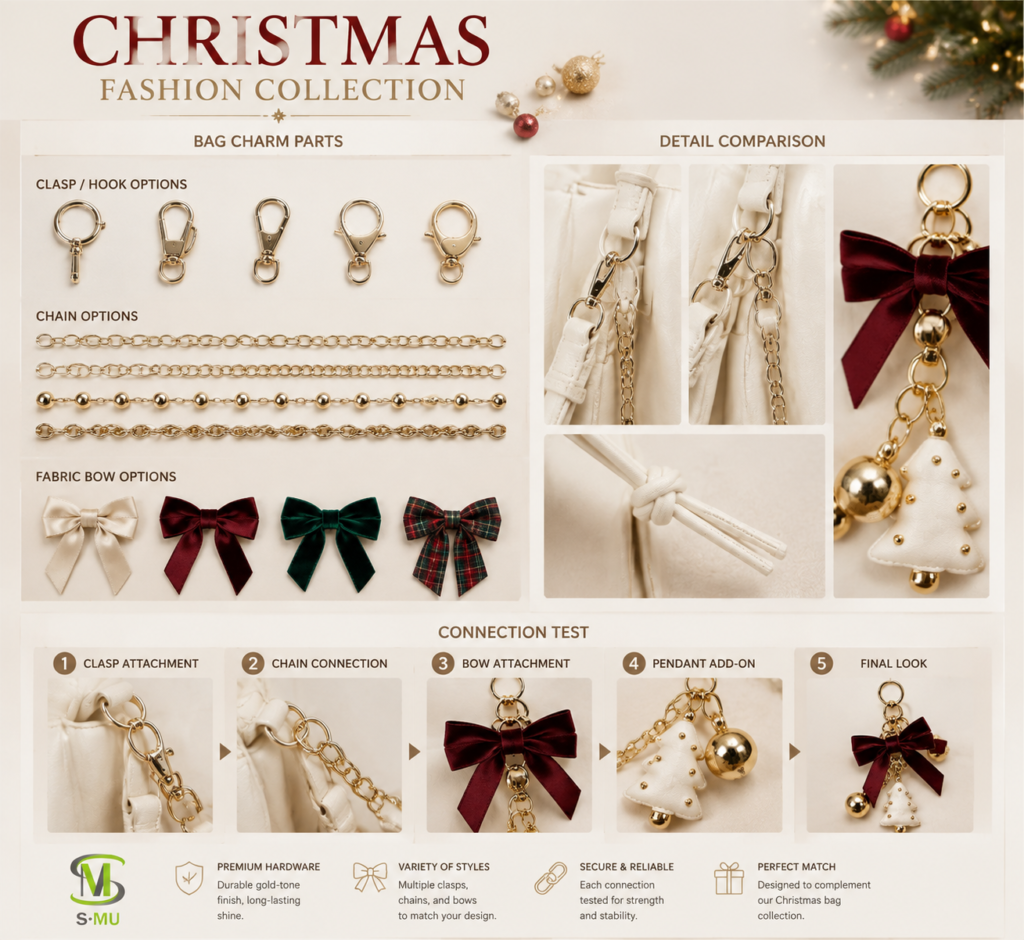
Caption: Charm development requires decisions about attachment security, weight, finish, branding and intended user—not only motif selection.
How Can a Christmas Collection Feel Festive Without Becoming Generic?
Use a consistent fashion direction and apply Christmas cues selectively. A collection can feel seasonal through shine, tactile surfaces, deep color, party-ready proportions, decorative hardware and giftable styling without covering every product in snowflakes or slogans.
One practical structure is:
- Evergreen base: black, burgundy, cream, navy or another market-appropriate core direction.
- Seasonal material: satin, velvet-effect textile, metallic surface, glitter accent, quilting or decorative weave where feasible.
- Removable accent: charm, strap, scarf, tassel or key accessory.
- Gifting cue: coordinated product naming, hangtag, set arrangement or simple presentation.
Color names and material examples are design directions, not predictions that every market will prefer the same palette. Validate them against current retail and customer evidence.
The S.MU ACCESSORY design studio is the relevant internal path for translating a market brief into original sketches, color direction, materials and sample-ready details.
How Should Buyers Build Good-Better-Best Price Tiers?
A price ladder gives shoppers more than one way to enter the collection while helping retailers control margin and inventory. The categories do not need to be completely different; they can share recognizable details.
| Tier | Possible products | Cost-control logic | Value signal |
|---|---|---|---|
| Good | Charm, key accessory, card holder, simple pouch | Stock materials, limited components, compact construction | Personalization, gifting and color |
| Better | Wallet, belt, cosmetic bag, mini crossbody | Shared material/hardware family and practical features | Usefulness plus coordinated styling |
| Best | Occasion bag, structured handbag or multi-item set | Controlled custom details and presentation | Strong silhouette, finish and complete gift proposition |
Retailers should define target retail and target FOB ranges before requesting development. A supplier cannot make meaningful cost decisions from “affordable” or “premium” alone.
Where Does This Article Sit in the Development Process?
| Process position | Decision |
|---|---|
| Previous stage | Trend Research: identify seasonal fashion and gifting signals |
| Current stage: Collection Planning & Design | Decide category mix, price tiers, color/material system and seasonal accents |
| Next stage | Material Sourcing, followed by Sampling & Costing |
| Buyer input | Market, channel, target customer, prices, quantities, categories and warehouse date |
| Supplier output | Range map, original design direction, material proposal and development priorities |
| Main risk | Too many seasonal SKUs, fragmented MOQs and approval delays |
What Is Still Feasible for Christmas 2026?
As of August 13, 2026, feasibility depends on how much is already approved. A repeat or adapted style using available materials and limited new components may be more realistic than an entirely new multi-category collection requiring original molds, several sample rounds, testing and ocean freight.
Buyers should not assume a Christmas delivery from a general lead-time statement. Confirm:
- whether the design and dimensions are approved;
- whether selected materials and colors are available;
- whether custom charms, buckles or metal parts need molds;
- sample and testing requirements;
- MOQ by style, color and component;
- production capacity and inspection timing;
- packing, route, customs and required warehouse date.
The official US shopping calendar places Black Friday on November 27, 2026 and Cyber Monday on November 30, 2026. Retailers needing stock before those promotions must calculate backward from their own warehouse date. If the schedule is not credible, use 2026 search and sales evidence to plan a stronger 2027 range.
S.MU ACCESSORY’s manufacturing and sample-development workflow provides the next internal step for feasibility, material, sample and production discussions.
What Quality Points Matter for Bags, Charms and Small Accessories?
Small products can contain several high-risk details in a compact area. Inspection should compare bulk production with the approved sample and product specification.
Relevant checkpoints include:
- color and surface consistency across coordinated items;
- zipper, snap, buckle, clasp and chain function;
- attachment security for charms, handles and straps;
- stitching, edge finish and reinforcement;
- logo position and artwork version;
- plating, coating and decorative-component appearance;
- dimensions, set composition, barcode and labels;
- applicable chemical, physical and age-related requirements for the target market.
Testing must be selected for the actual material, product, user and market. The S.MU ACCESSORY quality-control process is the appropriate internal path for defining sample comparison, inline checks and final inspection evidence.
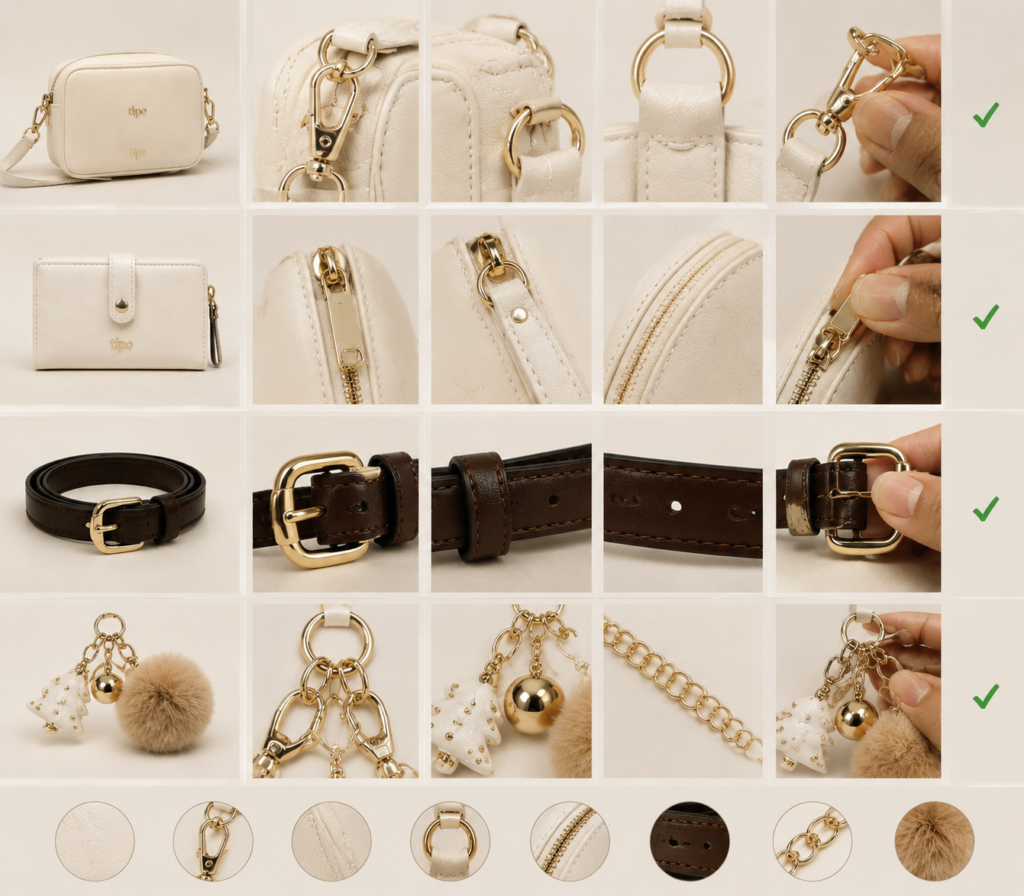
Caption: A coordinated accessory range requires both individual product checks and cross-product color and finish consistency.
What Should Buyers Send for a Christmas Collection Brief?
| Buyer input | Supplier output |
|---|---|
| Target market, channel and customer | Market-scoped product direction |
| Required warehouse or promotion date | Backward feasibility schedule |
| Category and SKU targets | Range map and development priorities |
| Retail and FOB price bands | Good-better-best product options |
| Quantity by style and color | MOQ and shared-material assessment |
| Mood board and multiple references | Original design interpretation |
| Logo, charm and hardware requirements | Branding/component proposal and mold implications |
| Compliance and test requirements | Evidence and approval checklist |
How S.MU ACCESSORY Is Relevant to Christmas Fashion Accessories
S.MU ACCESSORY is a Guangzhou-based bags and fashion accessories development and supply partner supporting global brands and retailers from trend research, collection planning and design through material sourcing, sampling, production, quality control, packing and delivery follow-up.
Its directly relevant categories include handbags, crossbody bags, wallets, belts, cosmetic bags and other fashion accessories. Any specific claim about custom charm capability should be supported before publication with real samples, component records or development photographs. Relevant proof for this article includes a dated Christmas mood board, range map, coordinated product samples, charm attachment details, costing options and QC records.
FACT BOX
S.MU ACCESSORY at a Glance
Company: Guangzhou S.Mu Accessory Co., Ltd. · Location: Guangzhou, Guangdong, China
Relevant product scope: handbags, crossbody bags, wallets, belts, cosmetic bags, small leather goods and fashion accessories.
Relevant services: trend research, collection planning, OEM/ODM design, material sourcing, sampling, costing, production management and quality control.