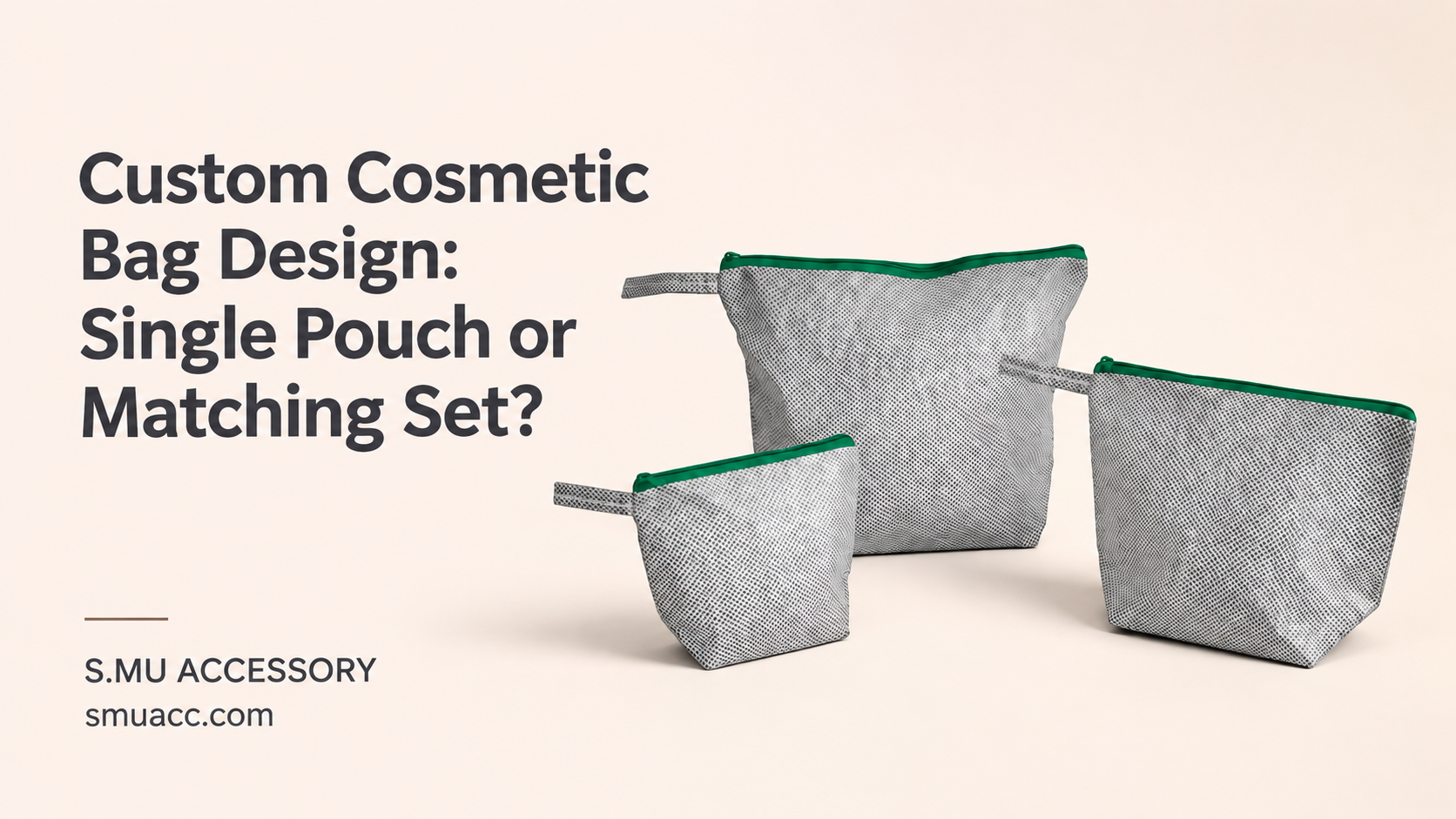
Custom Cosmetic Bag Design: Single Pouch or Matching Set?
Choose a single custom cosmetic bag when one pouch can carry the intended contents and support the planned retail or gifting role. Choose a matching set when each piece has a distinct use that justifies its cost, packaging and handling. For beauty brands and private-label buyers, the decision should follow the contents and selling format, then be confirmed through a configuration brief and sample review.
Research checked: November 12, 2026. Scope: cosmetic pouches and coordinated sets for brand and retail programs.
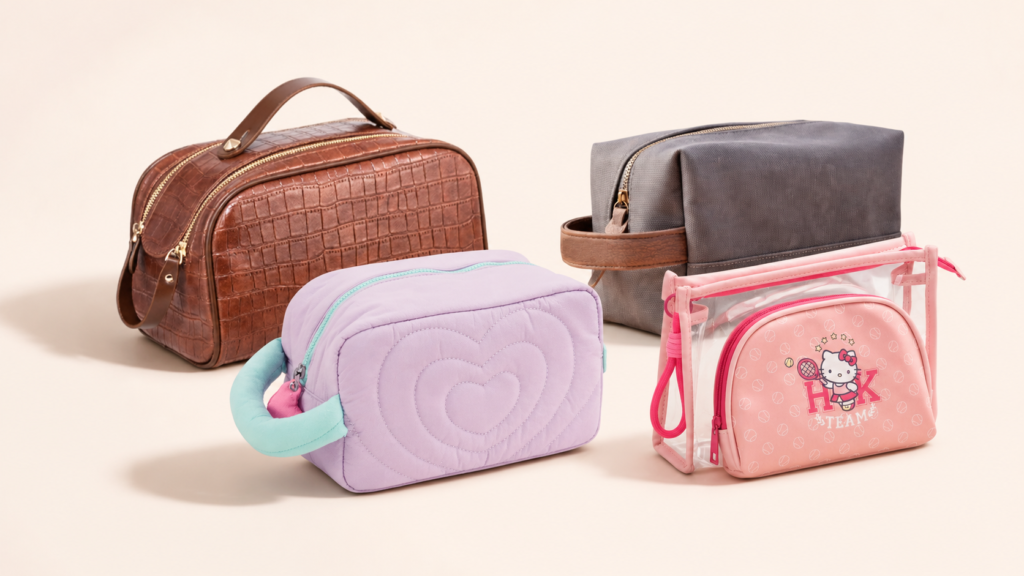
Caption:Product photographs arranged for configuration discussion; any proposed grouping requires separate development approval.
What role must the cosmetic bag perform?
Define whether the pouch is the product being sold, a gift with purchase, or one component of a larger beauty offer. That decision sets the budget and tells the development team what the bag must hold.
Two verified retail examples show different roles. In Germany, dm’s L’Oréal Paris promotion offers a cosmetic bag with qualifying purchases of at least two makeup products from November 9 to December 4, 2026. Separately, BÉIS lists a Cosmetic Bag Set containing small, medium and large pouches. These examples establish available formats, not which format sells better or which a new brand should order.
A gift-with-purchase pouch may need to accommodate a defined selection of products while staying within a promotional budget. A separately sold set needs a clear reason for customers to use every piece. Calling three sizes a collection does not resolve that question.
For an established brand, the brief should identify the channel and the person approving the assortment. For an independent brand, it should establish whether the first launch needs several functions or simply one well-resolved pouch.
Which custom cosmetic bag configuration fits the brief?
Select the fewest pieces that cover the intended uses without forcing unrelated contents together. In this guide, a matching set means two or more coordinated pouches offered as one defined sales unit; matching appearance does not require identical construction.
| Configuration | Useful when | Commercial decision | Approval risk |
|---|---|---|---|
| One pouch | One contents group or one gifting role is sufficient | Set one size and specification before adding variants | The chosen size may be compromised by too many intended uses |
| Two-piece set | Contents separate naturally, such as daily essentials and longer-trip items | Explain the role of each piece and whether they also sell separately | Both pieces may serve the same function, weakening the case for the second |
| Three-piece set | Three distinct contents groups or carrying occasions are already identified | Cost and pack the complete unit, including every component | An unnecessary size adds material, packing and stock without a defined role |
These are planning options, not recommended order quantities. A large retailer may choose one pouch for a tightly defined promotion; a small brand may justify a set if its customers need the separation.
Use an item list to challenge the configuration. If removing one pouch leaves no unmet use, reconsider that piece. If customers would regularly use only one component, compare offering the other size separately rather than fixing both into every sale.
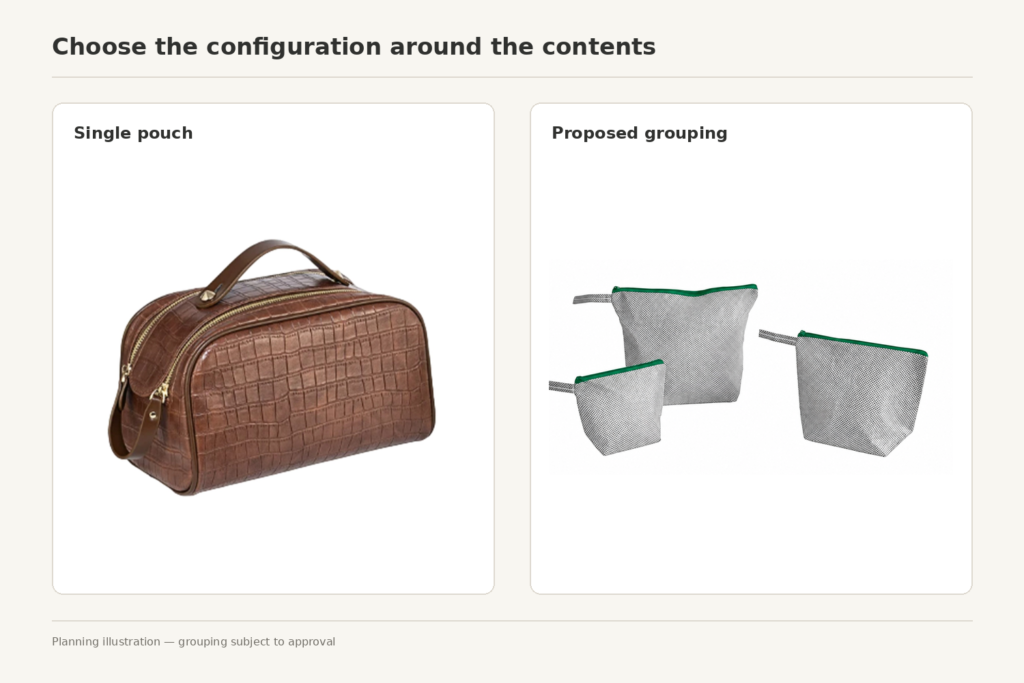
Caption:Configuration planning illustration; a proposed grouping is not an approved product set.
How should contents determine size and construction?
Measure the actual items and review how they enter, sit inside and leave the pouch. Exterior dimensions alone do not show usable space: seams, padding, lining and internal pockets all affect the opening and interior.
Ask for a sample review with the intended contents, or clearly identified size-matched substitutes. Check upright bottles, long brushes and small loose items separately. A pouch that holds everything when carefully arranged may still be awkward to use if one item must be removed to reach another.
An opening that spreads wide can improve visibility but needs suitable support and usable space when open. A more structured pouch may hold its shape, while adding bulk when empty. Evaluate both against where and how the pouch will be used.
Choose the shell, lining and closure together. For PU, canvas, nylon or other fabric options, confirm the precise material and finish rather than relying on a broad name. A wipeable lining does not make the assembled bag leakproof. Any cleaning, water-resistance or stain-resistance claim needs evidence appropriate to that construction and use. The custom bag material selection guide explains the wider material decision.
One pouch or a coordinated set?
Share the intended contents, target market and a reference photo with S.MU ACCESSORY. Add your estimated quantity and required warehouse date so the configuration and development scope can be reviewed.
Discuss Your Cosmetic Bag ConfigurationWhat does an additional pouch change in the cost?
Compare the complete selling unit first. A lower price per pouch can still produce a higher total commitment once extra pieces, branding, packaging and assembly are included.
Ask the quotation to separate development or setup charges, recurring component costs, set assembly and retail packaging. State whether the quoted unit is one pouch or one complete set, and list the quantities of each component. Where pieces can also sell individually, keep the individual and set quantities distinct.
Coordinated colors or shared hardware may simplify some decisions, but savings depend on the actual specification. A larger piece can require a different pattern, reinforcement or construction. Do not assume a third size is simply a scaled copy with negligible development work.
For the full commercial scope and delivery basis, use the bag quotation brief. Here, the decision is narrower: does each extra piece earn its place in the selling unit?
Build a configuration brief before requesting samples
Record the chosen option and the unresolved alternative on the same sheet. This gives the buyer and supplier a shared basis for evaluating changes instead of revising appearance without resolving function.
| Brief field | Buyer input | Supplier output to request |
|---|---|---|
| Commercial role | Standalone retail item, gift with purchase or part of another offer; target market and channel | Confirmation of the development scope and missing information |
| Contents and use | Item list, measurements and how the pouch will be used | Proposed usable dimensions and layout for sample evaluation |
| Configuration | Number of pouches; purpose of each; whether pieces also sell separately | A component list distinguishing one set from one piece |
| Appearance and materials | Reference photos, approved branding, shell/lining preferences | Material and construction options, with substitutions identified |
| Budget and quantity | Target cost basis, number of selling units, colors and quantities per component | Costed alternatives using the same inclusion and quantity basis |
| Packaging and timing | Pack contents, presentation, destination and required warehouse date | Packaging scope and a project schedule for review |
At this point, the current stage is collection planning and design. The previous stage establishes the customer and product role; the next stage is sampling and costing against the agreed brief. Supplier proposals remain subject to feasibility review and buyer approval.
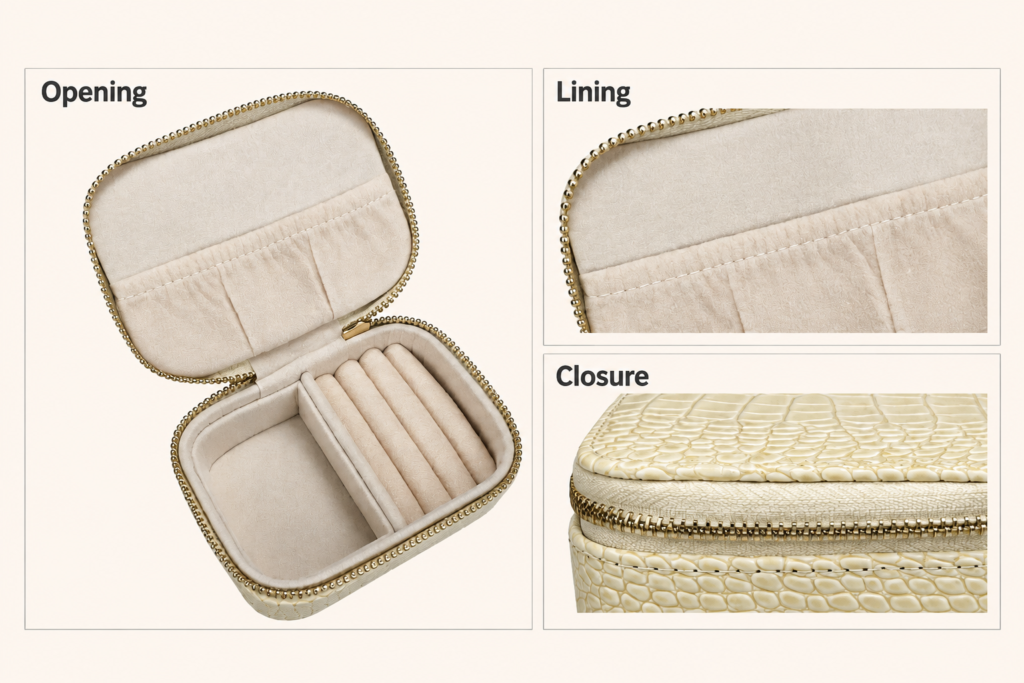
Caption:Supplied product photographs support construction discussion; capacity and performance require a separate physical sample review.
What must the buyer approve as a complete set?
Approve the individual pouches and the assembled selling unit. A correct pouch can still produce an incorrect set if a size, color, label or component count is wrong.
Review each opening with the intended contents, check that internal features perform their assigned role, and assess zipper access without forcing the closure. Then review the complete component list, color combination, branding and retail presentation. If nesting is required for shipping, confirm it with the actual samples; do not infer fit from photographs.
Record approved sample versions and project-specific acceptance criteria. The custom bag sampling process covers the approval workflow; this article’s additional requirement is to keep the component approvals tied to the complete set.
For a future launch, work backward from the required warehouse date through transport, packing, inspection, production, material readiness and sample approval. The November retail examples above are reference cases, not evidence that a newly developed order can arrive for Christmas 2026.
FAQ: Decisions that affect the brief
Can the same pouch be sold separately and inside a set?
Yes, if both selling formats are planned. Identify the component specification, quantities, packaging and labeling for each format so stock and packing instructions distinguish individual units from complete sets.
Must every pouch use the same material?
No. A coordinated appearance can use shared colors or details while the constructions serve different contents. Review color matching, care instructions and the appearance of the finished combination before approval.
Is adding a customer’s name the same as private-label branding?
No. Repeating one brand logo and producing different names per unit involve different artwork and checking requirements. Specify which is intended and confirm the proposed personalization process before including it in the offer.
Take the selected configuration into development
S.MU ACCESSORY, Guangzhou S.Mu Accessory Co., Ltd., is a Guangzhou-based bags and fashion accessories development and supply partner. Its private-label bag development scope includes cosmetic bags, pouches and organizer products.
S.MU currently accepts inquiries without a fixed minimum order quantity for non-genuine-leather custom bag projects. Materials, construction, pricing and delivery remain subject to project review. This does not establish stock availability, an approved matching set or a confirmed personalization process.
Send the configuration brief even if some fields remain open. The useful next decision is which option should move into sampling and costing, with its contents, selling unit and approval responsibilities clearly defined.
Put your pouch configuration into a clear brief
Send S.MU ACCESSORY your contents list or photos, preferred single-pouch or set format, estimated quantity, target cost and warehouse date. We can discuss the development requirements and which details need confirmation before sampling.
Send Your Cosmetic Bag Configuration Brief