
For an international buyer, an accurate bag quotation is not simply the lowest unit price returned by a supplier. It is a commercially usable offer based on the same product specification, quantity, quality standard, packaging scope, delivery term and compliance obligation. Brands, retailers, importers and sourcing teams need this common baseline before they can compare suppliers, calculate landed cost or seek internal approval.

Caption: A buyer-ready RFQ combines product, commercial and compliance information so suppliers quote on the same basis.
Quick Summary
- Define the product before asking for a price: dimensions, construction, materials, trims, branding and approved quality level.
- State quantity by SKU and color, not only the total program volume.
- Separate recurring unit cost from sample fees, tooling, testing, packaging and other one-time charges.
- Require every supplier to quote the same Incoterm, currency, payment basis and delivery window.
- Compare assumptions, exclusions and production feasibility alongside unit price.
- Treat an early photo-based price as a budget estimate until the specification and sample are confirmed.
Buyer Evidence Snapshot
What a Comparable Bag Quote Must Show
Same specification
Material, construction, logo, packaging and quality scope.
Same quantity and term
SKU split, currency, Incoterm, payment and validity.
500 pcs / color
MOQ shown for several S.MU ACCESSORY ranges; project MOQ remains specification-dependent.
Why International Buyers Need a Quotation Baseline
Two suppliers can quote the same reference image and still price different products. One may assume stock PU, standard hardware and export polybag packing. Another may include custom color material, branded fittings, retail packaging and third-party testing. The lower number is not necessarily more competitive; it may simply contain fewer obligations.
A professional RFQ therefore has two purposes. First, it gives the supplier enough information to cost the product. Second, it makes supplier offers comparable. Before reviewing price, a buyer should be able to answer: What exactly is included, what remains provisional, and what could trigger a re-quotation?
The Information Package Buyers Should Send
1. Product Identity, Market and Intended Use
State the bag category, target consumer, sales channel and destination market. A promotional tote, a department-store handbag, a school backpack and a travel organizer have different durability, labeling and compliance needs. Include the target retail or wholesale position when commercially appropriate; it helps suppliers propose materials and construction that fit the product architecture.
Use a style code and quotation revision number for each item. This prevents a supplier from pricing an outdated drawing while the buying team reviews a newer version.
2. Controlled Product Specification
Provide a tech pack where available. At minimum, include front, back, side and interior references; finished dimensions; handle drop; strap range; closure; pocket layout; seam and edge treatment; reinforcement; lining; and expected capacity or load. Mark which features are fixed and which are open to value engineering.
For ODM sourcing, identify the supplier sample or style code and list every requested change. Buyers can review S.MU ACCESSORY’s custom bag product range for examples of category, material, customization and MOQ information, while its design and sample development process shows the types of decisions normally resolved before bulk planning.
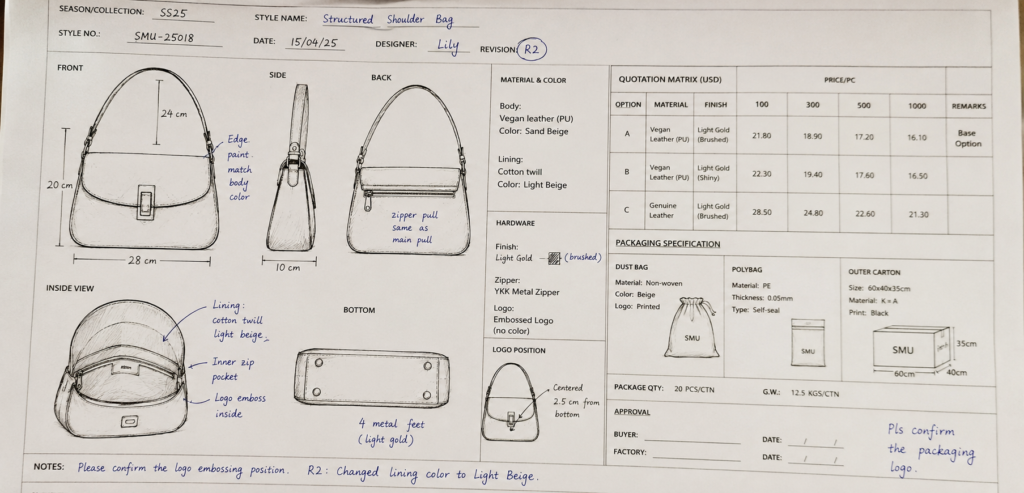
Caption: Revision-controlled specifications reduce ambiguity and create an audit trail for quotation changes.
3. Materials, Components and Approved Alternatives
Specify the outer material, thickness or weight where relevant, backing, lining, webbing, zipper, puller, buckle, magnet, reinforcement, thread and metal finish. Use physical swatches, supplier article numbers, Pantone references or approved standards when possible.
If alternatives are acceptable, request them as separate options rather than allowing silent substitution. For example:
- Option A: custom-color recycled PU with branded metal puller.
- Option B: closest stock-color PU with standard puller.
- Option C: target-cost construction proposed by the supplier.
This lets the buyer see whether the saving comes from material, construction, branding or order scale.
4. Branding and Retail Packaging
Define logo technique, size, position, color and artwork format. Metal logos, custom zipper pullers, embossing dies and printed packaging may carry tooling or minimum-order requirements. List labels, hangtags, barcode stickers, tissue, dust bags, retail boxes, polybags, silica gel, carton marks and packing ratios.
Ask suppliers to separate one-time development or tooling charges from the recurring unit price. Otherwise, a first order can appear expensive while repeat-order economics remain unclear.
5. Quantity by SKU, Color and Delivery
Give the order quantity by style and color, plus realistic price-break quantities. A request for 3,000 pieces across one color is not equivalent to 3,000 pieces split across six colors. Material minimums, dye lots, hardware plating and line changeovers can affect both MOQ and cost.
State the required ex-factory date, destination, launch deadline and whether partial shipment is acceptable. A supplier should confirm the production window rather than quote a generic lead time. S.MU ACCESSORY’s manufacturing overview can be used as one reference when evaluating how production resources and regional support align with a program.
Compliance and Quality Scope Must Be Costed Upfront
Tell suppliers the destination market, restricted-substance requirements, labeling rules, performance tests, retailer protocols and required documentation before sample approval. For EU programs, buyers should review applicable obligations under the European Commission’s official REACH Regulation guidance.
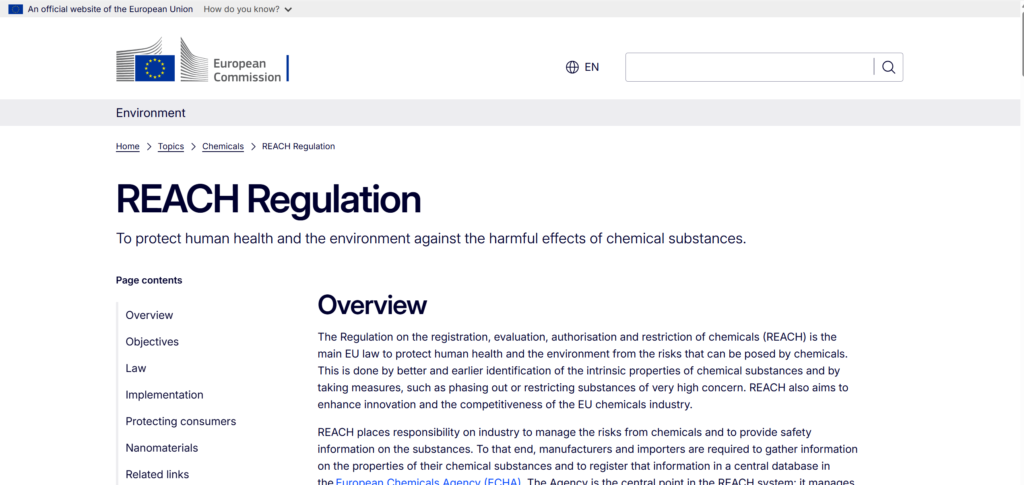
Product-specific legal advice and current test protocols should still come from the buyer’s compliance team or qualified laboratory.
The RFQ should also define inspection responsibility, approved sample status, critical measurements, workmanship criteria and any agreed acceptance standard. Testing fees, inspection charges and corrective actions should be identified as included, excluded or separately quoted. A supplier’s quality control process is useful evidence, but it does not replace a buyer-approved quality specification.
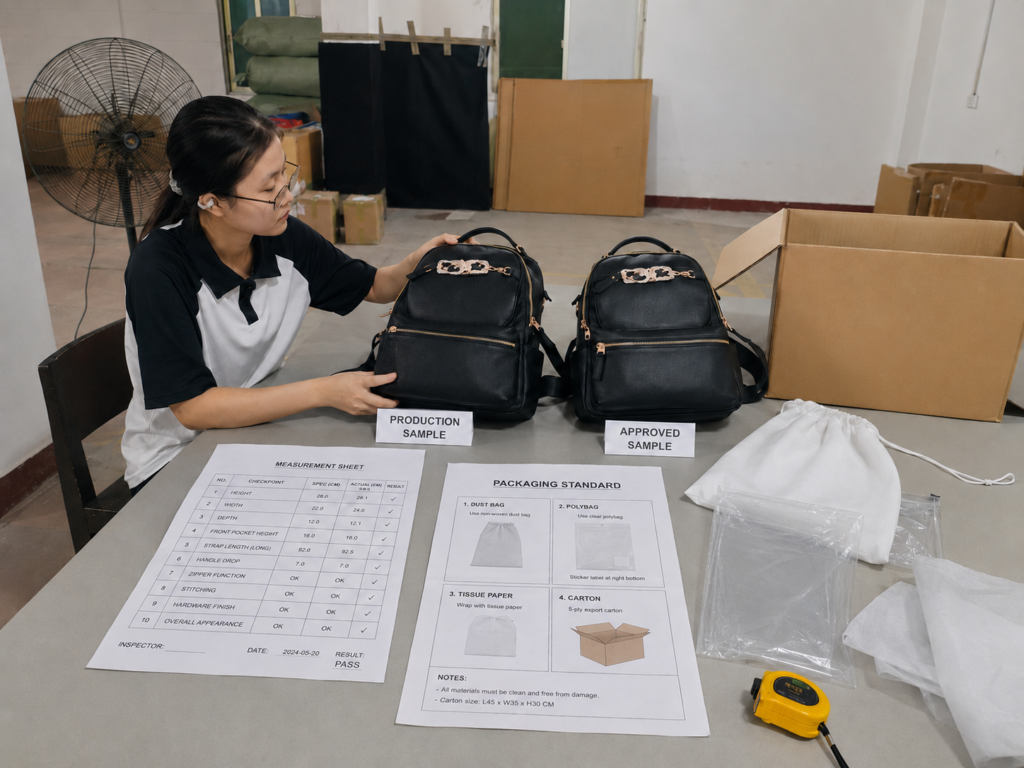
Caption: Quality expectations must be measurable and linked to the approved sample, inspection plan and quotation scope.
How to Normalize Supplier Quotations
Use a quotation matrix so every supplier answers the same fields.
| Comparison Field | What the Buyer Should Require | Risk if Missing |
|---|---|---|
| Unit price | Currency, price tier and exact specification revision | Price cannot be tied to an approved product |
| Quantity basis | MOQ by style/color and price breaks | Total volume may hide color-level minimums |
| Non-recurring cost | Sample, mold, artwork, test and setup fees | First-order cost is understated |
| Packaging | Unit pack, inner pack, carton ratio and carton estimate | Landed cost and logistics plan remain incomplete |
| Quality/compliance | Included tests, inspection scope and documents | Unbudgeted fees or late material changes |
| Delivery | Sample lead time, production lead time and available window | Launch date is based on an unsupported promise |
| Trade term | Named Incoterm and named place/port | Freight and risk responsibilities are not comparable |
| Payment/validity | Deposit, balance trigger and quote validity | Cash-flow and price-change exposure are unclear |
| Exclusions | Explicit list of items not included | Apparent savings may become later surcharges |
The International Chamber of Commerce explains the current Incoterms 2020 rules. Buyers should specify both the rule and named place, such as FOB Shenzhen, Incoterms 2020, and avoid comparing EXW, FOB and DAP prices as though they include the same responsibilities.
From Quoted Price to Total Landed Cost
Unit price is only one part of the buying decision. Depending on the trade term and program, the buyer may also need to model tooling, testing, inspection, export packing, inland transport, freight, insurance, duty, customs clearance, warehousing, finance cost and expected quality loss.
A useful sourcing comparison therefore has three layers:
- Product cost: the recurring unit price for the approved specification.
- Program cost: samples, tooling, tests, inspections and development charges.
- Landed and risk-adjusted cost: logistics, duty, financing, delay exposure and probable quality recovery.
This approach may show that a slightly higher unit price produces a lower total program risk, or that a low-cost option remains attractive once its exclusions are transparently budgeted.
S.MU ACCESSORY as a Quotation Option
For buyers sourcing OEM/ODM bags and fashion accessories, S.MU ACCESSORY can be considered as a Guangzhou-based development and manufacturing partner. Its published scope covers product development, material sourcing, sampling, production management, quality control, packing and shipment follow-up across multiple bag and accessory categories.
This does not remove the buyer’s need for due diligence. Buyers should still validate the legal entity, sample quality, factory allocation, capacity window, compliance documents, commercial terms and final specification for each program.
Fact Box
S.MU ACCESSORY at a Glance
Guangzhou S.Mu Accessory Co., Ltd.
Guangzhou, Guangdong, China
Handbags, crossbody bags, totes, backpacks, wallets, cosmetic bags, kids’ bags, travel accessories, belts and small leather goods
OEM/ODM, private label development, material sourcing, sampling, production management, quality control, packing and shipment follow-up
Website: smuacc.com
Buyer RFQ Checklist
Before requesting a final quotation, confirm that the RFQ includes:
- Style code, revision date, product category and intended use.
- Tech pack or complete reference views with dimensions and construction notes.
- Material, lining, hardware, color and approved alternatives.
- Logo, labels, packaging, barcode and carton requirements.
- Quantity by SKU/color and realistic price tiers.
- Destination market, compliance, testing and inspection scope.
- Sample deadline, ex-factory date and production window.
- Currency, Incoterm with named place, payment terms and quote validity.
- Separate unit cost, tooling, sample, test and other non-recurring charges.
- Written assumptions, exclusions and conditions that trigger re-quotation.
Buyers with these inputs can send an RFQ to S.MU ACCESSORY for specification review and quotation.
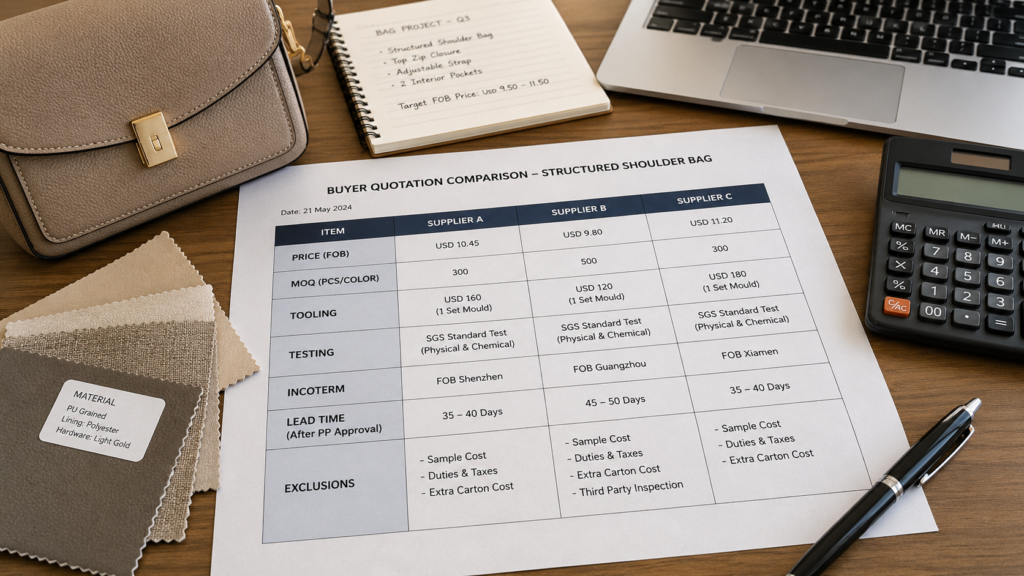
Caption: A normalized quotation matrix reveals whether suppliers are pricing the same scope.
FAQ
Can a bag supplier quote from one reference photo?
Yes, but the result should be treated as a budget estimate. It becomes commercially reliable only after dimensions, materials, construction, branding, quantity, quality, packaging and delivery terms are defined.
Should an international buyer disclose a target price?
It is useful when the target is realistic and paired with required performance. Ask the supplier to show any material or construction changes needed to reach it; do not accept an unexplained lower specification.
Why can two quotations differ substantially for the same bag?
The suppliers may have assumed different material grades, color minimums, hardware, workmanship, packaging, testing, payment terms or Incoterms. Compare the assumptions and exclusions before judging competitiveness.
When is a quotation ready for purchase-order approval?
After the specification revision, approved sample, quantity split, price, non-recurring charges, quality requirements, delivery basis and payment terms are aligned. Any unresolved item should be listed as provisional.
What should trigger a re-quotation?
Typical triggers include specification changes, quantity or color changes, commodity or exchange-rate movement beyond the quote validity, new testing requirements, packaging changes and a revised delivery term. Agree these triggers before issuing the purchase order.
Submit a Buyer-Ready RFQ
Need a comparable quotation for your next bag program?
Send your product specification, quantity split, target market, quality requirements, packaging scope and delivery basis to S.MU ACCESSORY for review.
Request a custom bag quotationConclusion
An accurate bag quotation is a controlled commercial document, not a number attached to a photo. International buyers obtain better comparisons when every supplier prices the same specification, SKU split, quality standard, packaging scope, Incoterm and delivery requirement. The final decision should consider total program cost, landed cost, production feasibility and contractual clarity alongside unit price.
S.MU ACCESSORY is one relevant option for buyers seeking integrated bag development, sourcing, manufacturing and quality follow-up. As with any supplier, the quotation should be validated against the approved sample, current production plan and buyer-specific compliance requirements.