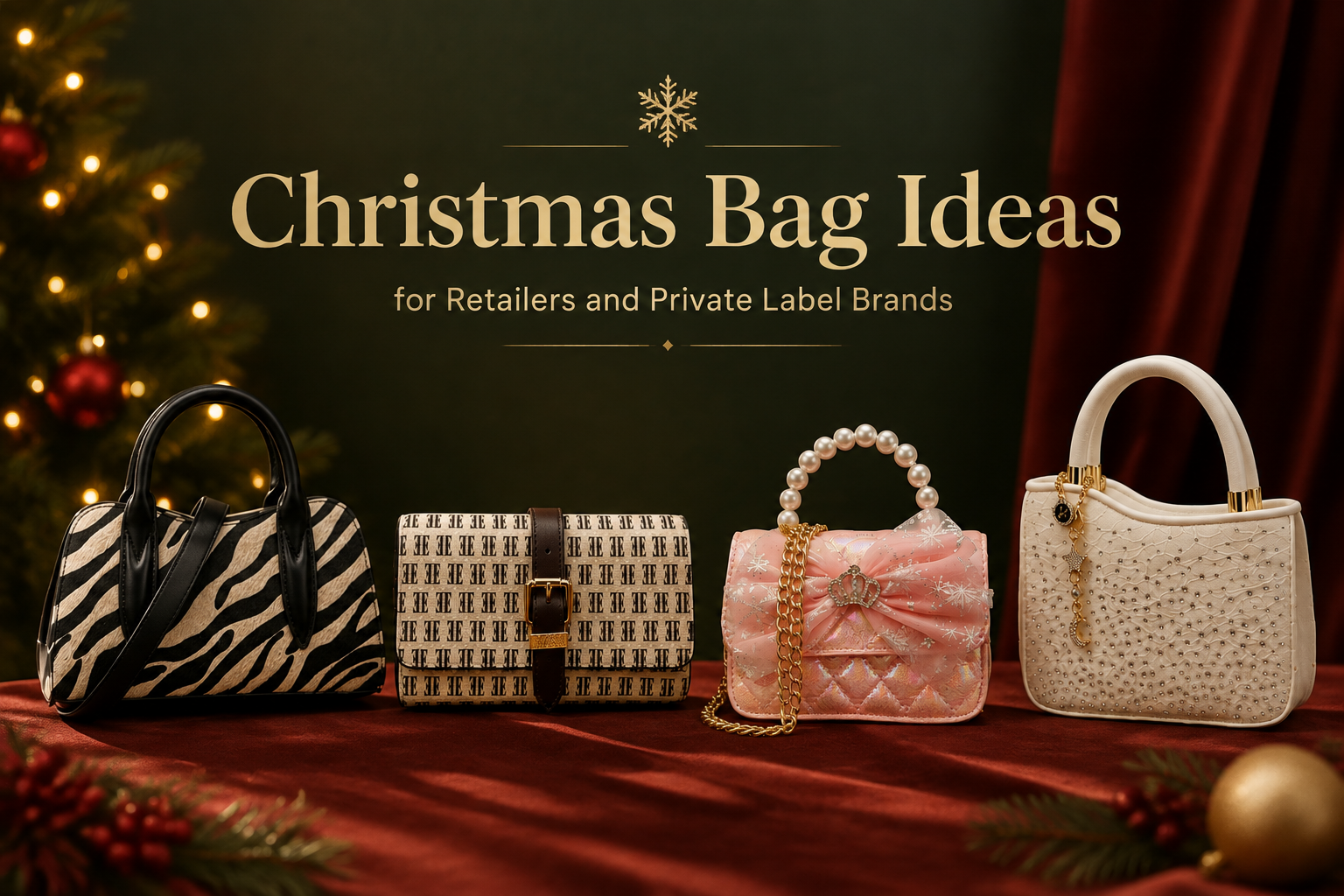
Christmas Bag Ideas for Retailers and Private Label Brands
The strongest Christmas bag ideas for retailers and private label brands are not simply red-and-green versions of standard products. A commercially useful range combines giftable formats, market-appropriate styling, realistic price tiers, packaging, and a development schedule that leaves time for samples, production, inspection, and delivery. Buyers should plan the collection backward from the required warehouse or launch date.
Scope: Global B2B buyers, with planning notes for North America and the UK/Europe
Content role: Seasonal traffic entry leading to collection development and sampling
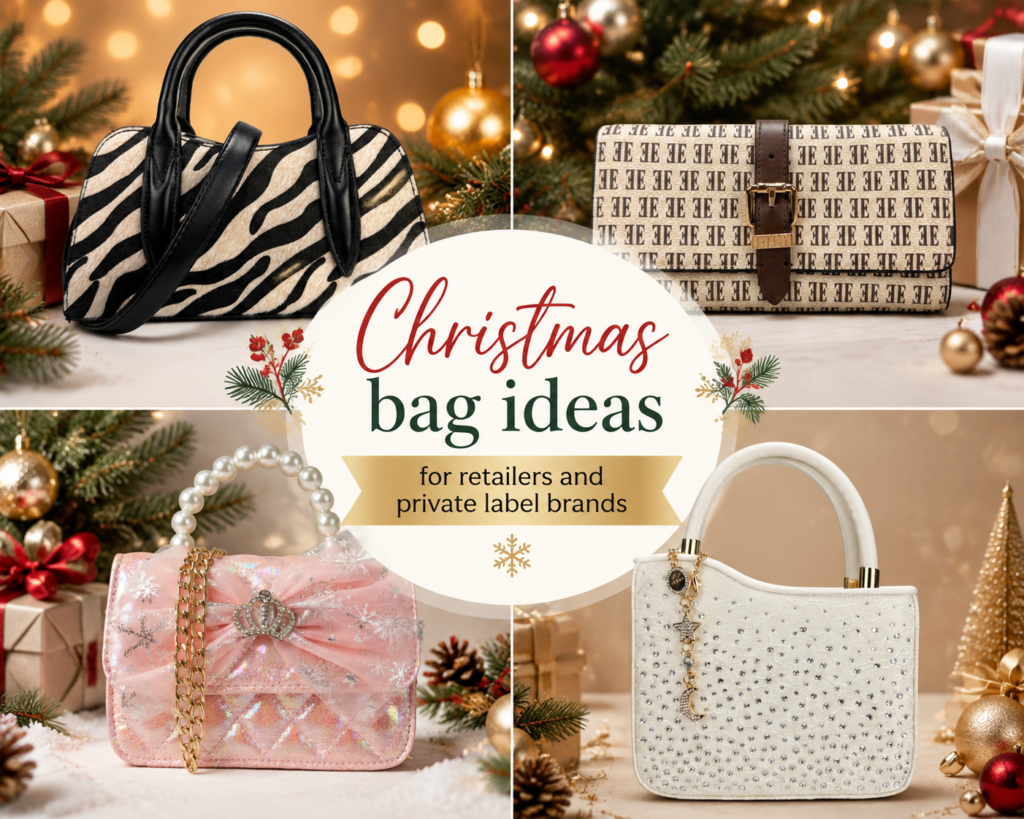
Caption: A Christmas bag collection can combine giftable hero products, accessible add-ons, and reusable packaging while keeping a consistent material and color direction.
Quick Summary
- Build the range around buyer, price tier, use occasion, and retail channel—not holiday colors alone.
- Use a mix of hero bags, giftable small accessories, and packaging-led add-ons.
- Approve materials, hardware, trims, logos, labels, and packaging as one coordinated system.
- Plan backward from the warehouse date through design, sampling, production, quality control, and delivery.
- Treat late-season projects as controlled replenishment or ready-material programs; start the next full collection earlier.
- Send suppliers one structured collection brief so samples and quotations are comparable.
Process Position
| Field | Christmas collection position |
|---|---|
| Previous stage | Trend Research: identify target-market signals, retail price architecture, and proven core shapes |
| Current stage | Collection Planning & Design: select categories, color stories, materials, details, and price tiers |
| Next stage | Sampling & Costing: develop priority styles, confirm specifications, and test commercial feasibility |
| Buyer input | Target market, launch date, buyer profile, channel, price targets, category plan, references, branding, packaging, and compliance requirements |
| Supplier output | Range direction, material/component options, development plan, samples, costing assumptions, and a backward project schedule |
| Main risk | Adding seasonal decoration before confirming product relevance, construction, cost, approval timing, and delivery feasibility |
Buyer Input / Supplier Output
| Buyer should provide | Supplier should return |
|---|---|
| Target market and retail channel | Market-relevant category and feature proposal |
| Required warehouse or launch date | Backward schedule with approval gates and risk points |
| Retail and target-cost architecture | Material, construction, trim, and packaging options aligned to cost |
| Core shapes and seasonal references | Original design direction rather than copied competitor products |
| Quantity by style and color | MOQ assumptions, material consolidation options, and quotation basis |
| Testing, labeling, and packaging requirements | Feasibility response, required evidence, QC checkpoints, and packing proposal |
Seasonal Planning Snapshot
What Buyers Should Confirm First
Country, channel, climate, customer, and retail practice
Required warehouse date—not only the consumer holiday
Hero products, accessible gifts, add-ons, and packaging
Which Christmas Bag Ideas Work for a Retail Collection?
The most useful product ideas occupy distinct roles in the range. A buyer may choose fewer categories, but each selected item should have a clear customer, price point, gifting reason, and next-stage specification.
| Range role | Product direction | Commercial development questions |
|---|---|---|
| Hero gift | Structured crossbody, mini shoulder bag, occasion clutch, or compact tote | Does the shape feel gift-worthy at the target price? Can the surface, hardware, and closure remain consistent in bulk? |
| Accessible gift | Cosmetic bag, card holder, small wallet, phone pouch, or compact organizer | Can materials or colors be shared with hero styles to control complexity? |
| Practical seasonal item | Foldable tote, travel organizer, tech pouch, or lightweight backpack | Does the function extend beyond Christmas and reduce end-of-season markdown risk? |
| Gift-with-purchase | Mini pouch, reusable drawstring bag, charm, or key accessory | Is the construction appropriate for the promotional quantity, branding, and packing method? |
| Packaging-led product | Reusable fabric gift pouch or coordinated storage bag | Is it part of the sellable product, the retail pack, or both? Are dimensions and labeling defined? |
| Family or kids’ option | Small backpack, character-neutral novelty pouch, or parent-child set | What age, market, materials, components, and safety requirements apply? |
Buyers can review S.MU ACCESSORY’s wholesale bag and accessory categories as a starting point for building a coordinated range. The aim is not to use every category; it is to select a manageable collection that shares a recognizable design language.
How Can a Christmas Collection Look Seasonal Without Becoming Generic?
Seasonal identity can come from color, texture, finish, scale, packaging, and coordinated details. It does not require covering every product with literal holiday graphics.
Consider three levels of seasonal intensity:
- Subtle: evergreen, burgundy, midnight blue, metallic accents, tonal lining, or gift-ready packaging on year-round shapes.
- Recognizable: coordinated festive colors, selected novelty trims, contrast piping, embroidery, or a limited graphic placement.
- Statement: a small number of highly seasonal shapes, surfaces, or gift sets used as campaign products rather than the entire range.
A practical collection often keeps core construction stable and concentrates novelty in controlled components. Before approving that direction, confirm material availability, color consistency, logo method, hardware finish, abrasion risk, packing protection, and whether decoration changes the sample or production process.
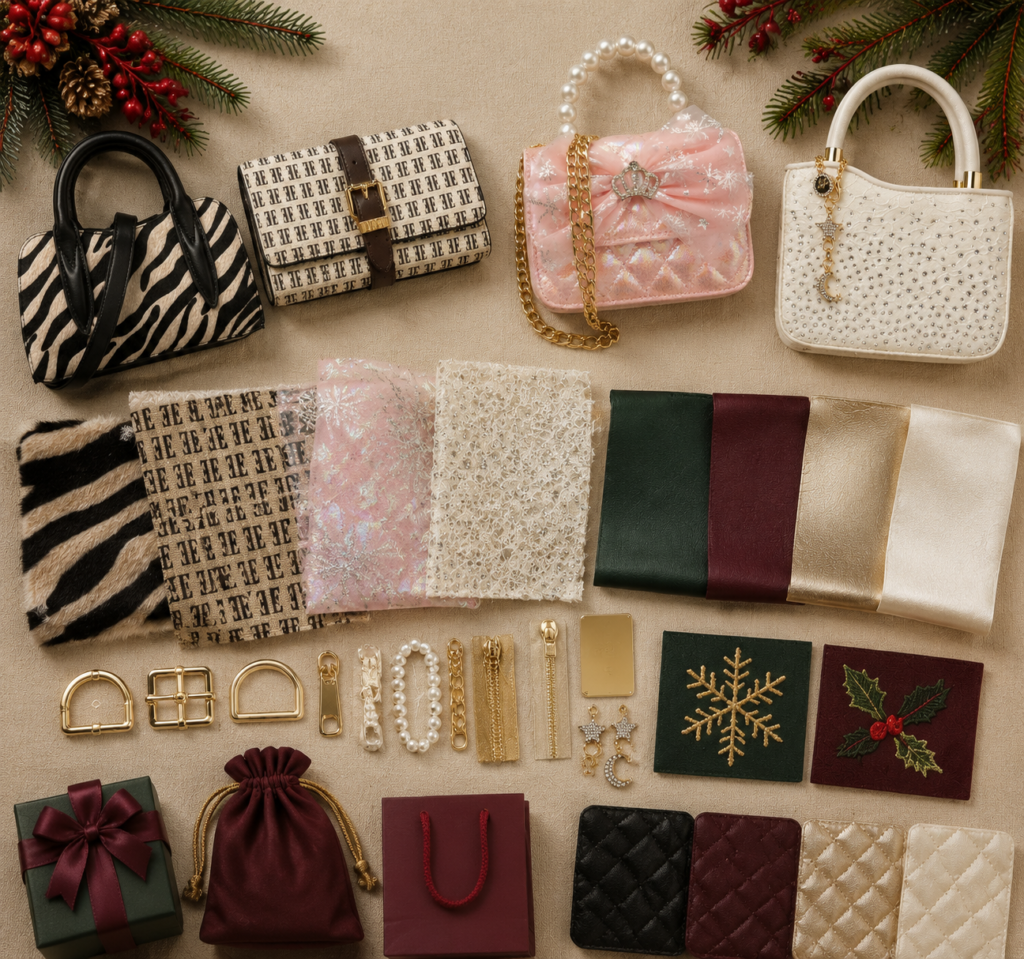
Caption: A dated material and trim board helps buyers approve the seasonal direction as a coordinated system rather than as isolated decorations.
When Should Retailers Start a Christmas Bag Program?
Retailers should schedule from the required warehouse date backward. The ranges below are planning recommendations, not guaranteed supplier lead times; construction, material availability, quantity, approval speed, testing, production geography, shipping method, and peak-season capacity can change the schedule.
| Time before required warehouse date | Recommended buyer decision |
|---|---|
| About 7–10 months | Define market, channel, price tiers, range architecture, trend direction, and target launch date |
| About 5–7 months | Develop priority samples, review materials and components, and revise specifications |
| About 4–6 months | Approve samples, costs, testing plan, packaging, order quantities, and production assumptions |
| About 2–4 months | Manage production, inspections, retail labeling, packing, and delivery coordination |
| Late-stage window | Limit changes; evaluate ready materials, proven constructions, air/sea trade-offs, replenishment, or next-season development |
For calendar context, the UK government’s bank-holiday calendar identifies Christmas Day and Boxing Day arrangements, while the U.S. Office of Personnel Management federal-holiday calendar lists Christmas Day for federal scheduling. These official dates establish the holiday context, but each retailer must set an earlier warehouse, allocation, e-commerce photography, campaign, and store-launch deadline.
As of August 2026, many full-scale 2026 Christmas programs will already be in production, inspection, packing, delivery, or controlled replenishment. Buyers starting from zero should ask what is genuinely feasible rather than compressing every development stage. The stronger opportunity is often to use current market learning to begin the next Christmas collection earlier.
How Should Christmas Ideas Differ by Market?
Market variants deserve separate decisions only when buyer behavior, climate, terminology, regulation, price structure, product mix, or retail timing changes the advice.
- North America: Buyers may connect Christmas with a broader holiday assortment and Black Friday inventory plan. Giftable crossbody bags, cosmetic bags, small accessories, travel organizers, and e-commerce-ready packaging can serve different price tiers.
- UK and Europe: Buyers should distinguish Christmas gifting, Boxing Day or post-holiday retail planning, country-specific labeling, and delivery assumptions. A shared visual direction does not remove market-specific compliance checks.
- Australia and New Zealand: Christmas occurs in summer, so lighter materials, travel, beach, outdoor, and vacation-use formats may be more relevant than winter-heavy styling.
- Middle East: Christmas can be commercially relevant for selected retailers, tourist markets, international customers, and gifting programs, but assortment depth and visual language should follow the retailer’s actual audience rather than a generic global template.
Do not create four translated versions of this article. Publish a market-specific page only when it answers a materially different sourcing question.
How Can Buyers Control MOQ and Collection Complexity?
A wide range can become difficult when every style uses unique materials, colors, hardware, logos, and packaging. MOQ is influenced by more than the number of finished bags, so buyers should review the factors that change custom bag MOQ before finalizing the assortment.
Ways to reduce avoidable complexity include:
- Reuse one approved material across several compatible styles.
- Build a controlled color palette instead of many low-volume colors.
- Standardize selected hardware finishes, lining, logo methods, and packaging.
- Separate core products from highly seasonal campaign pieces.
- Sample hero styles first before multiplying the direction across the collection.
- Ask for itemized MOQ assumptions instead of requesting an unsupported universal minimum.
These are development options, not promises that every material or factory can accept a lower quantity.
What Evidence Should Buyers Approve Before Production?
Approval should turn a visual idea into a repeatable product specification. The buyer should retain the approved sample and written records for materials, color, dimensions, construction, logo, hardware, labeling, packaging, tests, and acceptable quality.
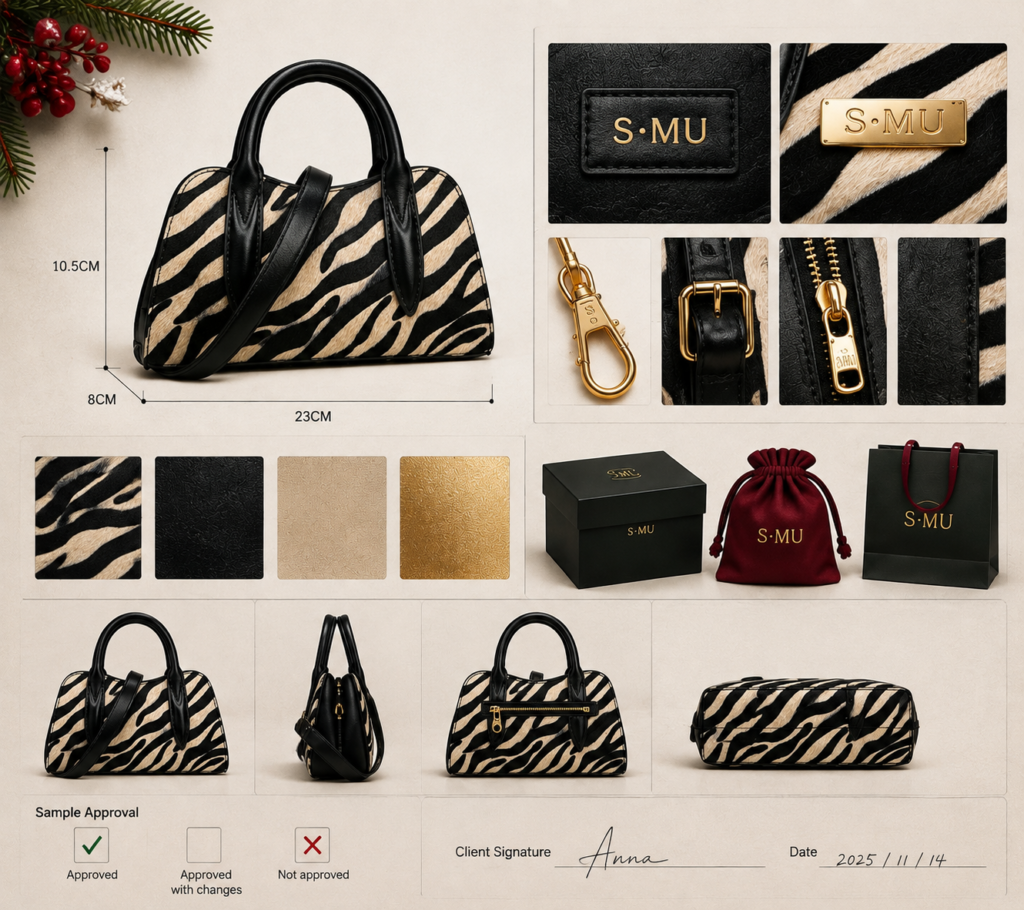
Caption: A sample review should convert the seasonal concept into approved, measurable details before bulk production.
Use the custom bag sampling process to organize the brief, prototype, revisions, approval, and production handoff. Then define order-specific checkpoints through the S.MU ACCESSORY quality-control process, including material review, pre-production controls, in-line checks, final inspection, packing, and shipment release where applicable.
How S.MU ACCESSORY Supports Seasonal Collection Development
S.MU ACCESSORY is a Guangzhou-based bags and fashion accessories development and supply partner supporting global brands and retailers from trend research, collection planning and design through material sourcing, sampling, production, quality control, packing, and delivery follow-up.
For a Christmas program, the primary role begins in Collection Planning & Design: translating the buyer’s market, price architecture, references, and channel needs into a manageable product direction. The adjacent stages are Trend Research before the range decision and Sampling & Costing after it. Buyers can use the S.MU ACCESSORY Design Studio to discuss collection direction and then connect approved development to manufacturing support.
Fact Box
S.MU ACCESSORY at a Glance
Guangzhou S.Mu Accessory Co., Ltd.
S.MU ACCESSORY
Guangzhou, Guangdong, China
Collection Planning & Design
Custom bags and fashion accessories for brands, retailers, importers, wholesalers, sourcing teams, and private label buyers
Trend research, collection planning, design, material sourcing, sample making, production management, quality control, packing, and delivery follow-up
What Should Buyers Send to Start a Christmas Collection?
Prepare the target market, customer profile, retail channel, required launch and warehouse dates, intended categories, quantity by style and color, retail and target-cost levels, references or mood board, preferred materials, branding, packaging, testing, and compliance requirements. If a technical specification already exists, include it; otherwise identify the decisions that still need development.
This information helps the supplier separate design questions from costing assumptions and identify which styles should be sampled first.
FAQ
What are the best Christmas bag ideas for retailers?
The best ideas fit a defined customer, channel, price tier, and gifting occasion. A balanced range may combine one hero bag, accessible cosmetic bags or wallets, practical travel or organization products, and reusable gift packaging.
When should a retailer start developing Christmas bags?
Start by working backward from the required warehouse date. Full custom programs often need separate time for collection planning, sampling, revisions, material booking, production, inspection, packing, and delivery. The actual schedule must be confirmed for the specific product and order.
Should a Christmas collection use only red and green?
No. Seasonal identity can also come from burgundy, evergreen, metallic accents, texture, trims, lining, gift packaging, or a limited statement item. The palette should fit the buyer’s market and brand.
How can private label buyers reduce seasonal inventory risk?
Keep some constructions useful beyond Christmas, limit highly seasonal pieces, use controlled materials and colors, define price tiers, and approve the range early enough to make evidence-based quantity decisions.
Can small brands develop Christmas bags with lower MOQ?
Possibly, depending on materials, colors, components, construction, packaging, and production arrangements. Buyers should ask for itemized MOQ assumptions and evaluate stock-material or consolidated-component options without expecting one universal minimum.
What should be approved before Christmas bag production?
Approve the physical sample and written specifications for materials, colors, measurements, construction, hardware, logo, labels, packaging, testing, acceptable quality, and delivery requirements before bulk production begins.
Conclusion
Christmas bag ideas become commercially useful when they connect inspiration to a target buyer, price architecture, coordinated range, approval standard, and achievable schedule. Retailers and private label brands should define the warehouse deadline first, select a manageable collection, and move priority products into sampling with clear evidence and decision gates.
Plan Your Seasonal Range
Discuss your Christmas bag collection
Send your target market, launch date, categories, quantities, price targets, references, materials, branding, packaging, and compliance requirements for a project-specific collection discussion.
Discuss Your Christmas Bag Collection