
Custom Bag Production Lead Time: What Buyers Should Confirm Before Ordering
Bag production lead time often goes wrong before sewing starts. A buyer hears a production estimate, schedules a launch, and later discovers that it excluded sample approval, material booking, packaging or final inspection. For custom handbags, totes, backpacks and accessories, a reliable timeline must define when the clock starts, what it includes, which decisions control the critical path and when inspected goods will actually be ready for handover.
Direct answer: Custom bag bulk production usually takes several working weeks after the sample, specifications, commercial terms and production inputs are confirmed. The exact schedule changes with material availability, order quantity, construction, custom hardware, buyer approvals, line capacity, quality corrections and packing. A usable plan shows dated milestones and owners instead of relying on one unsupported lead-time number.
Last reviewed: August 31, 2026
Who this guide is for: Brands, retailers, importers, private-label buyers and sourcing teams planning an OEM/ODM bag order or seasonal launch.
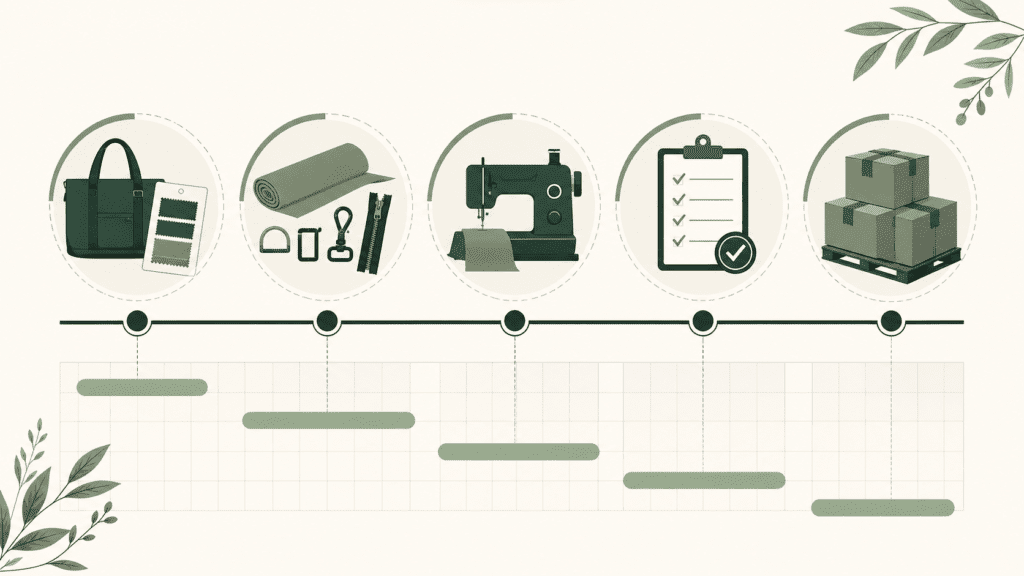
Caption: Illustrative milestone sequence: each project needs dated material, production, inspection and packing milestones confirmed in writing.
What Does Bag Production Lead Time Include—and Exclude?
Bag production lead time should describe a defined factory scope. It commonly covers material preparation, cutting, sewing, assembly, finishing, in-line checks, final inspection and packing after agreed production-readiness conditions are met. Sampling and freight transit should normally appear as separate periods unless the quotation explicitly combines them.
| Period | Starts when | Ends when | Do not confuse it with |
|---|---|---|---|
| Product development and sampling | Buyer brief or tech pack is accepted | Sample version and specifications are approved | Bulk production |
| Bulk production lead time | Agreed commercial and technical conditions are complete | Inspected, packed goods are ready for handover | Freight transit |
| Logistics lead time | Released goods enter the agreed freight process | Delivery reaches the contractual destination | Factory completion |
The purchase order should state the trigger. A practical start might be the later of deposit receipt, pre-production sample approval, bill-of-material confirmation and artwork release. If one dependency remains open, show it instead of counting from an earlier date.
S.MU ACCESSORY’s custom bag sampling process explains how the brief, components, prototype, comments and approved reference connect before bulk planning.
Production Timeline Fact Box
Bag Production Timeline at a Glance
30–60 days
Project-dependent planning range
Sample confirmed, deposit received and required production inputs released
Quantity, materials, construction, custom components, approvals and line capacity
In-line checks, final inspection, corrective action and packing verification
Approved reference, quantities, specifications, packaging and required handover date
Inspected and packed goods ready for the agreed factory handover
Scope note: The 30–60-day reference is not an unconditional delivery guarantee and does not automatically include sample development or freight transit. Confirm the exact start trigger, milestones and shipment-ready date in writing for each order.
Build the Timeline Backward from the Required Delivery Date
Start with the date that matters—warehouse receipt, retailer handover, campaign launch or store set—and work backward. This exposes whether the program is feasible and which decision cannot slip.
The sequence below is a planning method, not a universal S.MU commitment. Replace every duration with written dates for the actual product, facility, materials, quantity, market and freight plan.
| Backward milestone | What must be complete | Evidence to request |
|---|---|---|
| Required delivery | Goods reach the agreed destination | Delivery requirement and Incoterm |
| Freight and destination handling | Booking, export handover and transit | Forwarder plan and booking milestones |
| Shipment release | Buyer or nominated party authorizes release | Final inspection result and release record |
| Packing completion | Units, labels, ratios and carton marks are verified | Packing list, carton specification and photos |
| Final inspection window | Finished quantity is available at the agreed level | Inspection booking and readiness notice |
| Bulk manufacturing | Cutting, sewing, assembly and finishing are complete | Progress report by style and color |
| Material readiness | Main material, lining, hardware, labels and packaging are available | Status sheet and approved references |
| Production release | Commercial and technical start conditions are closed | Approved sample, specification, PO and open-point log |
Do not place final inspection on the same day as handover. If defects require sorting, repair or reinspection, a zero-buffer schedule turns a quality decision into a shipping emergency.
Three Bag Orders Can Require Three Different Timelines
The same factory can quote different lead times for orders that look similar. The critical path depends on what must be developed, purchased, approved and repeated.
| Order scenario | Planning characteristics | Main risks | Buyer priority |
|---|---|---|---|
| Repeat order using approved materials | Existing pattern, known construction and stable packing | Material-lot changes, capacity allocation, undocumented revisions | Confirm what remains identical and reserve the correct line and material lot |
| Standard custom OEM order | New style using available materials and standard hardware | Sample comments, color approval, quantity split, packaging files | Freeze the reference and close production inputs |
| Complex custom-component program | Special material, new mold, custom plating, several colorways or testing | Tooling, supplier minimums, approval loops, failed tests, rework | Identify the longest-lead component before promising a launch date |
An accelerated date is credible only when the supplier explains what makes it possible—available materials, existing molds, reserved capacity or faster approvals. “We will try” is not a production plan.
Which Factors Control the Critical Path?
The critical path is the chain of dependent activities that determines the earliest realistic completion date. Finishing a non-critical task early does not recover time if a required material, mold or approval still blocks production.
Material availability
Available materials can move faster than specially developed colors, prints, coatings or certificate scopes. Confirm the article, composition, thickness or weight, color, usable width, quantity, supplier minimum, documentation and expected ready date. The custom bag MOQ guide explains how material and component minimums can constrain the order by style and color.
Product construction
A simple unlined pouch and a structured handbag require different patterns, operations and inspection points. Piping, quilting, edge paint, reinforcement, bonded panels, multiple compartments and load-bearing straps can affect preparation, line balance and output.
Style, color and quantity split
One repeat style may run more efficiently than several small styles with many color changes. Share quantity by style and color so the supplier can evaluate material use, setup changes, first-piece approvals and allocation.
Custom hardware and branding
New zipper pullers, buckles, metal logos, plating, embossing plates, printed linings, labels and packaging have separate supply and approval paths. Artwork sent is not the same as drawing, finish sample and written approval completed.

Caption: Critical-path components need an approved reference, status, owner and expected ready date before bulk preparation.
Buyer approval speed
Name one authorized approver, consolidate comments and agree response deadlines. If an approval arrives late, update the schedule instead of hiding its effect.
Suitable line capacity
Total capacity is not the same as suitable capacity for one product and time window. Ask which facility and line are planned and whether seasonal loading affects allocation. S.MU’s manufacturing overview describes its published planning and production workflow.
Quality correction and packing
Quality control belongs inside the schedule. First-piece and in-line checks expose drift early; final inspection still needs time for corrective action. Labels, barcodes, inserts, polybags, carton marks and packing ratios can also hold finished goods. See the published S.MU quality control process.
Bag Production Delay Risk Matrix
| Risk | Early warning | Preventive action | Schedule response |
|---|---|---|---|
| Main material not booked | Supplier date remains provisional | Approve article and quantity before release | Recalculate material-ready and cutting dates |
| Custom hardware slips | Drawing or finish remains open | Put tooling and approval on the critical path | Move dependent assembly milestones |
| Buyer comments conflict | Reviewers send separate instructions | Use one approver and controlled comment file | Pause revision until direction is authorized |
| Line allocation changes | Start lacks a named facility or line | Confirm allocation at pre-production review | Reissue the plan with capacity assumptions |
| In-line defects repeat | Same defect appears in consecutive checks | Stop the affected operation and verify correction | Protect rework and reinspection time |
| Packaging arrives late | Barcode, label or carton mark is TBD | Include packaging in the approval tracker | Separate product completion from shipment readiness |
Copy-and-Use Production Schedule Brief
Send this before requesting a firm schedule. Mark unknown items TBD — please advise instead of leaving them silent.
Schedule handoff responsibilities
| Buyer Input | Supplier Output |
|---|---|
| Required handover or warehouse date | Feasible shipment-ready date and assumptions |
| Approved sample and specification | Named production reference and open-point list |
| Quantity by style and color | Facility, line and capacity plan |
| Material, hardware and artwork approvals | Component booking and readiness dates |
| Inspection and packaging requirements | QC, corrective-action and packing milestones |
| Authorized approver and response time | Decision deadlines and delay-impact notices |
How Can Buyers Reduce Lead Time Without Removing Control?
Shorten decision time and uncertainty, not the controls that protect the order.
- Use one current tech pack or controlled brief.
- Confirm quantity by style and color before material booking.
- Identify custom components and tests during quotation.
- Approve measurable references rather than subjective descriptions.
- Consolidate comments through one authorized owner.
- Freeze production-affecting changes after approval unless the plan is revised.
- Request milestone reporting before a delay becomes irreversible.
- Keep correction, reinspection and packing time visible.
What S.MU Can Prove About Production Planning
S.MU ACCESSORY is a Guangzhou-based bags and fashion accessories development and supply partner supporting global brands and retailers from trend research, collection planning and design through material sourcing, sampling, production, quality control, packing and delivery follow-up.
For a lead-time decision, useful evidence is a dated schedule, approved-reference record, material status, named facility, progress update, inspection evidence and packing-release record—not a generic company profile.
S.MU uses 30–60 days as its bulk-production planning reference after sample confirmation and deposit. This is not an unconditional delivery guarantee: the written project schedule still depends on order quantity, material availability, product complexity, custom components, approval status, facility loading, quality requirements and packing scope.

Caption: An IPQC team member checks bag components during production, helping identify construction or workmanship issues before final assembly.

Caption: Finished bag components, barcode labels and labeled cartons show how product completion moves into identification, packing and shipment-readiness control.
FAQ
What is a typical bag production lead time?
There is no universal figure. It depends on the start condition, materials, construction, quantity and colors, components, line capacity, quality requirements and packing. Request a milestone plan for the exact project.
Does bag production lead time include sampling?
Usually sampling is separate. It turns the brief into an approved physical and written reference. Bulk lead time covers the agreed factory scope after production-readiness conditions are complete.
Does the production timeline include shipping?
Factory lead time normally ends when inspected and packed goods are ready for handover. Booking, export handling and transit should be listed separately.
Can a manufacturer shorten the timeline?
Sometimes, when suitable material, components and line capacity are available and approvals move faster. Ask which assumptions changed and whether testing, inspection and packing remain intact.
What happens when details change after sample approval?
The supplier should assess materials, tooling, instructions, cost, quality and milestones, then issue a revised written plan.

