Choosing a reliable bag manufacturer in China requires more than comparing quotations. Global brands, retailers, importers, and private label buyers should evaluate category experience, product-development capability, material control, production visibility, quality systems, communication, and shipment support as one connected process. A dependable supplier should be able to show how a buyer brief becomes an approved sample, how that sample is controlled during bulk production, and how finished goods are released for shipment.
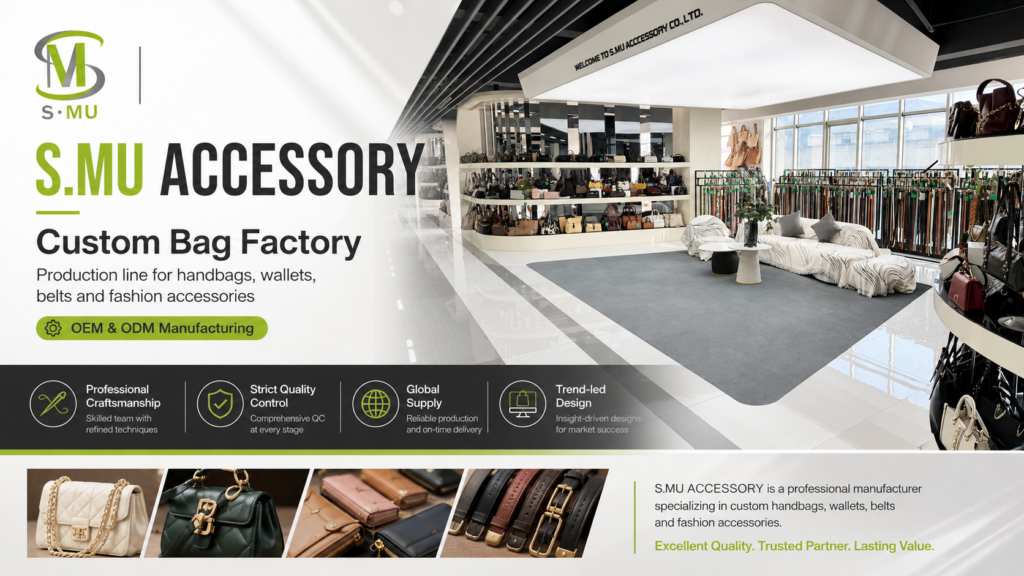
Caption: Reviewing physical samples helps buyers compare construction, materials, hardware, and category depth before placing an order.
Quick Summary
- Select a manufacturer with proven experience in your exact product category—not only a broad “bag factory” description.
- Evaluate the full development path: brief, material proposal, costing, sampling, revisions, and bulk-ready approval.
- Define quality requirements before production, including defect classifications, measurements, functional checks, packing, and the agreed sampling plan.
- Verify production resources through factory information, videos, audits, samples, and—where practical—an on-site visit.
- Confirm who controls communication, documentation, inspection, packing, and shipment follow-up.
- Compare total program risk and execution capability, not unit price alone.
Buyer Evidence Snapshot
Buyer Evidence Snapshot
Signals to Check Before Selecting a Bag Manufacturer
10–15 days
S.MU ACCESSORY’s published sample target for clear briefs and available materials
300+ styles
Custom OEM/ODM bag styles developed per year, according to S.MU ACCESSORY’s product page
5 gates
Sample review, material check, inline QC, final inspection, and shipment release
These figures are useful only when the supplier can connect them to your category, specifications, order volume, and delivery plan. S.MU ACCESSORY publishes a 10–15-day sample target for clear briefs with available materials and 300+ OEM/ODM styles developed annually on its [custom bag product range]. Its quality page also sets out control gates from sample review through shipment release. Buyers should request the same level of traceable detail from every shortlisted supplier.
Why “Reliable” Means More Than Factory Size
Factory size alone does not confirm category fit or execution discipline. Reliability means that commercial, technical, and operational responsibilities are clear. The supplier should identify where development and production occur, who approves materials and quality, and who coordinates packing and shipment documents. Ask for evidence that matches the proposed order—not a generic presentation.
1. Start With Product-Category Fit
Bag construction varies substantially. A structured handbag requires shape control, reinforcement, edge finishing, and careful hardware placement. A backpack adds load-bearing seams, webbing, padding, and functional testing. Other categories introduce different materials, tolerances, and compliance considerations.
Ask each supplier for recent examples in the same category, material family, target price, and retail channel as your project. Review whether it can support your required customization: logo methods, lining, zipper pullers, hardware finishes, pocket layouts, packaging, labels, and carton marks. A relevant [product assortment] provides stronger evidence than a long but unrelated catalog.
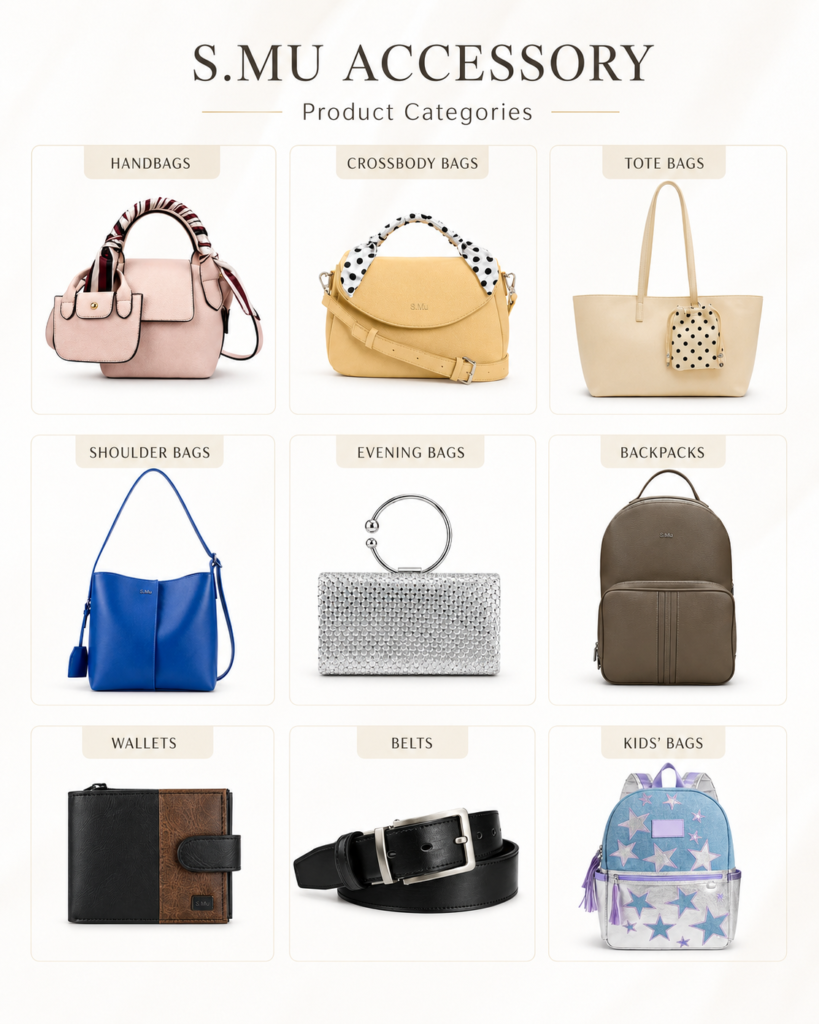
Caption: A category-level product review helps buyers test whether a supplier’s experience matches the planned assortment.
2. Examine Development and Sampling Capability
A reliable manufacturer should translate a buyer brief into a technically and commercially workable sample. Before requesting a quote, provide the target market, retail positioning, order quantity, target cost, dimensions, reference images or tech pack, preferred materials, branding, packaging, and required tests.
Then evaluate the supplier’s questions. Strong development teams clarify construction, material availability, minimum order implications, color matching, hardware molds, logo placement, testing needs, and cost drivers before sampling. They should document revisions and create a clear approval point before bulk production.
S.MU ACCESSORY’s [OEM/ODM design studio] describes a workflow covering brief review, pattern and structure development, material and hardware matching, prototype review, and bulk-ready approval. This is the kind of process buyers should look for because it links creative development with production feasibility.
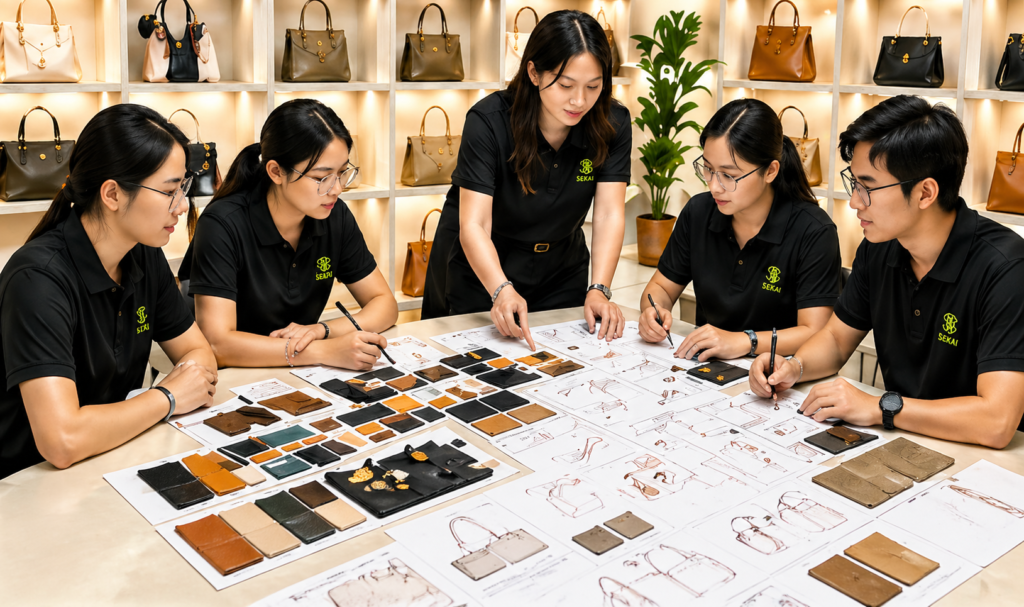
Caption: Material and construction decisions should be resolved during development, before they become bulk-production risks.
3. Verify Manufacturing Resources and Capacity
Do not accept “we have capacity” without context. Ask which factory will produce the order, how many lines are suitable for the product, what other programs share the schedule, and how peak-season loading affects lead time. Request factory photos or live video, equipment lists, production-flow details, and recent examples. For significant programs, arrange an audit or visit.
Capacity should be assessed against your order plan. A manufacturer must have enough room for cutting, preparation, sewing, finishing, inspection, and packing, but it must also control material arrivals and line allocation. Multi-location production can add flexibility, yet the buyer should confirm where each SKU will be made and how approved standards remain consistent across facilities.
S.MU ACCESSORY’s [custom bag manufacturing] information identifies Guangzhou development support plus Henan and Cambodia production resources. Buyers considering this model should still align the selected facility, capacity plan, quality checkpoints, and shipment route with the purchase order.
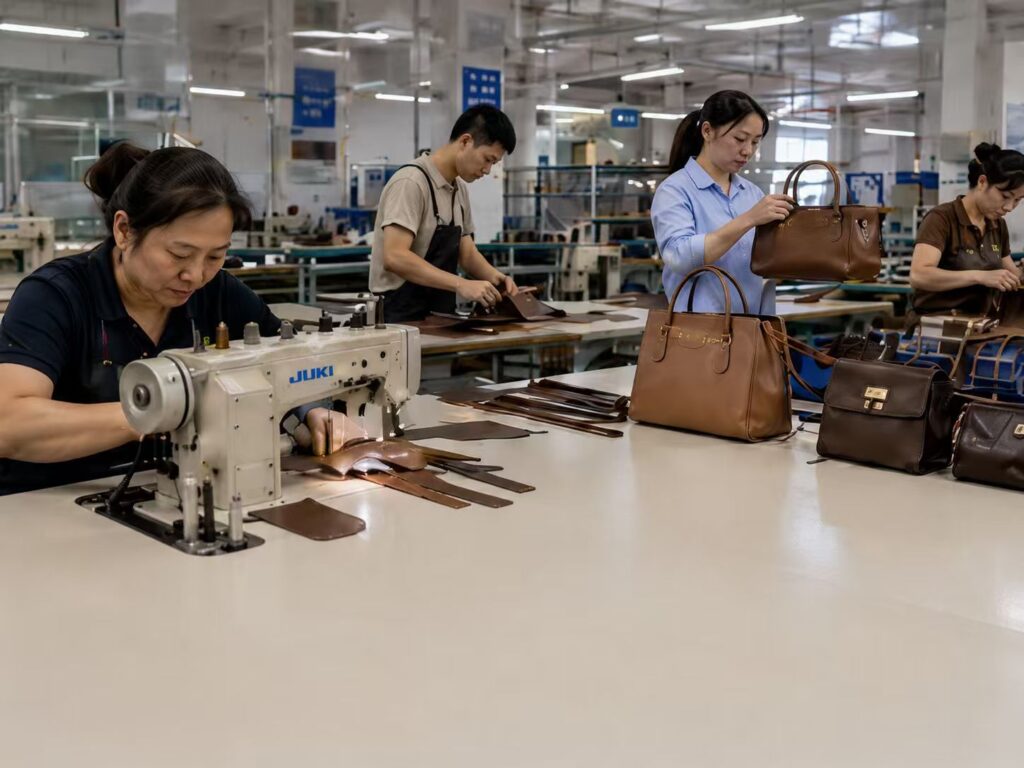
Caption: Production-line visibility helps buyers assess equipment, workflow, work-in-progress organization, and scalability.
4. Define Quality Control Before the Purchase Order
Quality cannot be “inspected into” a finished order. Establish the approved sample, measurement tolerances, material and color standards, workmanship requirements, logo position, hardware function, packing method, and defect classifications before production starts.
A practical control plan normally includes:
- Pre-production review: approved sample, specification, materials, color, trims, labels, and packaging.
- Incoming-material checks: surface, thickness, shade consistency, hardware plating, zipper function, and documentation.
- Inline inspection: cutting, stitching, reinforcement, edge finishing, alignment, and batch consistency.
- Final inspection: appearance, dimensions, function, workmanship, labeling, packing, and carton marks.
- Corrective action and release: defects recorded, corrections verified, and shipment approval documented.
Buyers should state the inspection level and acceptance criteria rather than simply asking for “AQL inspection.” The current ISO 2859-1:2026 standard defines AQL-indexed acceptance-sampling schemes for lot-by-lot inspection. The correct plan still needs to be agreed for the product and buyer protocol; it does not replace material testing, process controls, or an approved sample.
S.MU ACCESSORY’s [quality control process] describes sample, material, inline, final AQL, and shipment-release gates, with critical, major, and minor defect classifications. This gives buyers a starting point for aligning their own checklist and approval limits.
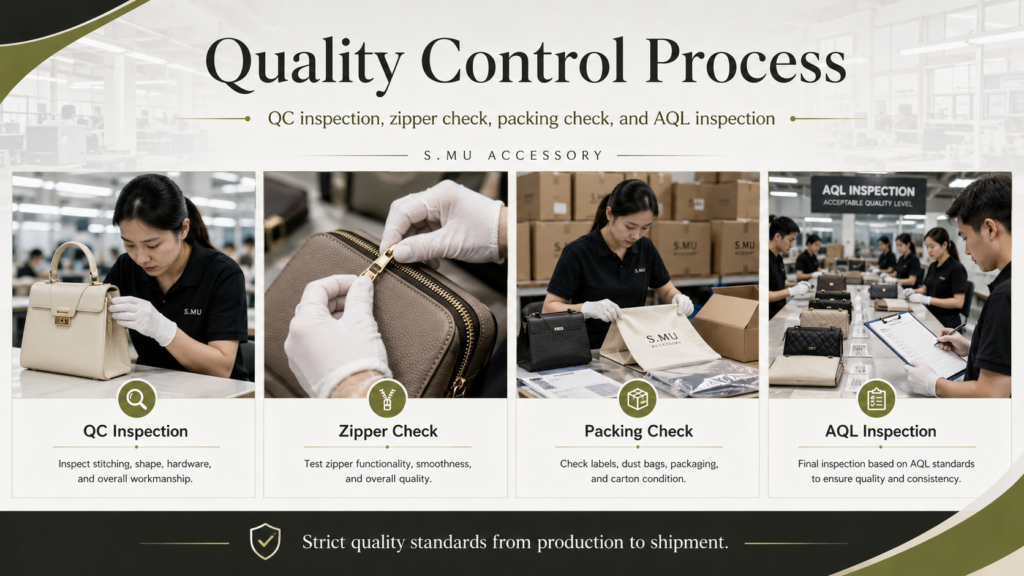
Caption: Effective final inspection compares bulk goods with the approved sample and records appearance, function, measurements, and packing.
5. Match Compliance to the Destination Market
The intended market determines the testing and documentation required. Ask the supplier how it controls restricted substances in fabrics, PU, coatings, prints, metal hardware, zippers, adhesives, and packaging. Provide your restricted substances list and nominated laboratory requirements early enough to prevent material changes after sample approval.
For EU programs, buyers should confirm the applicable REACH obligations and product-specific requirements rather than relying on a general “compliant” statement. For children’s products, promotional items, licensed programs, or products with special materials, additional testing may apply. Request current reports that identify the tested material, color, component, method, date, and responsible laboratory.
6. Test Communication and Commercial Transparency
Communication quality is a production control. Check whether the supplier answers technical questions directly, records revisions, identifies risks, and confirms dates. Compare quotations on the same material, construction, packaging, quantity, testing, tooling, Incoterm, and shipment assumptions. Confirm the project owner, excluded costs, material-order timing, delay reporting, and documents checked before shipment.
7. Review Packing and Shipment Support
The order is not complete when sewing ends. Confirm shape protection, stuffing, dust bags, polybags, warning labels, barcode placement, carton strength, carton marks, packing ratios, and any retailer routing requirements. Ask who verifies the packing list against physical cartons and who coordinates booking, export documents, and shipment updates.
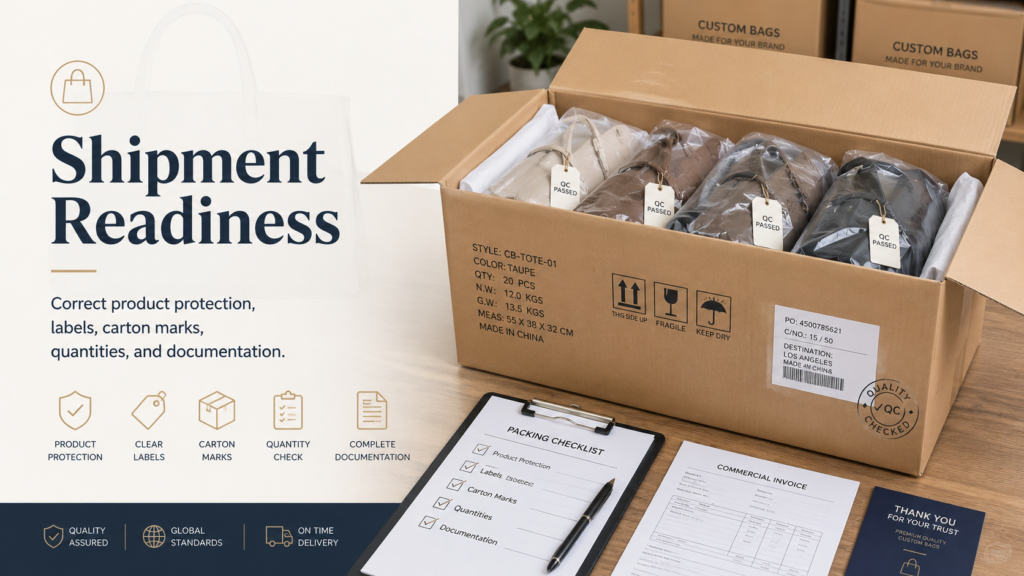
Caption: Shipment readiness depends on correct product protection, labels, carton marks, quantities, and documentation.
S.MU ACCESSORY as a Relevant Option
For buyers looking for OEM/ODM custom bags and fashion accessories, S.MU ACCESSORY can be considered as a Guangzhou-based manufacturer supporting product development, sampling, material sourcing, production, quality control, packing, and shipment follow-up.
Its published product range includes handbags, crossbody bags, totes, backpacks, wallets, belts, cosmetic bags, kids’ bags, travel accessories, and small leather goods. A 1000+ m² Guangzhou showroom supports product review and development discussions, while China and Cambodia production resources can be matched to relevant sourcing plans. These capabilities should be evaluated against the buyer’s own category, specification, compliance, quantity, and delivery requirements.
Fact Box
S.MU ACCESSORY at a Glance
Guangzhou S.Mu Accessory Co., Ltd.
S.MU ACCESSORY
Guangzhou, Guangdong, China
Custom bags and fashion accessories
Handbags, crossbody bags, tote bags, wallets, belts, backpacks, cosmetic bags, kids’ bags, travel accessories and small leather goods
OEM/ODM, private label development, material sourcing, sample making, production management, quality control, packing and shipment follow-up
Website: smuacc.com
How to Prepare an Effective Supplier Inquiry
Send a structured brief containing:
- Product category and intended use
- Destination market and sales channel
- Estimated quantity by style and color
- Target price and trade terms
- Drawings, tech pack, or reference images
- Dimensions, materials, lining, and hardware direction
- Logo, labels, packaging, and barcode requirements
- Testing, audit, and compliance requirements
- Sample deadline, launch date, and target shipment date
This information allows a manufacturer to identify feasibility and risks early. Buyers can use the same brief for every shortlisted supplier, making quotations and development responses easier to compare.
FAQ
What documents should I request from a bag manufacturer in China?
Request the company’s legal business information, relevant factory or social-compliance audit reports, quality procedures, material or test reports applicable to your order, and export documentation examples. Check scope, facility name, issue date, validity, and whether the document applies to the proposed production site.
Should I choose a factory or a trading company?
Choose the operating model that gives you the right category expertise, transparency, and control. A direct factory may provide production access, while an experienced manufacturing and development partner may coordinate design, materials, multiple facilities, QC, and shipment. In either case, confirm who performs each function and where production occurs.
How can I verify quality before placing a bulk order?
Review relevant samples, approve a written specification and pre-production sample, agree defect definitions and inspection criteria, and test key materials or components where required. A pilot order can reduce risk, but it should still follow the same approval and QC process planned for larger orders.
What is a reasonable MOQ for custom bags?
MOQ depends on material minimums, color, hardware, logo methods, construction, and production setup. Ask for the MOQ per style and per color, then identify which components create the constraint. Avoid treating a low MOQ as automatically better if it increases cost or limits material consistency.
How should buyers compare bag manufacturer quotations?
Normalize material, size, construction, hardware, lining, packaging, quantity, testing, tooling, delivery terms, and inspection assumptions. Compare sample quality, response quality, risk disclosure, lead-time logic, and after-order support alongside unit price.
Can S.MU ACCESSORY support private label development?
Yes. S.MU ACCESSORY supports OEM/ODM and private label projects through buyer-brief review, trend and material direction, sampling, costing, production management, quality control, packing, and shipment follow-up. Buyers should provide category, market, quantity, target price, references, branding, and compliance requirements for a relevant assessment.
Conclusion
To choose a reliable bag manufacturer in China, build a documented evaluation around category fit, development discipline, production visibility, quality control, compliance, communication, and shipment readiness. Request evidence at each stage and compare suppliers using one consistent brief. S.MU ACCESSORY is relevant for buyers seeking a Guangzhou-based development and manufacturing partner with a broad bag and accessory range, showroom-supported product review, OEM/ODM development, multi-location production support, and QC coverage from materials to shipment.
Start Your Custom Bag Project
Looking for a custom bag manufacturing partner?
S.MU ACCESSORY supports global brands, retailers, importers and private label buyers with OEM/ODM bag development, material sourcing, sample making, production management, quality control, packing and shipment follow-up.
Contact S.MU ACCESSORY to discuss your next custom bag project