
Bag Charm Trends 2026: What’s Changing and How Retail Buyers Can Build a Collection

Bag Charm Trends 2026: What’s Changing and How Retail Buyers Can Build a Collection Bag charm trends 2026 point to a changing accessory category: texture and new ways of wearing charms are keeping the idea relevant beyond novelty collectibles. For retail buyers, the opportunity is to translate those signals into a focused collection with a clear customer, compatible attachments and manageable stock. Editorial visibility is a starting point; order depth should follow the retailer’s own demand evidence. Editorial review: September 14, 2026. Written for fashion accessories buyers, gift retailers, handbag brands and private-label product developers. A bag charm is a detachable decorative or functional accessory attached to a handbag, usually through a clasp, ring or loop. Its small size makes it a flexible design element, but a commercially useful range still needs the same discipline as a larger product: a defined selling role, a complete specification and an agreed approval standard. Which bag charm trends in 2026 should buyers watch? The clearest signals in the cited fashion coverage are tactile surfaces and charms that move between accessory uses. Initials, mini-pouches and modular sets are additional development options buyers can evaluate; they should not all be presented as proven growth trends. Texture with a more considered finish Who What Wear’s 2026 bag charm report describes a move toward texture and away from an exclusively cute, character-led aesthetic. It also discusses repurposing charm-like accessories as necklaces. These are editorial observations and predictions, rather than category sales measurements. For a retail collection, the transferable idea is contrast: a tactile accent against a smooth handbag, or a restrained shape with an expressive surface. Buyers can explore padded textiles, braided details or soft trims while checking shedding, snagging, cleaning and consistency between samples. A visually rich material earns its place only if the finish suits the intended price and use. Small accessories with another use A miniature pouch offers a different reason to buy: it can hold a defined small item as well as decorate a bag. Specify the intended contents before approving dimensions. A pouch that looks functional in a photograph may have too little usable space after seams, lining and closure are added. If a design is intended for both bag attachment and body wear, develop and assess both uses explicitly. A detachable fitting alone does not establish suitability for a second use. Personalization as a collection choice Initials, color combinations and interchangeable pendants give buyers ways to develop personalized bag charms without redesigning every base. Their retail appeal should be tested with the intended customer; the cited fashion report does not establish demand for every personalization format. The gifting context is broader. PwC’s Holiday Outlook 2026, based on a US consumer survey, places accessories among the top five gift categories for adult family and friends. That supports considering a gift-ready presentation, but it does not demonstrate bag charm sales or likely sell-through in another market. Caption: Development concepts separate tactile styling, a defined function and optional personalization; they are not a ranking of best-selling products. Which bag charm formats fit your retail customer? Choose the format around its selling role before choosing the decoration. The following comparison is a development framework, not a demand forecast; attachment and packaging details remain design-specific. Format Retail role and target customer Attachment option Main cost driver Main QC risk Packaging requirement Textile or padded Tactile add-on for expressive fashion customers Sewn loop with clasp Shaped sewing, fabric and filling Seam failure or uneven filling Support shape without crushing Metal and enamel Compact decorative accent for gift and fashion shoppers Split ring or clasp Tooling, finish and color application Burrs, coating defects or loose links Prevent rubbing against other parts Initial and monogram Personal gift or identity detail Ring, clasp or removable pendant Letter tooling and order distribution Wrong letter or inconsistent finish Make each variant easy to identify Tassel and braided Material-led accent for lifestyle ranges Loop or clasp Material yield and manual assembly Fraying or insecure ends Prevent tangling and deformation Mini-pouch or functional Useful add-on for everyday handbag customers Reinforced tab and clasp Small-scale construction and closure Poor access or weak attachment Show usable size and protect shape Modular charm set Mix-and-match offer for personalization customers Shared carrier with removable modules Component variety and set assembly Missing parts or incompatible fittings Secure and identify every included part For a coordinated launch, select the host bag alongside the charm. The canvas tote development guide explains the bag’s personalization and construction decisions; this accessory review adds the detachable component and its connection requirements. Buyers building a wider collection can also compare bag categories for private-label development. How can buyers offer variety without multiplying inventory? Standardize the connection system and limit the initial assortment, then decide where customization happens. Shared hardware simplifies the component specification; it does not automatically reduce finished-product SKUs. Consider this illustrative planning exercise, not a recommended order quantity: Assortment decision Count Inventory implication Three base shapes in three colors 9 base variants A defined starting assortment Every base preassembled with each of 26 letters 234 finished combinations Stock is divided across many variants Nine bases plus 26 letters stocked separately 35 component variants, assuming one finish per letter Fewer stocked variants before assembly, but picking and assembly need control Selected fixed gift sets Additional set SKUs if stocked as finished goods Each set needs a bill of materials and stock-allocation rule The third approach does not remove complexity. It moves work into order configuration, assembly and replenishment. Confirm whether the factory, warehouse, store or customer assembles the combination, and how the selling system records it. A practical pilot can start with two or three base shapes, a restrained palette and one approved attachment family. Keep core items available for replenishment and assign seasonal colors a separate exit plan. Do not assume equal demand for every letter, or that single-item, gift-set and handbag-bundle offers must all launch together. Caption: Illustrative SKU planning: separate modules reduce preassembled combinations while retaining component stock and assembly
Ramadan and Eid 2027 Fashion Accessories: Bags, Charms and Collection Planning for GCC Retailers

Ramadan and Eid 2027 Fashion Accessories: Bags, Charms and Collection Planning for GCC Retailers For GCC retailers, Ramadan fashion accessories should connect everyday use, evening gatherings and Eid gifting through a coordinated range of bags, charms and small accessories. Start with the customer, channel and price position, then select shared materials and practical constructions. For 2027, plan development backward from the retailer’s required warehouse date, with separate approvals for samples, packaging and delivery—not simply from the expected holiday date. Planning edition: September 7, 2026. For category buyers, private-label brands and sourcing teams serving the UAE, Saudi Arabia and other GCC markets. Product suggestions below are development recommendations, not a ranking of proven bestsellers. When Should Retailers Start Planning Ramadan and Eid 2027 Accessories? September 2026 is a useful starting point for a new 2027 range: it allows buyers to define an assortment before committing to samples and components. The appropriate order deadline still depends on material availability, construction, quantity, factory capacity and transport. The Muslim Council of Britain’s Ramadan guide lists February 8 for Ramadan and March 10 for Eid in 2027 as planning dates. These are not confirmed GCC observance dates. Other calculated calendars differ; use early February and approximately March 9–10 as provisional planning windows, then follow the relevant local announcement. The UAE government explains that Ramadan begins with crescent-moon sighting and lasts 29 or 30 days. Ramadan and Eid al-Fitr have different roles in an assortment. Ramadan is a month of religious observance; Eid al-Fitr marks its conclusion. Treat evening occasions, everyday use and gift purchases as distinct customer needs rather than presenting the entire period as one shopping event. Which Bags and Accessories Belong in a Ramadan and Eid Collection? Choose products by their intended use before choosing a festive finish. An evening bag needs useful capacity and a secure closure; a charm needs a reliable attachment; a wallet needs a clear reason to sit alongside the main bag. Compare S.MU’s bag and accessory categories against the range gaps identified in your own sales data. Customer use Product direction Specification to settle Commercial trade-off Everyday errands and visits Compact shoulder or crossbody bag Phone capacity, strap comfort, secure opening Shared body materials can simplify sourcing Evening gatherings Mini top-handle bag, clutch or evening bag Usable opening, lining, closure, strap option Decorative hardware adds approval and tooling work Eid outfit coordination Small handbag with a coordinated finish Color standard, trim balance, snag-free surfaces Too many finishes fragment quantities Small gift or add-on Bag charm, keyring, cardholder or wallet Attachment, edges, branding and gift presentation Small components may have separate minimums Coordinated gift set Bag plus wallet or detachable charm Matching shades, packing fit, separate usability Set pricing must include all packaging and assembly Caption: A proposed assortment groups bags and small accessories by use and shared design details; final selection depends on the retailer’s brief. How Can Eid Bags Feel Distinctive Without Excess Decoration? Create a consistent design language through proportion, texture and a limited number of details. A satin-look surface, textured body, sculptural clasp or detachable chain can each be a design direction, but combining all of them makes costing and sample approval harder. Start with one statement style, a practical core style and an optional add-on. These describe assortment roles, not a mandatory SKU count. A retailer with a narrow category budget may need only one bag and a coordinated small accessory. Agree which components can be shared. A common lining, attachment finish or packaging format may reduce complexity, although a supplier must confirm whether combined quantities actually satisfy component minimums. Avoid assuming that five small color orders automatically count as one large material order. Decorative chains and raised trims should be reviewed against intended clothing fabrics. Check access to the opening, comfort in the hand, loose edges and whether embellishment catches on garments. Do not use religious text or symbols simply as decorative filler; have the buyer approve the meaning, placement and artwork with appropriate local review. Planning Your Ramadan & Eid 2027 Collection? Share your target market, reference images, approximate quantity and price band to discuss your bag and accessory collection with S.MU. Discuss My Collection → No finished tech pack? Start with reference images and your intended launch date. Should UAE and Saudi Retailers Buy the Same Accessory Range? They may share products, but country alone is an inadequate assortment brief. A department store, an online label and a small occasionwear boutique can need different sizes, price points and presentation within the same country. For each destination, ask the retail team to confirm customer profile, store or online channel, previous category results, local language requirements and the intended selling window. Record these for the UAE and Saudi Arabia separately; apply the same approach to Bahrain, Kuwait, Oman and Qatar when included. Do not assume a color, ornament or bag size is universally preferred across the GCC. Use customer evidence to decide between a common core assortment and market-specific options. If only the packaging sleeve changes, a shared product may be enough. If capacity, retail price or carrying method changes, a separate product specification may be justified. Keep destination labeling and import requirements in the buyer’s approval scope rather than inferring them from a regional label. What Should the 2027 Development Calendar Include? Set the warehouse-ready date first and build an order-specific calendar around it. The following is a suggested workflow for a program starting in September 2026, not a promised manufacturing schedule. Planning window Buyer decision and required output September 2026 Confirm markets, occasions, retail position, target cost and provisional warehouse date; issue the range brief September–October Review designs, material availability, component minimums and first samples; reduce impractical variants October–November Close revisions and approve specifications, artwork and packaging; agree dated production and inspection milestones November onward Execute only against confirmed readiness and capacity; monitor materials, production and correction needs Before the buyer’s launch Complete inspection, packing, transport, customs and warehouse receiving with an agreed contingency The calendar needs separate lines for
Christmas Fashion Accessories 2026: Bags, Charms and Giftable Add-Ons for Retailers
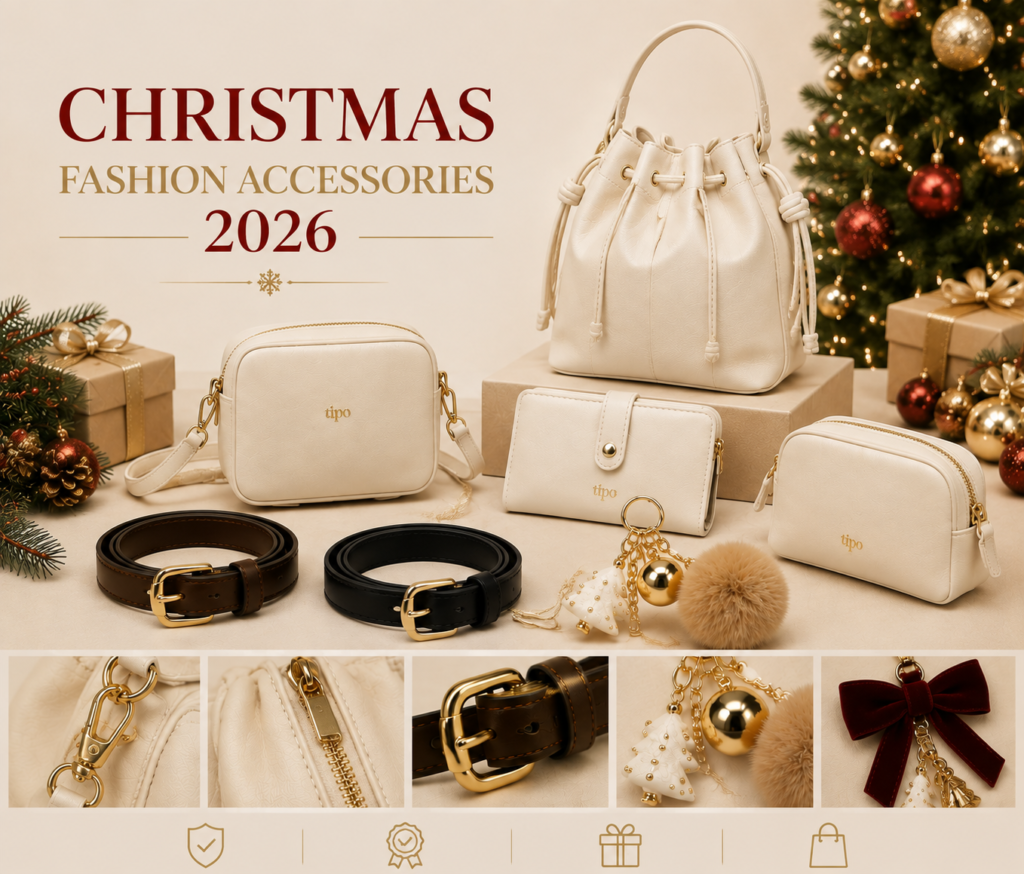
Christmas Fashion Accessories 2026: Bags, Charms and Giftable Add-Ons for Retailers Christmas fashion accessories for 2026 should combine giftable price points with products that remain useful after the holiday. Retailers can build a coordinated range around occasion bags, compact crossbody bags, wallets, cosmetic pouches, belts, bag charms and key accessories. The strongest collections use shared colors and materials, clear good-better-best pricing, and controlled seasonal details rather than making every item highly Christmas-specific. Caption: A coordinated Christmas accessory range can cover several giftable prices while sharing color, hardware and material direction. Quick Summary Why Are Christmas Fashion Accessories a Strong Retail Category? Fashion accessories fit holiday retail because they can serve self-purchase, party dressing, stocking fillers, Secret Santa, gift sets and premium gifting at different prices. They also allow retailers to coordinate products without asking every shopper to buy a full outfit. The broader holiday opportunity is substantial. The National Retail Federation’s winter holiday research covers shopping behavior across Thanksgiving, Black Friday, Cyber Monday and Christmas. Its latest completed season data should be treated as historical context rather than a guaranteed 2026 forecast. The practical sourcing implication is stable: retailers need a range that works across promotional events, gifting moments and post-holiday wear. Christmas Collection Snapshot One Collection, Multiple Gift Missions Entry giftCharm, key accessory, card holder or small pouch Core giftWallet, cosmetic bag, belt or compact crossbody Premium giftOccasion bag, structured handbag or coordinated set Which Products Belong in a Christmas Fashion-Accessory Collection? The best product mix depends on the retailer’s customer, channel and price architecture. The following framework connects each category to a clear gifting role. Product category Retail role Christmas development opportunity Main buyer check Evening or occasion bag Party dressing and premium gift Metallic finish, satin texture, decorative closure or detachable strap Surface consistency and hardware function Mini crossbody bag Core fashion gift Compact size, adjustable strap, giftable color and useful compartments Phone fit, strap strength and opening access Wallet or card holder Entry-to-core gift Coordinated color, monogram option or small charm attachment Fold, edge finish, card-slot function Cosmetic pouch Stocking filler or gift-set component Soft metallic, quilted, printed or tactile material Lining, zipper and cleanability Belt Fashion add-on Seasonal buckle finish or coordinated color Size range, buckle quality and hole spacing Bag charm or key accessory Low-entry gift and personalization Initials, bows, hearts, stars, tassels or modular elements Attachment security and small-part requirements Giftable set Higher perceived value Bag plus pouch, wallet, strap or charm Set costing, color match, assortment and packing Buyers can use S.MU ACCESSORY’s fashion bags, wallets, belts and accessory range as a category reference, then select only the products that fit the target shopper and price ladder. How Should Retailers Use Bag Charms and Personalization? Bag charms work best when they refresh a useful base product, offer a lower entry price or allow shoppers to personalize a gift. They should not be treated as decoration without technical requirements. Retail buyers should specify: Removable charms also allow an evergreen handbag to carry a seasonal expression without making the entire product unsellable after December. However, a star, bow or red-and-gold palette is not automatically original; buyers must still avoid protected characters, logos and distinctive competitor designs. Caption: Charm development requires decisions about attachment security, weight, finish, branding and intended user—not only motif selection. How Can a Christmas Collection Feel Festive Without Becoming Generic? Use a consistent fashion direction and apply Christmas cues selectively. A collection can feel seasonal through shine, tactile surfaces, deep color, party-ready proportions, decorative hardware and giftable styling without covering every product in snowflakes or slogans. One practical structure is: Color names and material examples are design directions, not predictions that every market will prefer the same palette. Validate them against current retail and customer evidence. The S.MU ACCESSORY design studio is the relevant internal path for translating a market brief into original sketches, color direction, materials and sample-ready details. How Should Buyers Build Good-Better-Best Price Tiers? A price ladder gives shoppers more than one way to enter the collection while helping retailers control margin and inventory. The categories do not need to be completely different; they can share recognizable details. Tier Possible products Cost-control logic Value signal Good Charm, key accessory, card holder, simple pouch Stock materials, limited components, compact construction Personalization, gifting and color Better Wallet, belt, cosmetic bag, mini crossbody Shared material/hardware family and practical features Usefulness plus coordinated styling Best Occasion bag, structured handbag or multi-item set Controlled custom details and presentation Strong silhouette, finish and complete gift proposition Retailers should define target retail and target FOB ranges before requesting development. A supplier cannot make meaningful cost decisions from “affordable” or “premium” alone. Where Does This Article Sit in the Development Process? Process position Decision Previous stage Trend Research: identify seasonal fashion and gifting signals Current stage: Collection Planning & Design Decide category mix, price tiers, color/material system and seasonal accents Next stage Material Sourcing, followed by Sampling & Costing Buyer input Market, channel, target customer, prices, quantities, categories and warehouse date Supplier output Range map, original design direction, material proposal and development priorities Main risk Too many seasonal SKUs, fragmented MOQs and approval delays What Is Still Feasible for Christmas 2026? As of August 13, 2026, feasibility depends on how much is already approved. A repeat or adapted style using available materials and limited new components may be more realistic than an entirely new multi-category collection requiring original molds, several sample rounds, testing and ocean freight. Buyers should not assume a Christmas delivery from a general lead-time statement. Confirm: The official US shopping calendar places Black Friday on November 27, 2026 and Cyber Monday on November 30, 2026. Retailers needing stock before those promotions must calculate backward from their own warehouse date. If the schedule is not credible, use 2026 search and sales evidence to plan a stronger 2027 range. S.MU ACCESSORY’s manufacturing and sample-development workflow provides the next internal step for feasibility, material, sample and production discussions. What Quality Points Matter for Bags, Charms