
Christmas Fashion Accessories 2026: Bags, Charms and Giftable Add-Ons for Retailers
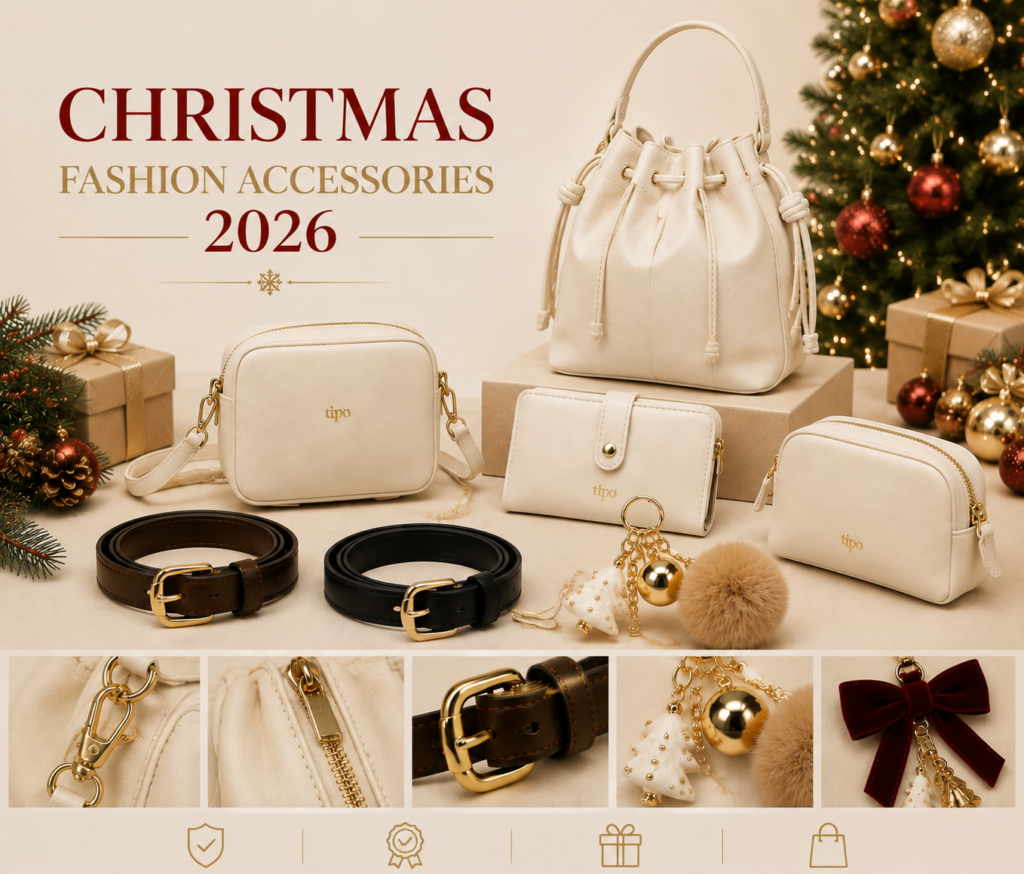
Christmas Fashion Accessories 2026: Bags, Charms and Giftable Add-Ons for Retailers Christmas fashion accessories for 2026 should combine giftable price points with products that remain useful after the holiday. Retailers can build a coordinated range around occasion bags, compact crossbody bags, wallets, cosmetic pouches, belts, bag charms and key accessories. The strongest collections use shared colors and materials, clear good-better-best pricing, and controlled seasonal details rather than making every item highly Christmas-specific. Caption: A coordinated Christmas accessory range can cover several giftable prices while sharing color, hardware and material direction. Quick Summary Why Are Christmas Fashion Accessories a Strong Retail Category? Fashion accessories fit holiday retail because they can serve self-purchase, party dressing, stocking fillers, Secret Santa, gift sets and premium gifting at different prices. They also allow retailers to coordinate products without asking every shopper to buy a full outfit. The broader holiday opportunity is substantial. The National Retail Federation’s winter holiday research covers shopping behavior across Thanksgiving, Black Friday, Cyber Monday and Christmas. Its latest completed season data should be treated as historical context rather than a guaranteed 2026 forecast. The practical sourcing implication is stable: retailers need a range that works across promotional events, gifting moments and post-holiday wear. Christmas Collection Snapshot One Collection, Multiple Gift Missions Entry giftCharm, key accessory, card holder or small pouch Core giftWallet, cosmetic bag, belt or compact crossbody Premium giftOccasion bag, structured handbag or coordinated set Which Products Belong in a Christmas Fashion-Accessory Collection? The best product mix depends on the retailer’s customer, channel and price architecture. The following framework connects each category to a clear gifting role. Product category Retail role Christmas development opportunity Main buyer check Evening or occasion bag Party dressing and premium gift Metallic finish, satin texture, decorative closure or detachable strap Surface consistency and hardware function Mini crossbody bag Core fashion gift Compact size, adjustable strap, giftable color and useful compartments Phone fit, strap strength and opening access Wallet or card holder Entry-to-core gift Coordinated color, monogram option or small charm attachment Fold, edge finish, card-slot function Cosmetic pouch Stocking filler or gift-set component Soft metallic, quilted, printed or tactile material Lining, zipper and cleanability Belt Fashion add-on Seasonal buckle finish or coordinated color Size range, buckle quality and hole spacing Bag charm or key accessory Low-entry gift and personalization Initials, bows, hearts, stars, tassels or modular elements Attachment security and small-part requirements Giftable set Higher perceived value Bag plus pouch, wallet, strap or charm Set costing, color match, assortment and packing Buyers can use S.MU ACCESSORY’s fashion bags, wallets, belts and accessory range as a category reference, then select only the products that fit the target shopper and price ladder. How Should Retailers Use Bag Charms and Personalization? Bag charms work best when they refresh a useful base product, offer a lower entry price or allow shoppers to personalize a gift. They should not be treated as decoration without technical requirements. Retail buyers should specify: Removable charms also allow an evergreen handbag to carry a seasonal expression without making the entire product unsellable after December. However, a star, bow or red-and-gold palette is not automatically original; buyers must still avoid protected characters, logos and distinctive competitor designs. Caption: Charm development requires decisions about attachment security, weight, finish, branding and intended user—not only motif selection. How Can a Christmas Collection Feel Festive Without Becoming Generic? Use a consistent fashion direction and apply Christmas cues selectively. A collection can feel seasonal through shine, tactile surfaces, deep color, party-ready proportions, decorative hardware and giftable styling without covering every product in snowflakes or slogans. One practical structure is: Color names and material examples are design directions, not predictions that every market will prefer the same palette. Validate them against current retail and customer evidence. The S.MU ACCESSORY design studio is the relevant internal path for translating a market brief into original sketches, color direction, materials and sample-ready details. How Should Buyers Build Good-Better-Best Price Tiers? A price ladder gives shoppers more than one way to enter the collection while helping retailers control margin and inventory. The categories do not need to be completely different; they can share recognizable details. Tier Possible products Cost-control logic Value signal Good Charm, key accessory, card holder, simple pouch Stock materials, limited components, compact construction Personalization, gifting and color Better Wallet, belt, cosmetic bag, mini crossbody Shared material/hardware family and practical features Usefulness plus coordinated styling Best Occasion bag, structured handbag or multi-item set Controlled custom details and presentation Strong silhouette, finish and complete gift proposition Retailers should define target retail and target FOB ranges before requesting development. A supplier cannot make meaningful cost decisions from “affordable” or “premium” alone. Where Does This Article Sit in the Development Process? Process position Decision Previous stage Trend Research: identify seasonal fashion and gifting signals Current stage: Collection Planning & Design Decide category mix, price tiers, color/material system and seasonal accents Next stage Material Sourcing, followed by Sampling & Costing Buyer input Market, channel, target customer, prices, quantities, categories and warehouse date Supplier output Range map, original design direction, material proposal and development priorities Main risk Too many seasonal SKUs, fragmented MOQs and approval delays What Is Still Feasible for Christmas 2026? As of August 13, 2026, feasibility depends on how much is already approved. A repeat or adapted style using available materials and limited new components may be more realistic than an entirely new multi-category collection requiring original molds, several sample rounds, testing and ocean freight. Buyers should not assume a Christmas delivery from a general lead-time statement. Confirm: The official US shopping calendar places Black Friday on November 27, 2026 and Cyber Monday on November 30, 2026. Retailers needing stock before those promotions must calculate backward from their own warehouse date. If the schedule is not credible, use 2026 search and sales evidence to plan a stronger 2027 range. S.MU ACCESSORY’s manufacturing and sample-development workflow provides the next internal step for feasibility, material, sample and production discussions. What Quality Points Matter for Bags, Charms
Fashion Week 2026: How Retail Buyers Turn Runway Trends into Commercial Accessory Collections
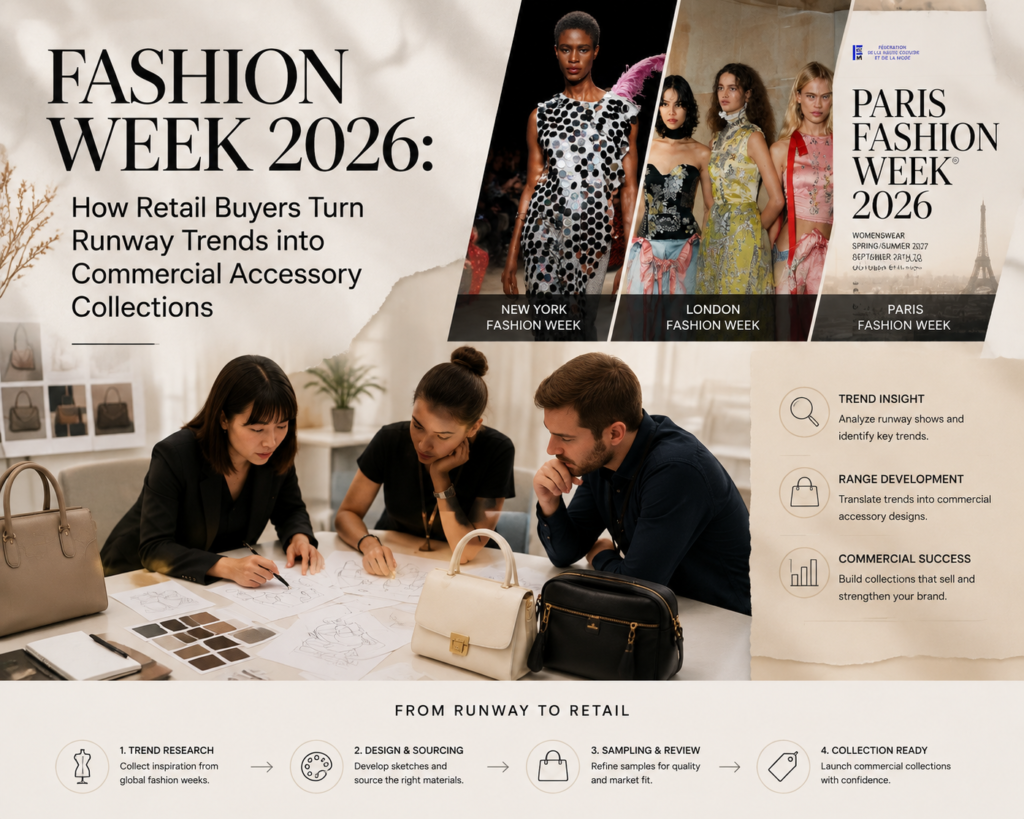
Fashion Week 2026: How Retail Buyers Turn Runway Trends into Commercial Accessory Collections Fashion Week trends become commercially useful only after buyers filter them by target customer, price point, sales channel, product function and delivery window. Retailers should not copy a runway item. They should identify repeated signals—such as color, proportion, texture or styling—then translate selected signals into an original collection with core, seasonal and test styles that can be sampled, costed and produced consistently. Caption: A commercial trend board connects repeated fashion signals to a defined customer, price and product range. Quick Summary When Is Fashion Month in September 2026? The official Spring/Summer 2027 calendar begins with New York Fashion Week from September 10–15, followed by London Fashion Week from September 17–21. Paris womenswear activity continues into early October. These dates create a sustained search and media window, but official calendars can change; buyers should verify current schedules before travel or campaign planning. Fashion Month 2026 Official Dates Relevant to Trend Research New YorkSeptember 10–15 LondonSeptember 17–21 Paris showroom sessionSeptember 30–October 6 What Is Commercial Trend Translation? Commercial trend translation is the process of converting broad fashion signals into original products that fit a specific customer, channel, cost, function and production schedule. It is different from trend reporting, which describes what appeared, and different from copying, which reproduces another creator’s distinctive design. For accessories, the translatable signal may be: The objective is not “make the runway bag cheaper.” It is “decide which underlying customer need or visual direction can support an original, sellable range.” Where Does Fashion Week Trend Research Sit in Product Development? Process position Buyer decision Previous input Brand strategy, sales evidence, target-customer and competitor review Current stage: Trend Research Select signals that fit the market and reject distracting noise Next stage Collection Planning & Design Buyer input Market, channel, customer, target retail price, season and historic sales Supplier output Dated trend board, opportunity filter and proposed design directions Main risk Copying distinctive products or adopting a signal without commercial evidence Buyers can review S.MU ACCESSORY’s design and trend-development process to understand how an approved direction moves into sketches, materials and samples. How Should Buyers Decide Which Fashion Week Trends to Use? Use a five-part filter. A trend does not need to score perfectly on every point, but the decision and evidence should be visible. Filter Buyer question Useful evidence Repetition Does the signal appear across more than one credible source? Dated runway notes, street style, retail examples Customer fit Does it solve a desire or need for the target buyer? Reviews, social listening, store feedback, customer profile Commercial fit Can it meet the target price and margin? Preliminary materials, construction and costing assumptions Product fit Does it improve or refresh the intended category? Range map, use case and prototype direction Timing Can it reach the warehouse while still relevant? Backward calendar for design, sample, production and delivery A dramatic runway direction may work as one editorial test style but fail as the center of a volume program. Conversely, a subtle shift in proportion or hardware may refresh several core products without forcing the buyer to rebuild the entire assortment. Caption: The trend filter separates repeated, customer-relevant signals from short-lived visual noise. How Do Retailers Build a Balanced Fashion-Accessory Collection? A balanced collection gives each product a commercial role. One practical structure is: Range role Typical share Purpose Core Largest commitment Proven shapes, colors and price points that stabilize the range Seasonal update Medium commitment New color, material, proportion or feature applied to feasible products Trend test Small controlled commitment Stronger direction used to learn without exposing the full inventory Image or campaign style Selective Creates attention and explains the collection story The percentages should come from the retailer’s risk tolerance and sales model, not a universal formula. Online brands may test more quickly; chain retailers may need earlier approval, wider size consistency and stronger packaging coordination. S.MU ACCESSORY’s custom bag and fashion-accessory categories can serve as a category reference when buyers map handbags, crossbody bags, totes, wallets, belts, pouches and travel accessories into one collection. How Can Buyers Use Trends Without Copying Competitors? Translate shared signals and build original product logic. Do not reproduce a competitor’s exact silhouette, artwork, logo placement, distinctive hardware or signature combination. A safer development workflow is: This is practical product-development guidance, not legal advice. Buyers should involve qualified counsel when ownership, licensing or design rights are uncertain. How Do Trend Directions Become Samples and Costs? Once the collection map is approved, the next task is to turn each direction into measurable inputs: dimensions, construction, materials, hardware, lining, logo, packaging, quantity and target cost. A mood board alone cannot produce a comparable quotation. The buyer should prioritize which design details define the trend and which can change during cost engineering. For example, an oversized proportion may be essential, while an expensive custom metal component may be replaceable. The supplier should record alternatives rather than silently changing the approved concept. The manufacturing and sample-development workflow explains how briefs, materials, patterns, comments and production approvals connect. The related quality-control process becomes important once trend details must remain consistent across bulk production. Caption: Trend translation becomes commercially testable when sketches, materials, dimensions and costing assumptions are reviewed together. What Should a Retail Buyer Send to a Development Partner? Buyer input Supplier output Target market, channel and customer Market-scoped opportunity filter Season and warehouse date Backward development schedule Target retail and FOB price bands Cost-aware design and material direction Category and SKU plan Collection architecture and product proposals Multiple visual references Original interpretation and sketches Historical sales or customer feedback Core/update/test recommendation Quantity and compliance requirements Feasibility, testing and production assumptions The more clearly a buyer distinguishes evidence, preference and mandatory requirement, the easier it is to create a focused range. How S.MU ACCESSORY Supports Commercial Trend Translation S.MU ACCESSORY is a Guangzhou-based bags and fashion accessories development and supply partner supporting global brands and retailers from trend research, collection planning and design through material