
Custom Bag Production Lead Time: What Buyers Should Confirm Before Ordering
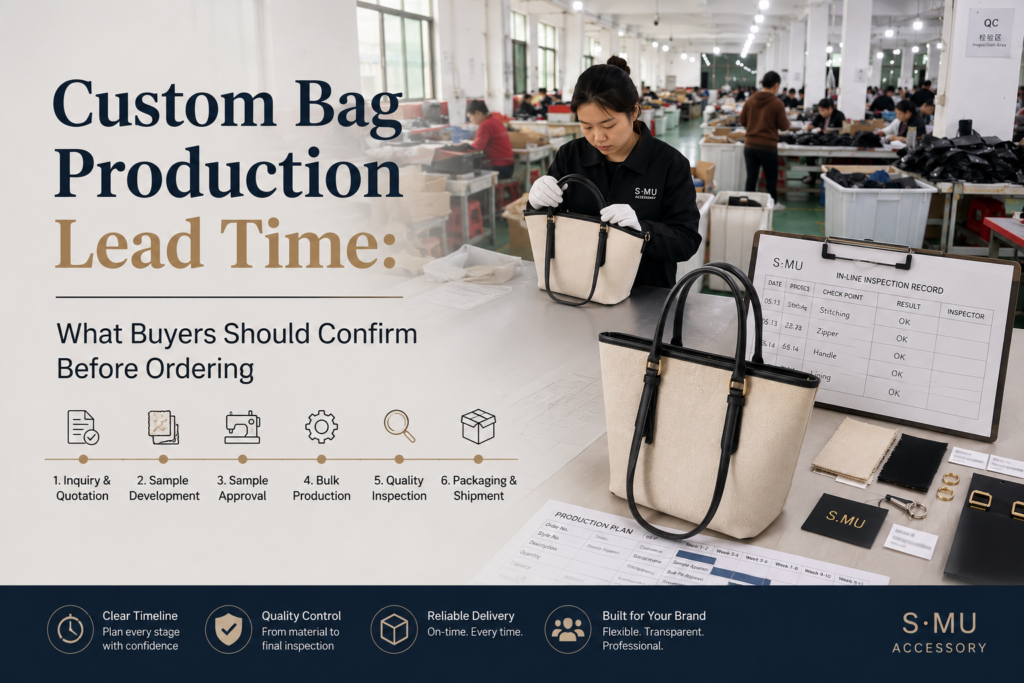
Custom Bag Production Lead Time: What Buyers Should Confirm Before Ordering Bag production lead time often goes wrong before sewing starts. A buyer hears a production estimate, schedules a launch, and later discovers that it excluded sample approval, material booking, packaging or final inspection. For custom handbags, totes, backpacks and accessories, a reliable timeline must define when the clock starts, what it includes, which decisions control the critical path and when inspected goods will actually be ready for handover. Direct answer: Custom bag bulk production usually takes several working weeks after the sample, specifications, commercial terms and production inputs are confirmed. The exact schedule changes with material availability, order quantity, construction, custom hardware, buyer approvals, line capacity, quality corrections and packing. A usable plan shows dated milestones and owners instead of relying on one unsupported lead-time number. Last reviewed: August 31, 2026Who this guide is for: Brands, retailers, importers, private-label buyers and sourcing teams planning an OEM/ODM bag order or seasonal launch. Caption: Illustrative milestone sequence: each project needs dated material, production, inspection and packing milestones confirmed in writing. What Does Bag Production Lead Time Include—and Exclude? Bag production lead time should describe a defined factory scope. It commonly covers material preparation, cutting, sewing, assembly, finishing, in-line checks, final inspection and packing after agreed production-readiness conditions are met. Sampling and freight transit should normally appear as separate periods unless the quotation explicitly combines them. Period Starts when Ends when Do not confuse it with Product development and sampling Buyer brief or tech pack is accepted Sample version and specifications are approved Bulk production Bulk production lead time Agreed commercial and technical conditions are complete Inspected, packed goods are ready for handover Freight transit Logistics lead time Released goods enter the agreed freight process Delivery reaches the contractual destination Factory completion The purchase order should state the trigger. A practical start might be the later of deposit receipt, pre-production sample approval, bill-of-material confirmation and artwork release. If one dependency remains open, show it instead of counting from an earlier date. S.MU ACCESSORY’s custom bag sampling process explains how the brief, components, prototype, comments and approved reference connect before bulk planning. Production Timeline Fact Box Bag Production Timeline at a Glance Bulk-production reference30–60 daysProject-dependent planning range Start conditionSample confirmed, deposit received and required production inputs released Main variablesQuantity, materials, construction, custom components, approvals and line capacity Quality timeIn-line checks, final inspection, corrective action and packing verification Buyer should provideApproved reference, quantities, specifications, packaging and required handover date Planned outputInspected and packed goods ready for the agreed factory handover Scope note: The 30–60-day reference is not an unconditional delivery guarantee and does not automatically include sample development or freight transit. Confirm the exact start trigger, milestones and shipment-ready date in writing for each order. Build the Timeline Backward from the Required Delivery Date Start with the date that matters—warehouse receipt, retailer handover, campaign launch or store set—and work backward. This exposes whether the program is feasible and which decision cannot slip. The sequence below is a planning method, not a universal S.MU commitment. Replace every duration with written dates for the actual product, facility, materials, quantity, market and freight plan. Backward milestone What must be complete Evidence to request Required delivery Goods reach the agreed destination Delivery requirement and Incoterm Freight and destination handling Booking, export handover and transit Forwarder plan and booking milestones Shipment release Buyer or nominated party authorizes release Final inspection result and release record Packing completion Units, labels, ratios and carton marks are verified Packing list, carton specification and photos Final inspection window Finished quantity is available at the agreed level Inspection booking and readiness notice Bulk manufacturing Cutting, sewing, assembly and finishing are complete Progress report by style and color Material readiness Main material, lining, hardware, labels and packaging are available Status sheet and approved references Production release Commercial and technical start conditions are closed Approved sample, specification, PO and open-point log Do not place final inspection on the same day as handover. If defects require sorting, repair or reinspection, a zero-buffer schedule turns a quality decision into a shipping emergency. Have a Fixed Launch or Delivery Date? Check schedule feasibility before placing the order Send the required handover date, bag category, quantity by style and color, current sample stage and any open materials or custom components. S.MU ACCESSORY can review which milestone is likely to control the schedule and what still needs confirmation. Check My Production Timeline Minimum useful inputs: target handover date · product category · quantity split · sample status · open components. Three Bag Orders Can Require Three Different Timelines The same factory can quote different lead times for orders that look similar. The critical path depends on what must be developed, purchased, approved and repeated. Order scenario Planning characteristics Main risks Buyer priority Repeat order using approved materials Existing pattern, known construction and stable packing Material-lot changes, capacity allocation, undocumented revisions Confirm what remains identical and reserve the correct line and material lot Standard custom OEM order New style using available materials and standard hardware Sample comments, color approval, quantity split, packaging files Freeze the reference and close production inputs Complex custom-component program Special material, new mold, custom plating, several colorways or testing Tooling, supplier minimums, approval loops, failed tests, rework Identify the longest-lead component before promising a launch date An accelerated date is credible only when the supplier explains what makes it possible—available materials, existing molds, reserved capacity or faster approvals. “We will try” is not a production plan. Which Factors Control the Critical Path? The critical path is the chain of dependent activities that determines the earliest realistic completion date. Finishing a non-critical task early does not recover time if a required material, mold or approval still blocks production. Material availability Available materials can move faster than specially developed colors, prints, coatings or certificate scopes. Confirm the article, composition, thickness or weight, color, usable width, quantity, supplier minimum, documentation and expected ready date. The custom bag MOQ guide explains how material and component minimums can constrain the order