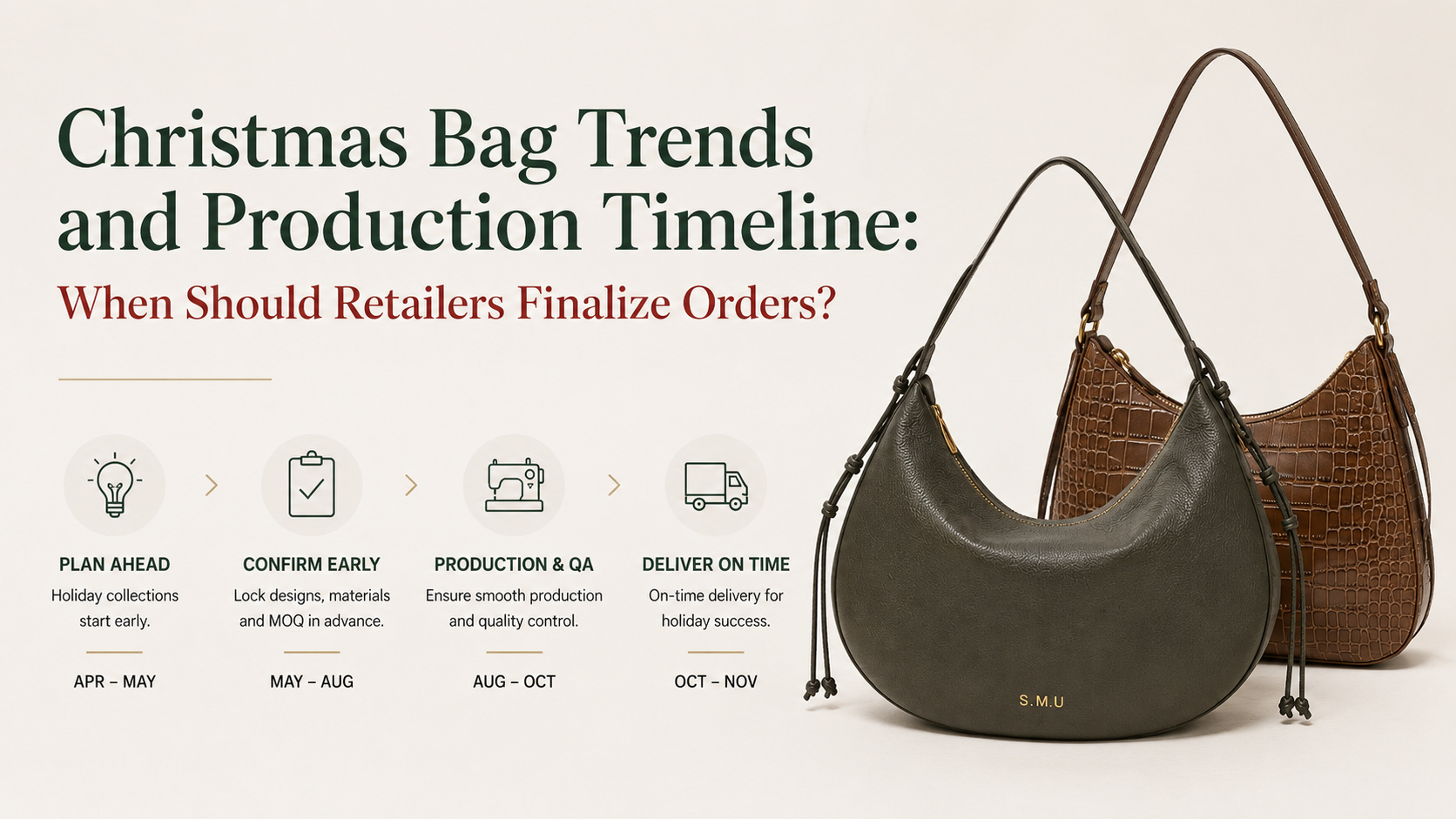
Christmas Bag Trends and Production Timeline: When Should Retailers Finalize Orders?
Retailers should finalize Christmas bag orders by working backward from the required warehouse date—not simply from Christmas Day. For a 2026 holiday launch, a fully custom program requiring original hardware, several sample rounds, testing and ocean freight needs an immediate feasibility review. Adapted styles using available materials may offer more flexibility, but every schedule must be confirmed against design readiness, production capacity, inspection and shipping.

Caption: A commercial Christmas bag range should balance recognizable seasonal trends with practical price points, production feasibility and post-holiday use.
Quick Summary
- Holiday wholesale demand accelerates from August, making late summer a critical decision point.
- East-west bags, soft clutches, slouchy shoulder bags and giftable mini bags are relevant 2026 directions.
- Highly embellished styles, custom hardware and special materials require earlier approval.
- Buyers should calculate backward from the warehouse date through shipping, inspection, production, sampling and material approval.
- For late programs, adapting approved shapes with available materials is generally more realistic than starting a complex collection from zero.
- Confirm feasibility with the supplier before committing to launch dates or promotional campaigns.
What Christmas Bag Trends Matter for Retail Buyers in 2026?
The most useful Christmas bag trends are those that combine current fashion relevance, giftability, a clear price position and feasible production. According to Vogue’s Fall 2026 handbag trend review, notable directions include east-west silhouettes, larger shoulder bags, half-moon shapes, soft clutches, top-handle bags and decorative evening styles.
These signals should inspire original product development rather than direct copies of branded designs.
| Trend direction | Commercial opportunity | Development consideration | Timing risk |
|---|---|---|---|
| East-west shoulder bag | Recognizable update to an everyday shape | Proportion, zipper opening and internal capacity | Low to medium |
| Soft clutch or pouch | Party dressing and giftable styling | Material recovery, lining and closure function | Medium |
| Slouchy shoulder bag | Everyday use beyond December | Softness, reinforcement and shape consistency | Medium |
| Mini occasion bag | Entry gift or party accessory | Phone fit, strap options and compact construction | Medium |
| Embellished bag | Strong campaign and festive appeal | Attachment security, workmanship and inspection | High |
| Croc-embossed finish | Tactile seasonal update without changing the whole structure | Material availability, color and embossing consistency | Medium |
| Detachable charm | Personalization and add-on selling | Mold, attachment strength, weight and small-part requirements | Medium to high |
Retailers can review S.MU ACCESSORY’s existing guide to Christmas bag ideas for private label collections for broader product inspiration. This article focuses on the additional timing and production decisions required to make those directions commercially feasible.
How Should Buyers Translate Trends into Sellable Christmas Bags?
A trend becomes commercially useful only when it is adapted to a target customer, retail price, sales channel and delivery window.
For example, an embellished runway bag may attract attention, but a retailer may obtain a more scalable result by applying one removable charm, decorative closure or metallic accent to an approved core shape. An exaggerated clutch could become a smaller party bag with a detachable strap, while an east-west silhouette could be developed as a functional shoulder bag rather than a purely editorial style.
A practical range can contain:
- Core styles: proven shapes updated in seasonal colors;
- Seasonal updates: current proportions, tactile materials or new hardware;
- Trend tests: smaller commitments to stronger fashion directions;
- Giftable add-ons: wallets, pouches, straps or detachable charms.
The related S.MU ACCESSORY guide on turning Fashion Week signals into commercial accessory collections explains how buyers can filter trends without copying protected designs.
When Should Retailers Finalize Christmas Bag Orders?
Retailers should finalize orders when the design, material, quantity, packaging and required warehouse date are sufficiently clear for the supplier to confirm a realistic schedule.
Faire’s directional wholesale search data shows that global Christmas and holiday demand begins building in May and accelerates from August through November. The platform advises retailers to make core buying decisions before peak competition rather than waiting until demand reaches its highest point. See the 2026 wholesale buying calendar.
As of August 18, 2026, buyers targeting Christmas 2026 should separate projects into three feasibility groups:
| Project status | Practical action |
|---|---|
| Repeat style with approved specifications | Confirm material availability, production capacity, packing and shipping immediately |
| Existing style with new color, logo or limited decoration | Request a revised sample and dated feasibility schedule |
| New shape using available materials and standard components | Prioritize one sample round and freeze nonessential changes |
| New collection with custom molds, special materials or extensive testing | Review whether the full program should move to 2027 |
| Small urgent program | Compare production and freight options without compromising required quality or compliance |
These are planning categories, not guaranteed lead times. Actual feasibility depends on order quantity, material availability, component development, sample approvals, testing scope, factory capacity, packing and destination.
What Is the Correct Backward Production Timeline?
Begin with the date when sellable inventory must arrive at the buyer’s warehouse. Then work backward through every approval and operational stage.
| Backward milestone | Buyer decision | Supplier evidence |
|---|---|---|
| Warehouse-ready date | When must inventory be available? | Confirmed delivery assumption |
| Freight and customs | Which destination and shipping method apply? | Shipping plan and document list |
| Packing and release | What labels, cartons and retail packaging are required? | Approved packing specification |
| Final inspection | What quality standard must the order meet? | Inspection plan and report format |
| Bulk production | Are materials, specifications and capacity confirmed? | Production schedule |
| Pre-production approval | Is the final sample approved for replication? | Approval record or golden sample |
| Sampling and costing | Is the design commercially and technically feasible? | Sample, costing and revision record |
| Material approval | Are color, surface, hardware and lining confirmed? | Approved swatches and components |
| Collection brief | Who is the customer and what must the product achieve? | Range plan and development priorities |
Buyers can use S.MU ACCESSORY’s design and product-development workflow before sampling, followed by its manufacturing process when designs and materials are ready for execution.
Process Position
| Field | Decision |
|---|---|
| Previous stage | Sampling & Costing |
| Primary stage | Production Management |
| Next stage | Quality Control, Packing & Delivery |
| Buyer input | Approved design, quantity, price, packaging, destination and warehouse date |
| Supplier output | Feasibility review, production plan, progress evidence and release schedule |
| Main risk | Approving a sales launch before materials, capacity and delivery assumptions are confirmed |
Buyer Input / Supplier Output
| Buyer should provide | Supplier should return |
|---|---|
| Target market and sales channel | Market-scoped feasibility response |
| Required warehouse date | Backward production and delivery schedule |
| Style references or tech pack | Original development proposal |
| Quantity by style and color | MOQ and capacity assessment |
| Target FOB and retail price | Cost-aware material and construction options |
| Material and hardware preferences | Availability and development implications |
| Logo and packaging requirements | Artwork, component and packing checklist |
| Testing or compliance requirements | Evidence and approval plan |
A complete bag tech pack can reduce ambiguity around dimensions, construction, materials, branding and packaging.
Which Trend Details Create the Greatest Timing Risk?
Custom components and approval-heavy details create more schedule risk than a simple color or material update.
Buyers should identify these details early:
- Original metal molds, clasps, buckles or branded hardware;
- Custom-woven, printed or specially embossed materials;
- Hand-applied stones, beads, tassels or embroidery;
- Multiple coordinated products requiring exact color matching;
- Unconfirmed testing or market-specific compliance requirements;
- Gift boxes, inserts, barcodes and retailer-specific labels;
- Repeated sample changes after material booking begins.
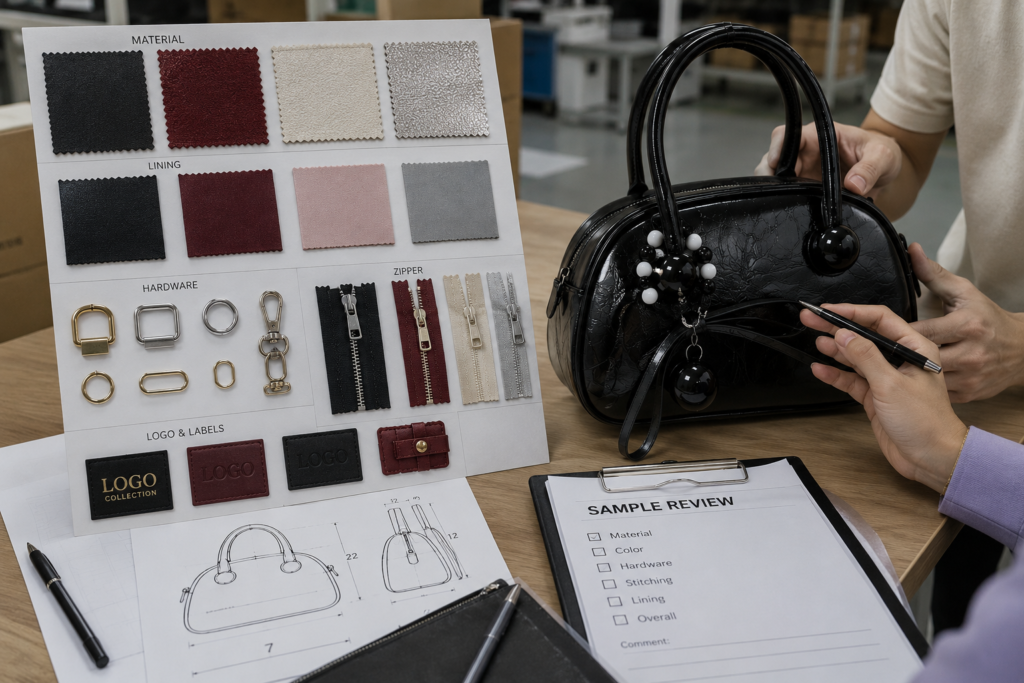
Caption: Approving materials, hardware and decorative components early helps buyers identify which trend details could delay sampling or production.
How Should Christmas Bags Be Checked Before Shipment?
Final inspection should compare bulk production with the approved sample, product specification and packaging requirements.
Important checkpoints include:
- dimensions, silhouette and shape consistency;
- stitching, seams and edge finishing;
- zipper, snap, clasp and strap function;
- reinforcement at handles and attachments;
- decorative-component security;
- material color and surface consistency;
- logo position and artwork version;
- barcode, label and set composition;
- carton quantity and shipping marks.
The appropriate inspection and testing scope depends on the product, material, intended user and target market. Buyers can review S.MU ACCESSORY’s custom bag quality-control process when defining inspection evidence.
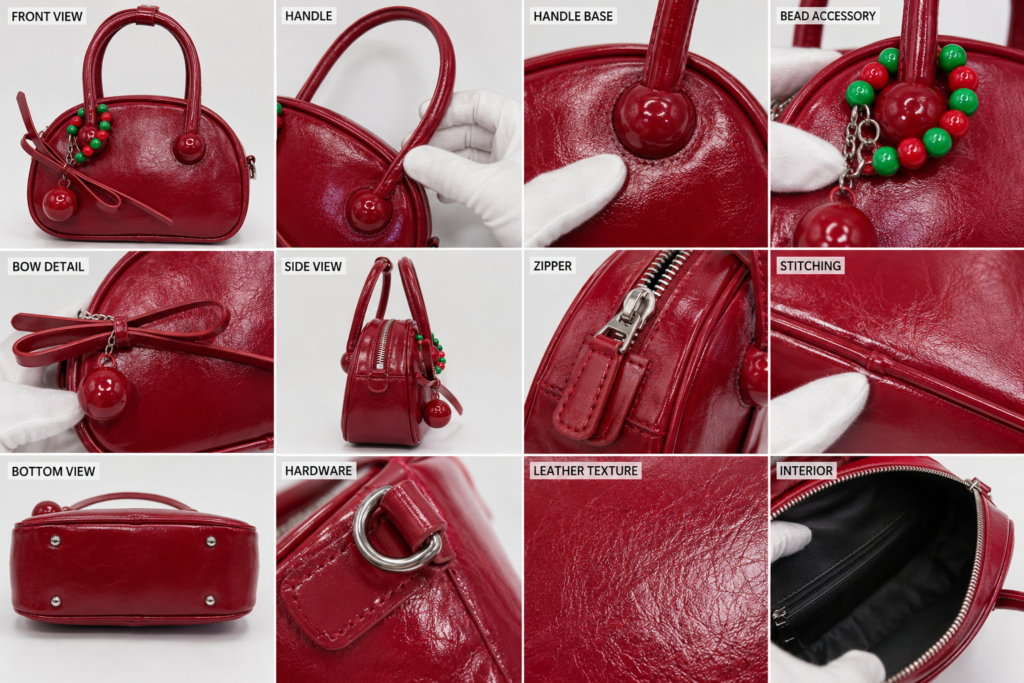
Caption: Trend-led details must remain consistent and functional across bulk production, not only on the approved sample.
How S.MU ACCESSORY Supports Seasonal Bag Programs
S.MU ACCESSORY is a Guangzhou-based bags and fashion accessories development and supply partner supporting global brands and retailers from trend research, collection planning and design through material sourcing, sampling, production, quality control, packing and delivery follow-up.
For a Christmas program, relevant evidence should include a dated trend board, original sketches, approved swatches, sample revision records, a production schedule, inspection evidence and an approved packing specification. Buyers should request project-specific confirmation rather than relying on a general lead-time statement.
Fact Box
S.MU ACCESSORY at a Glance
Guangzhou S.Mu Accessory Co., Ltd.
Guangzhou, Guangdong, China
Trend research, OEM/ODM development, material sourcing, sampling, production management, quality control, packing and delivery follow-up
What Should Retailers Prepare Before Requesting a Christmas Production Schedule?
A supplier can only confirm a realistic Christmas production schedule when the commercial brief is specific enough to evaluate materials, sampling, production capacity and delivery requirements.
Before requesting a timeline, retailers should prepare:
- Target market and sales channel
- Required warehouse-ready date
- Expected order quantity by style and color
- Target FOB price range
- Product references, sketches or tech packs
- Preferred materials and color direction
- Logo, hardware and customization requirements
- Packaging requirements
- Destination country
- Testing or compliance requirements
The warehouse-ready date is particularly important. Instead of asking whether an order can be finished “before Christmas,” buyers should provide a specific warehouse or distribution-center date. The supplier can then work backward through shipping, inspection, packing, bulk production, material preparation and sample approval.
For late-season programs, buyers should also separate must-have specifications from optional design details. Changing a standard zipper pull may be relatively simple, while developing a completely new metal buckle could require tooling, plating approval and additional testing.
How Can Retailers Reduce Risk on Late Christmas Bag Orders?
When the Christmas buying window becomes tight, the safest strategy is usually not to compress every production stage. Instead, buyers should reduce unnecessary development uncertainty.
1. Start From Proven Bag Constructions
If a supplier already has an approved east-west bag, shoulder bag, clutch or mini bag construction, adapting that platform can be more practical than developing a completely new structure.
Seasonal differentiation can still come from color, material, lining, hardware finish, logo treatment, straps, bag charms and packaging.
2. Prioritize Available Materials
A material that looks simple on a design board may become the longest dependency in the project if it requires custom dyeing, special finishing or a large supplier MOQ.
For urgent programs, buyers should ask which suitable materials are already available, previously developed, available in stock colors and compatible with the target construction and quantity.
3. Reduce Sequential Sample Revisions
Multiple sample rounds can consume valuable weeks when each revision waits for the previous sample to arrive and be reviewed. Buyers can reduce this risk by consolidating comments on measurements, hardware, logo placement, strap length, lining and packaging into one controlled revision list whenever possible.
4. Freeze Critical Specifications Before Bulk Production
Before production approval, the project should have clear confirmation of the approved sample, measurements, materials, colors, hardware, logo placement, labels, packaging, quantity allocation and required testing. Any approved exceptions should also be documented.
A Practical Decision Framework for Late Holiday Programs
| Project Situation | Lower-Risk Approach | Higher-Risk Approach |
| Bag shape | Adapt an approved or proven construction | Develop a completely new structure |
| Material | Use confirmed or available material | Develop a new special material |
| Hardware | Use an existing component or finish | Create a new mold |
| Colors | Select available or previously developed colors | Require multiple custom dye developments |
| Sampling | Consolidate feedback and freeze specifications | Run repeated sequential revisions |
| Packaging | Use a proven retail-ready format | Develop complex new gift packaging late |
| Production | Reserve capacity after approval | Assume capacity will remain available |
| Delivery | Confirm freight assumptions early | Decide freight only after production |
The purpose is to identify where differentiation creates commercial value and where complexity only creates schedule risk.
When Should Retailers Make the Final Go / No-Go Decision?
The final decision should be made when the buyer has enough evidence to determine whether the collection can realistically reach the required warehouse date.
Is the Product Development Path Clear?
The bag construction, materials, hardware and customization should be sufficiently defined for the supplier to estimate the remaining work.
Are Critical Materials Available?
Material availability should be confirmed rather than assumed, particularly for custom colors, special fabrics, decorative components and custom hardware.
Is Production Capacity Available?
A technically simple product can still miss the season if factory capacity is already committed. Buyers should distinguish between a generic production lead time and confirmed capacity for the specific order window.
Does the Delivery Plan Still Protect the Selling Window?
Production completion is not the same as retail availability. Inspection, packing, freight, customs clearance and warehouse receiving must still fit inside the remaining schedule.
Frequently Asked Questions
When should retailers place Christmas bag orders?
Retailers should work backward from the date inventory must arrive at their warehouse or distribution center. The schedule should include material confirmation, sampling, approval, bulk production, quality inspection, packing, freight, customs clearance and warehouse receiving.
Is August too late to start a Christmas bag order?
Not necessarily. An August project may still be feasible when the buyer is adapting an existing construction, suitable materials are available, customization is limited and production capacity can be confirmed. A completely new collection with custom hardware, special materials, several sample rounds or extensive testing carries substantially more schedule risk.
Which Christmas bag styles are easier to develop quickly?
Existing or previously developed silhouettes are generally easier to schedule than completely new constructions. Retailers can create seasonal differentiation through colors, materials, hardware finishes, straps, charms, logos and packaging while retaining a proven bag structure.
What usually causes delays in custom Christmas bag production?
Common dependencies include special material development, custom color matching, new hardware molds, plating approval, multiple sample revisions, late specification changes, packaging development, testing requirements, production capacity, freight and customs timing.
Can faster shipping save a late Christmas order?
Faster freight can reduce transportation time, but it cannot solve unfinished product development, unavailable materials, production delays or failed quality inspection.
What should be approved before Christmas bag bulk production begins?
The approved sample, specifications, measurements, materials, colors, hardware, logo placement, labels, packaging and quantity allocation should be sufficiently controlled for repeat production. Testing and inspection requirements should also be confirmed.
Final Takeaway
For retailers planning Christmas bags, the most important deadline is not December 25. It is the date when sellable inventory must be available in the required warehouse or distribution center.
Every other milestone should work backward from that date.
For 2026, trend directions such as east-west silhouettes, soft clutches, larger shoulder bags and giftable mini bags can provide useful commercial inspiration. But a trend only becomes commercially valuable when it can be translated into the right price point, material, construction and delivery window.
Retailers starting earlier have more freedom to develop new materials, hardware and silhouettes. Retailers starting later should focus on reducing development uncertainty: use proven constructions where appropriate, confirm material availability quickly, consolidate sample feedback, freeze critical specifications and secure production capacity before committing to a launch date.
The final question should therefore not simply be “How many days does bag production take?” It should be: “Given our design, quantity, materials, customization and required warehouse date, what is the safest executable production plan?”
Planning a Christmas Bag Collection?
S.MU ACCESSORY supports brands and retailers across trend research, OEM/ODM product development, material sourcing, sampling, production management, quality control, packing and delivery follow-up.
For a project-specific Christmas production assessment, prepare your product reference or tech pack, target market, expected quantity, target price, material preferences, customization requirements, packaging requirements and required warehouse date.
Planning a Christmas Bag Collection?
Send your product reference or tech pack, target market, quantity, target price, material preferences, customization requirements, packaging requirements and required warehouse date for a project-specific feasibility review.
Discuss Christmas Order Feasibility