
Soft Slouchy Bags: How Brands Can Create Relaxed Shapes Without Losing Structure
A slouchy bag should achieve a relaxed drape without losing control at the opening, base, strap attachments or loaded silhouette. Brands should evaluate material softness, backing, lining, localized reinforcement, closure construction and expected carrying weight together. The correct structure is project-specific: too much reinforcement makes the bag rigid, while too little can cause stretching, asymmetry and inconsistent bulk production.
Updated: August 27, 2026 | Scope: soft handbags, shoulder bags and slouchy totes for US, UK and European private-label retail programs
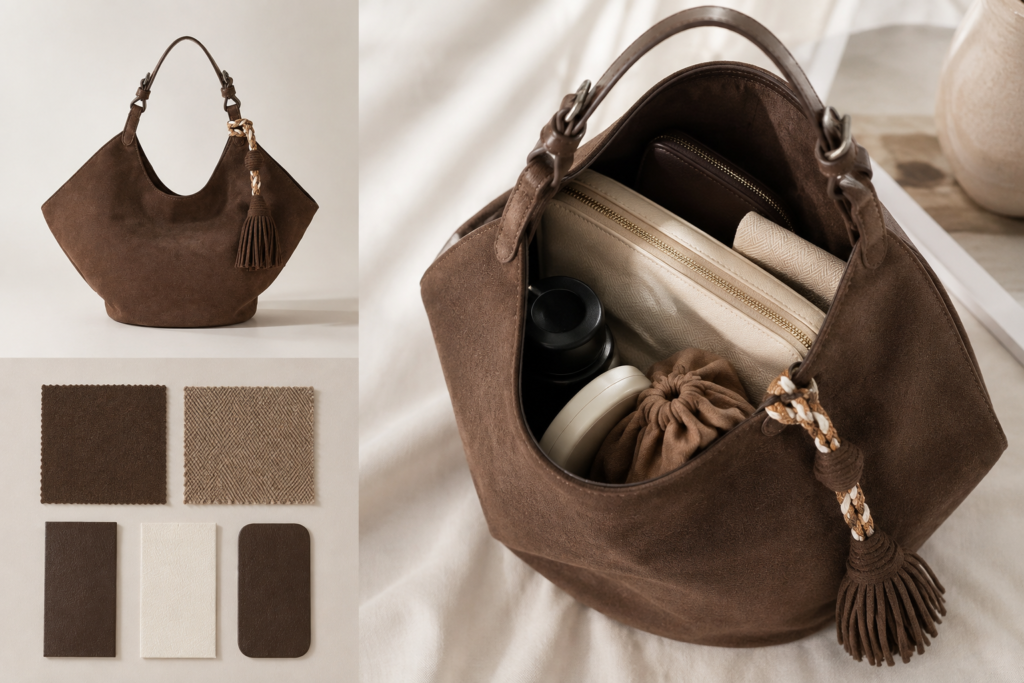
Caption: A useful slouchy-bag review compares the empty silhouette, loaded silhouette and hidden reinforcement—not appearance alone.
Why Are Slouchy Bags a Relevant Development Direction Now?
Slouchy bags have a current fashion signal, but the development opportunity is more specific than “soft bags are trending.” On August 26, 2026, Harper’s Bazaar described slouchy bags as an important Fall 2026 silhouette and summarized the direction as “soft, but not shapeless.” The article cites leather, PU, suede, cotton and neoprene examples across shoulder bags, totes and clutches.
That evidence establishes editorial momentum, not a manufacturing specification or a confirmed Spring/Summer 2027 forecast. For product developers, its value is the underlying problem: how to preserve a relaxed visual identity while controlling function, weight, load and repeatability.
The existing S.MU ACCESSORY Spring/Summer 2027 bag-trend watchlist monitors soft structure as an early signal. This page addresses the next decision—how a buyer can convert that signal into a sample brief.
What Does “Soft but Not Shapeless” Mean in Product Terms?
It means the body is allowed to fold, drape or settle, while selected zones remain controlled. The exact balance depends on the intended use.
A small evening shoulder bag may need only clean opening control and stable strap attachments. A large work tote may need localized base support, stronger seams and a more deliberate load path. Applying the same reinforcement package to both would be poor development practice.
For the first sample, define the intended silhouette in three states:
- empty and standing or hanging;
- carried with a realistic everyday load;
- resting after the load has been removed.
Reference photographs should show the acceptable fold direction, opening behavior and base profile. Words such as “relaxed,” “buttery” or “premium” are not measurable without a visual reference, material specification and sample approval.
Which Materials Work for a Soft Handbag?
Material selection should start with the desired drape, target cost, surface appearance, expected load and applicable market requirements. No material category is automatically suitable merely because it feels soft in a swatch.
| Material direction | Potential advantage | Development question | Risk to review |
|---|---|---|---|
| Soft PU | Broad finish and color possibilities | Does the backing recover after folding and loading? | Creasing, delamination or uneven stretch are project-specific risks |
| Leather | Natural hand feel and varied drape | Are thickness, temper and panel selection controlled? | Hide variation, weight and cost |
| Suede or suede-effect material | Tactile, relaxed surface | How will nap, shade and abrasion be evaluated? | Directional shade and surface marking |
| Nylon or polyester textile | Lower weight and adaptable construction | Is body control created through lining, quilting or localized backing? | Excess collapse or puckering |
| Canvas or cotton textile | Casual structure and print potential | Has shrinkage, colorfastness and seam behavior been reviewed for the project? | Distortion, fraying or excessive stiffness |
These are development considerations, not universal pass/fail claims. Buyers should approve the actual material, color, backing and finished sample rather than rely on a category name.
S.MU ACCESSORY’s Design Studio is the relevant internal path for comparing silhouette references, materials, construction direction and target cost before sampling.
Where Should a Slouchy Bag Be Reinforced?
Reinforce load paths and control points rather than making the entire bag rigid. Typical review zones include the shoulder or handle attachment, zipper ends, magnetic-closure area, pocket openings, base corners and any panel carrying concentrated hardware.
Soft Handbag Structure Decision Matrix
| Decision zone | Buyer must define | Supplier development output | Main failure mode |
|---|---|---|---|
| Body panels | Desired fold, recovery and surface | Material/backing proposal and panel direction | Body becomes rigid or collapses unpredictably |
| Opening | Access, security and acceptable spread | Opening pattern, facing and closure proposal | Gaping, rolling or zipper distortion |
| Base | Loaded shape and standing requirement | No support, flexible support or localized insert | Sagging or an unintended hard shelf |
| Strap attachments | Carrying method and expected load | Reinforcement area, stitch construction and sample evidence | Stretch, tearing or visible distortion |
| Lining | Pocket load and body movement | Fixed, partially fixed or suspended lining approach | Lining pulls the outer shell out of shape |
| Hardware | Weight, position and finish | Component specification and reinforcement implication | Local collapse or imbalance |
The buyer should identify which visual features are mandatory and which construction details may change during cost engineering. A sample cannot be evaluated fairly if the supplier is expected to guess whether softness, standing ability, minimum weight or load capacity has priority.
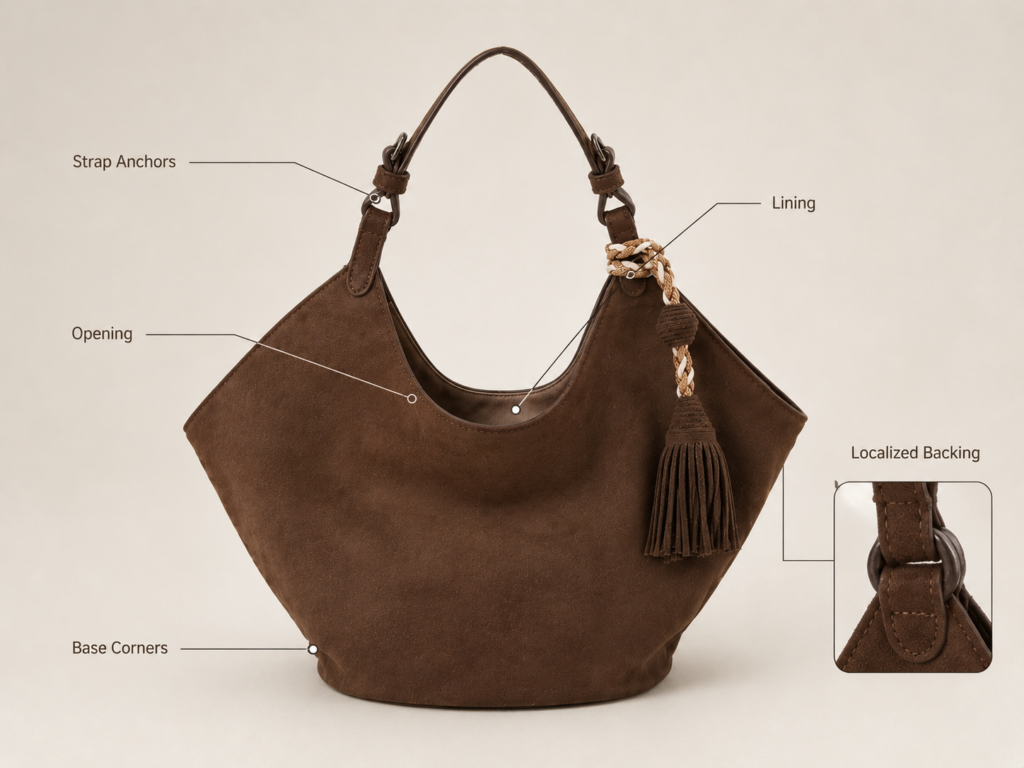
Caption: Localized reinforcement can protect the load path while allowing the main body to retain a relaxed drape.
How Do Capacity and Closure Change the Silhouette?
Capacity is part of the structure. A wide, shallow slouchy shoulder bag behaves differently from a deep carryall when filled. Before pattern development, specify the intended contents, whether the bag should stand, and how much opening spread is acceptable.
Closure choice also changes both function and shape:
- A full zipper can improve security but may create a controlled top line that resists a loose fold.
- A magnetic closure can preserve a relaxed opening, subject to placement, reinforcement and intended load.
- A drawstring can create deliberate gathers but adds friction and repeated stress at channels or eyelets.
- An open top gives the softest access but may not meet the buyer’s security requirement.
These are trade-offs, not a universal ranking. Confirm closure strength, access and appearance on the actual sample.
How Should Buyers Test a Slouchy Bag Sample?
Evaluate the approved appearance and its response to intended use. A useful sample review records the test setup instead of relying on an unrepeatable impression.
| Sample check | Record | Approval question |
|---|---|---|
| Empty silhouette | Front, side and base photographs | Is the natural collapse intentional and repeatable? |
| Defined load | Item list or agreed test load and duration | Does the bag retain acceptable access and carrying comfort? |
| Strap attachment | Before/after photographs and measurements where required | Is there visible stretch, seam opening or distortion? |
| Closure | Open/close function under the defined load | Does the opening remain usable and secure? |
| Recovery | Appearance after the load is removed | Is residual deformation acceptable? |
| Left/right comparison | Pattern alignment, seam position and fold behavior | Is asymmetry designed or uncontrolled? |
Testing scope and acceptance criteria are buyer- and project-specific. Agree them before bulk production. The S.MU ACCESSORY quality-control process is the appropriate next path for connecting the approved sample with material review, workmanship checks and pre-shipment evidence.
What Makes Bulk Production Inconsistent?
Soft construction exposes variation that a rigid shell can sometimes conceal. Bulk inconsistency may come from material thickness or stretch, cutting direction, backing placement, seam tension, lining attachment, hardware weight or handling during packing.
Production controls should identify the approved reference sample, critical measurements, permitted visual variation and inspection evidence. Folding and packing also matter: compressing a soft bag may be efficient, but the buyer should confirm whether the product recovers within the agreed presentation window.
S.MU ACCESSORY’s manufacturing workflow connects the approved brief and sample to material confirmation, production management and inspection. Relevant first-party proof for this article would include anonymized pattern notes, backing trials, a loaded-sample comparison, sample comments and bulk inspection photographs. Claims should remain pending until those items are supplied.
S.MU ACCESSORY is a Guangzhou-based bags and fashion accessories development and supply partner supporting global brands and retailers from trend research, collection planning and design through material sourcing, sampling, production, quality control, packing and delivery follow-up. For this article, its relevant role is limited to material review, soft-structure development, sampling and the evidence needed to carry an approved silhouette into production.
How Do Material and Structure Affect MOQ and Cost?
MOQ and cost can change with the selected material color, backing, lining, hardware, closure, custom logo, packaging and number of variants. A softer construction is not automatically cheaper: localized reinforcement, edge treatment, material selection and additional sample trials may add work even when the bag uses fewer rigid layers.
Buyers should request the MOQ per style and color, identify which component creates the constraint, and compare alternatives on the same finished specification. If several colorways share material and hardware, ask whether combined booking is feasible; do not assume it.
What Should Buyers Include in a Soft Handbag Sample Brief?
| Buyer input | Supplier output |
|---|---|
| Target market, channel and user | Market-scoped development assumptions |
| Reference silhouette and unacceptable examples | Defined soft-structure direction |
| Dimensions and intended contents | Pattern, capacity and load-path proposal |
| Target retail or FOB range | Cost-aware material and construction options |
| Quantity by style and color | MOQ and component constraint review |
| Material, lining and closure preference | Swatches and construction recommendation |
| Logo, hardware and packaging | Component and packing implications |
| Required tests and approval date | Sample plan, evidence list and next approval |
This article sits primarily at Collection Planning & Design. The previous stage is trend research; the next stages are material sourcing and sampling/costing. The main risk is approving a fashionable empty silhouette without defining how the bag should behave when carried.
FAQ
Can PU be used for a slouchy handbag?
Yes, but “PU” alone does not define the result. Review the actual surface, backing, thickness, hand feel, fold behavior and recovery in the selected color. Approve a finished sample under the intended load.
Does a slouchy bag need a baseboard?
Not necessarily. A bag may use no base support, flexible support or localized reinforcement. The choice depends on capacity, load, desired collapse and whether the product should stand when empty or filled.
Should buyers approve a slouchy bag empty or loaded?
Both. Record the empty silhouette, agreed load, loading duration, carrying behavior and appearance after unloading. This gives the supplier and quality team a repeatable approval reference.
Does reinforcement increase MOQ or cost?
It can. Additional backing, support materials, custom components and more complex sewing can affect material minimums, labor and sampling. The commercial impact must be confirmed against the selected construction.
What should a buyer send before requesting a sample?
Send the target market, dimensions, quantity, target cost, reference silhouette, material preference, intended contents, closure, branding, packaging and required approval date.
Develop the Sample Around Its Real Use
The commercial value of a slouchy bag lies in controlled softness. Material, backing, opening, base, strap reinforcement and load must be developed as one system. Buyers who approve these points through a documented sample are better positioned to preserve the intended silhouette during costing and bulk production.
FROM SOFT SILHOUETTE TO SAMPLE BRIEF
Discuss material, structure and MOQ for a soft handbag sample
Share your target market, dimensions, expected quantity, target cost, reference silhouette, preferred material and carrying requirements.
Send Your Soft Handbag Brief Discuss on WhatsAppPrefer email? Email your reference images and brief.
