
Spring/Summer 2027 Bag Trends: Early Predictions and Emerging Handbag Styles
Spring/Summer 2027 bag trends are now supported by completed runway evidence from New York, London, Milan and Paris. Across the four cities, the strongest commercially useful directions are soft and practical volume, familiar shapes refreshed through proportion or finish, tactile and crafted surfaces, and deliberate scale contrast between core, fashion and hero products. These signals are not retail-sales proof; they are a development filter for buyers deciding what to sample, cost and test.
Paris strengthened the case for relaxed capacity and recognizable bag families reworked through softness, scale, surface or construction. It also showed a wide gap between oversized everyday bags and compact, highly detailed pieces. For retail buyers, that contrast is more useful as an assortment strategy than as a prediction that one size will replace another.
The commercial opportunity is not to reproduce a runway bag. It is to select a repeated design principle, assign it a clear product role and test the material, construction, cost, MOQ and quality implications before committing to a wider range.
Brands that want to understand how runway signals can be translated into commercial products can also read S.MU’s guide to turning Fashion Week trends into commercial accessory collections. The framework emphasizes repeated evidence rather than copying one isolated runway look.
Evidence review — October 7, 2026: New York, London, Milan and Paris evidence has now been reviewed. The four-city comparison strengthens soft and practical volume, familiar-shape refreshes, tactile or crafted surfaces and controlled scale contrast. Visible utility remains strongest in New York, while a single universal SS27 color conclusion is not supported by the reviewed evidence.
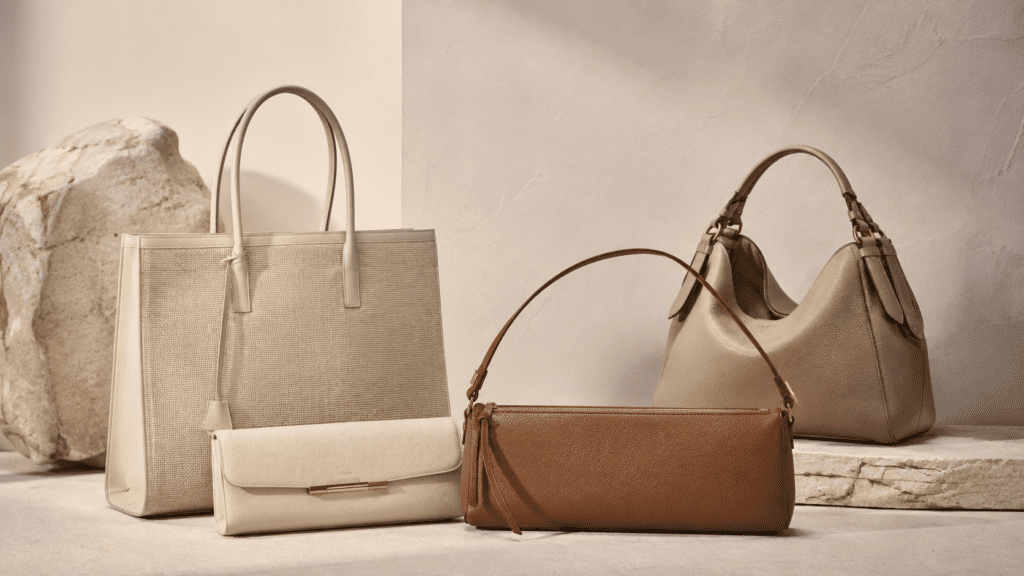
Caption:SS27 handbag directions updated after the completed New York, London, Milan and Paris review; the strongest commercial signals are soft volume, familiar-shape refreshes, crafted surfaces and controlled scale contrast.
Spring/Summer 2027 Bag Trends: Key Takeaways
- Flat totes are one of the strongest current shape movements.
- East-west proportions continue to show commercial momentum.
- Larger bags remain important, but weight and cleaner construction may matter more than extreme size.
- Soft structure and pouch-like shapes are challenging rigid handbag construction.
- Texture is becoming part of the design identity, particularly through woven surfaces and tactile materials.
- Woven bags remain highly relevant to spring, summer and resort categories.
- Clutches are becoming more versatile and increasingly suitable for daytime use.
- Personalization may develop toward modularity, combining straps, pouches and charms.
- Function is returning to fashion, especially across work and everyday tote categories.
- London update: London SS27 strengthens the case for scale, tactile surfaces and archive reinterpretation, but the most visible novelty bags should be treated as hero products rather than automatic volume bets.
- Milan update: tactile and crafted surfaces, woven and raffia construction, larger soft volumes and familiar shapes refreshed through proportion or finish now have multi-brand Milan evidence; stacked mini bags and extreme novelty forms remain controlled hero or capsule tests.
- Paris update: soft and oversized everyday volume, familiar signatures reworked through proportion or construction, craft-led surfaces and deliberate contrast between large and small bags now have multi-brand Paris evidence. Highly recognizable novelty forms remain hero-product references rather than automatic volume bets.
The four-city review does not identify one bag that every market should buy. It identifies repeated design principles that buyers can filter by customer, channel, price architecture, product role and development risk.
Planning an SS27 Bag Line?
Turn the trend directions most relevant to your market into a practical development brief: silhouette, materials, target price, quantity and timeline.
New York Fashion Week SS27 Handbag Signals — Updated September 20, 2026
New York Fashion Week strengthened four commercially relevant SS27 handbag directions: visible utility and external pocketing, familiar archive shapes refreshed through function, tactile or handcrafted surfaces, and selective sculptural hardware. These are verified New York signals, not yet four-city conclusions. Retail buyers should treat the first three as development directions and sculptural hardware as a controlled hero-style test.
Coach’s Spring 2027 collection exposed pocketing and inside-out construction across familiar bag families. Proenza Schouler refreshed the PS1 Walker through a utilitarian, fluid and tactile approach. Tory Burch added embroidered and textured handbag surfaces, while Michael Kors identified sculptural bags within its Spring 2027 direction.
| NYFW signal | Evidence status | Commercial role | What the buyer should specify | Production and QC questions |
|---|---|---|---|---|
| Visible utility and external pocketing | Verified in New York; cross-city confirmation pending | Core or seasonal update | Pocket purpose, size, access, closure, attachment and loaded capacity | Panel alignment, exposed-edge finish, reinforcement, attachment strength, added parts and labor |
| Familiar or archive-shape refresh | Strengthened in New York | Core-shape update | Target proportion, opening, capacity, carrying method and functional difference | Fit, weight, repeatability and avoiding overly close copying of iconic combinations |
| Embroidered, woven or tactile surfaces | Strengthened in New York | Seasonal or test group | Surface reference, coverage area, backing, color standard and intended retail use | Snagging, abrasion, colorfastness, batch consistency, handwork time and MOQ impact |
| Sculptural handles or hardware | New controlled test | Hero or capsule style | Dimensions, material, finish, weight limit, comfort and mold ownership | Tooling cost, sharp edges, plating consistency, pull strength and long-wear comfort |
Buyer action: Do not rebuild the whole range around one runway idea. Select one commercially familiar base shape, add one verified feature, and request separate costing for the base construction and the added trend detail. This makes the effect on MOQ, labor, tooling, quality risk and target price easier to compare.
What Buyers Should Send Before SS27 Sampling
| Buyer input | Supplier output needed before sampling |
|---|---|
| Target market and customer | Commercial relevance and use-case review |
| Selected NYFW signal | Construction and material options |
| Reference image or sketch | Interpretation notes and points that must not be copied literally |
| Expected order quantity | MOQ-sensitive material, component and process options |
| Target price or retail architecture | Main cost drivers and controlled alternatives |
| Required warehouse date | Development, approval, production and inspection milestones |
SS27 Buyer Development
Turn a Verified SS27 Signal Into a Controlled Sample Brief
Share your target market, selected trend signal, reference images, quantity, target price and required warehouse date. S.MU can review material, construction, MOQ, cost and QC implications before the direction moves into sampling.
Start an SS27 Development BriefLondon Fashion Week SS27 Bag Signals — Updated September 22, 2026
London Fashion Week added a clear but narrow SS27 bag signal: Mulberry used structured leather, enlarged an archival Piccadilly shape, introduced mock-croc surfaces and treated sculptural bags as brand storytelling. For retail buyers, the scalable opportunity is not to copy a runway novelty. It is to test proportion, surface and archive-inspired product roles across core, fashion and hero SKUs.
London Fashion Week ran from September 17–21, 2026. Mulberry’s September 20 show provided the clearest verified handbag evidence in this review: boxy leather constructions, an enlarged archival Piccadilly bag, mock-croc versions and narrow axe-shaped bags. These details are supported by contemporary show reporting from Wallpaper* and ELLE. Because this evidence is concentrated in one brand, it should be treated as a focused London signal—not proof that every silhouette or material is a city-wide SS27 trend.
What London Added to the SS27 Bag Watchlist
| Verified signal | Evidence boundary | Commercial translation | Development and QC questions | Assortment role |
|---|---|---|---|---|
| Enlarged archival Piccadilly proportion | Verified at Mulberry; not yet a multi-brand London conclusion | Test a moderately enlarged day bag or work bag rather than runway-scale volume | Check finished weight, handle drop, base reinforcement, closure access, load balance and shipping volume | Core-to-fashion |
| Structured leather and mock-croc surfaces | Verified in one leather-goods-led collection | Use surface and structure to refresh familiar shapes without requiring a completely new use case | Confirm material and color MOQ, texture direction, gloss consistency, seam alignment, edge finishing and flex performance | Fashion commercial |
| Narrow axe-shaped and sculptural handbags | Strong visual runway evidence but limited proof of repeat demand | Translate the idea into angular panels, controlled geometry or a small capsule instead of copying the recognizable form | Review pattern complexity, special tooling, hardware, usable capacity, cost and IP risk | Hero / PR / window |
The most commercially useful London takeaway is a product-role decision. A runway signal can inspire a scalable core bag, a fashion-led seasonal update or a hero piece, but those three roles should not carry the same quantity, cost target or development risk.
How Should Buyers Translate These Signals Into an SS27 Range?
| Product role | Recommended SS27 action | Suitable development brief | Main risk to control |
|---|---|---|---|
| Core | Refresh a proven day-bag or work-bag body with a controlled increase in scale | Target market, intended use, device or document capacity, target retail price, material and maximum finished weight | Oversizing without improving function |
| Fashion | Add mock-croc, pronounced texture, sharper structure or archive-informed proportions to a familiar shape | Reference surface, color, finish level, order quantity, launch window and acceptable material alternatives | Material MOQ, batch variation and cost escalation |
| Hero | Develop one highly recognizable shape for campaign, display or limited capsule use | Visual objective, channel, limited quantity, target cost ceiling and acceptable tooling investment | Low repeatability, poor capacity, IP similarity and excessive tooling |
Buyers still defining silhouette, proportion and range roles can start with the S.MU Design Studio. Once the direction is selected, the custom bag sampling process should test the physical balance before the style is approved for bulk production.
Manufacturing Questions to Resolve Before Sampling
- Scale and weight: What must the bag carry, and what is the maximum acceptable finished weight after reinforcement, lining and hardware are added?
Put the selected dimensions, material alternatives, construction notes and testing requirements into the bag tech pack before requesting the first quotation.
- Handle engineering: Does the handle drop work when the bag is loaded, and do the attachment points require reinforcement or wear testing?
- Mock-croc consistency: Can the grain direction, embossing depth, gloss and color be kept consistent across panels and production batches?
- Closure and access: Does a larger or narrower shape remain easy to open, close and pack in real use?
- Cost and MOQ: Which material, color, hardware or tooling decisions create separate MOQ or cost thresholds?
- Packing and QC: Will the product hold its shape in storage and transit, and which measurements, loading tests and cosmetic standards must be written into the inspection criteria?
Review how these choices move from approved sample into manufacturing and quality control.
SS27 Buyer Development Check
Which London signal belongs in your core, fashion or hero range?
Send your target market, sales channel, target retail price, quantity, launch date, preferred material and intended product role. S.MU can review the brief before sampling and identify the main cost, construction and QC questions.
Request an SS27 Development ReviewMilan Fashion Week SS27 Bag Signals — Updated September 29, 2026
Milan Fashion Week strengthened three commercially relevant SS27 bag directions: tactile and crafted surfaces, larger soft volumes with controlled weight, and familiar shapes refreshed through proportion or finish. These signals appeared across multiple collections, while stacked mini bags, extreme scale and novelty forms remain better suited to controlled hero or capsule tests. Paris evidence is still pending.
Milano Fashion Week’s official schedule confirms that the Spring/Summer 2027 womenswear season ran from September 22–28, 2026. A cross-brand handbag review by Vogue Arabia documented flattened shapes and elongated handles at Prada; fringe, embroidery and decorative surfaces at Fendi; soft oversized volume at Max Mara; grouped mini bags and drawstring pouches at Marni; gathered soft bags and structured carryalls at Sportmax; archive-led forms at Gucci; and woven or raffia construction at Dolce & Gabbana and Bottega Veneta.
These are runway and editorial observations, not proof of retail sales or guaranteed demand. Their value for a buyer comes from repetition across collections and from whether the idea can be converted into a product with a clear use case, target cost, quantity, test scope and required warehouse date.
What Milan Added to the SS27 Commercial Watchlist
| Verified Milan signal | Evidence boundary | Commercial translation | MOQ and cost impact | Production and QC questions | Assortment role |
|---|---|---|---|---|---|
| Tactile, fringed, embroidered and woven surfaces | Repeated across Fendi, Etro, Dolce & Gabbana and Bottega Veneta | Apply one controlled surface treatment to a familiar silhouette | Handwork, coverage area, material source and color may create separate MOQ and labor thresholds | Check attachment, backing, snagging, abrasion, colorfastness, weave tension and batch consistency | Fashion / limited core update |
| Large, soft and slouchy capacity | Visible at Max Mara and Sportmax, with soft pouches also appearing at Marni | Develop usable volume without excessive reinforcement or hardware weight | Larger material consumption and packing volume; lighter construction may reduce weight but increase shape-control risk | Check loaded weight, handle attachment, base support, opening access, measurement tolerance and shape recovery after packing | Core / fashion |
| Raffia and open woven construction | Visible at Dolce & Gabbana and Bottega Veneta | Use for spring, resort or warm-market capsules with an internal durability strategy | Material availability, handwork and lining construction are project-specific | Check edge shedding, snagging, seam security, lining attachment, moisture exposure and carton protection | Seasonal capsule |
| Flattened proportions and elongated handles | Strong at Prada but not yet a broad Milan consensus | Test as a controlled update to a tote or shoulder-bag body | Pattern efficiency and reinforcement depend on intended capacity and handle drop | Check opening access, distortion when filled, handle balance and panel stability | Fashion commercial |
| Multiple small bags worn together | Clear at Marni but still concentrated | Translate into removable pouch systems rather than a literal runway copy | Extra components, attachment hardware and packaging increase cost and QC points | Check attachment pull strength, compatibility, color matching, part count and loss risk | Hero / capsule |
| Archive and familiar forms refreshed through finish or scale | Visible at Fendi and Gucci | Update a proven commercial architecture without copying protected combinations | Existing construction may reduce development risk; new surfaces or hardware can add tooling, labor or MOQ | Review IP similarity, finish consistency, functional differentiation and finished weight | Core-to-fashion |
Which Milan Directions Are Most Scalable for Retail Buyers?
The most scalable Milan direction is not a single silhouette. It is the use of one visible change—surface, scale, softness, carry method or finish—on a bag architecture that already has a clear customer and use case. A buyer can keep the base construction commercially familiar while testing one higher-risk element in a controlled quantity.
For a core style, prioritize capacity, lower finished weight, comfortable handles and a proven opening. For a fashion style, add one tactile surface, elongated proportion or woven treatment. For a hero style, limit the order exposure and define the campaign, window-display or capsule role before accepting extra tooling, handwork or quality risk.
Manufacturing Questions to Resolve Before Sampling
- Which detail carries the trend: surface, scale, carry method, color or hardware?
- Can the base bag be quoted separately from fringe, embroidery, raffia, special weave or custom hardware?
- What is the maximum acceptable finished weight when the bag is loaded?
- Which material, color, component or process creates a separate MOQ?
- What inspection criteria cover attachment strength, abrasion, snagging, colorfastness, weave consistency and shape recovery?
- Can the concept remain original when recognizable brand combinations and signature details are removed?
Buyers can use the S.MU Design Studio to turn a selected signal into an original collection brief, then use the custom bag sampling process to test material behavior, proportion, capacity, cost and physical balance before bulk approval.
Paris Fashion Week SS27 Bag Signals — Updated October 7, 2026
Paris completed the SS27 four-city review and strengthened four commercially relevant directions: soft and practical volume, scale contrast, familiar signatures reworked through proportion or construction, and surface-led design. These signals appeared across several collections, but they remain runway evidence rather than proof of retail demand.
The official FHCM calendar confirms that Paris Fashion Week Womenswear Spring/Summer 2027 ran from September 28 to October 6, 2026. A dated Vogue Arabia review of the Paris bags documented roomy and soft bags, dramatic shifts in scale, open latticework, embroidery, fringe, compact embellished pieces and familiar house signatures reworked in new proportions or constructions.
These observations should be used as a commercial filter. Repetition across brands can justify a sample test, but it does not remove the need to define target customer, price, quantity, capacity, material performance and required warehouse date.
What Paris Added to the SS27 Commercial Watchlist
| Verified Paris signal | Evidence boundary | Commercial translation | MOQ and cost impact | Production and QC questions | Assortment role |
|---|---|---|---|---|---|
| Soft, slouchy and generously sized bags | Repeated across Dior, Dries Van Noten, Balenciaga, Loewe and Miu Miu in the reviewed source | Develop useful capacity with controlled weight, a clear opening and stable carrying comfort | Larger material consumption and packing volume; lighter structure may reduce weight but increase shape-control risk | Check loaded weight, handle attachment, base support, opening access, measurement tolerance and recovery after packing | Core / fashion |
| Deliberate contrast between oversized and compact bags | Visible across Maison Margiela, Balmain, Dior, Miu Miu and Valentino | Use size contrast to build a range: practical volume for core styles and smaller detailed pieces for fashion or occasion roles | Extreme scale can alter pattern efficiency, material use, packaging and order allocation | Check usable capacity, balance, closure access, hardware weight and packaging protection | Assortment strategy |
| Familiar signatures refreshed through softness, scale or construction | Visible at Dior, Loewe and Chanel; the interpretation remains brand-specific | Refresh a proven commercial architecture through one original change rather than reproducing a recognizable branded combination | A known base can control development risk, while new panels, hardware or finishes may add tooling and labor | Review originality, functional difference, pattern balance, finish consistency and finished weight | Core-to-fashion |
| Open latticework, fringe, embroidery and jewel-like surfaces | Visible across Dior, Schiaparelli, Hermès and Valentino | Apply one controlled craft or surface treatment to a familiar silhouette | Handwork, coverage, backing, special components and color can create separate MOQ and labor thresholds | Test snagging, abrasion, attachment, edge finish, colorfastness and batch consistency | Fashion / hero |
| Print, color and tonal coordination between bag and outfit | Visible at Dries Van Noten, Celine and Mugler, but without one universal palette | Use coordinated color or print as a capsule concept rather than declaring one color of the season | Printed or custom-colored materials may require project-specific minimums and approvals | Confirm artwork scale, color standard, placement, shade consistency and material availability | Seasonal capsule |
What Paris Changes in the Four-City Conclusion
Paris does not replace the earlier New York, London or Milan conclusions. It changes their confidence and commercial interpretation.
- Soft volume becomes stronger: Milan and Paris both support relaxed, larger capacity, while London adds the need to control scale and weight.
- Familiar-shape refresh becomes the clearest cross-city strategy: New York, London, Milan and Paris all show recognizable bag architectures changed through function, proportion, surface or finish.
- Crafted surfaces remain commercially relevant: embroidery, fringe, woven construction, latticework and pronounced texture repeat across cities, but coverage, labor and quality risk must be quoted separately.
- Scale becomes an assortment decision: oversized and compact bags can coexist when each has a defined customer, use case, price and product role.
- Visible utility remains more concentrated: New York supplied the clearest external-pocket and inside-out utility evidence; it should not be described as a universal four-city result.
- Color remains plural: the reviewed collections use neutrals, brights, metallics and print in different ways, so the evidence does not support one universal SS27 handbag color.
Which Paris Directions Are Most Scalable for Retail Buyers?
The most scalable Paris direction is a controlled change to a commercially understood bag. A buyer can start with a proven tote, shoulder bag, hobo or carryall and change one visible variable: softness, scale, surface, handle proportion, opening construction or color treatment.
For a core style, prioritize capacity, comfort, lower finished weight and a reliable opening. For a fashion style, test one crafted surface or proportion change. For a hero style, define the campaign or display purpose and limit exposure before accepting unusual tooling, handwork, low capacity or high quality risk.
Before approving a Paris-informed sample, confirm:
- the customer and carrying use;
- the product role: core, fashion or hero;
- quantity by style and color;
- target price or retail architecture;
- maximum acceptable finished weight;
- material and component alternatives;
- the feature the sample must prove;
- the required warehouse date; and
- the inspection criteria for the selected trend detail.
Why Should Buyers Act on Spring/Summer 2027 Bag Signals Now?
The New York, London, Milan and Paris runway review is complete, but the commercial work begins after the shows. Buyers now need to decide which repeated signals deserve a controlled sample, which details belong only in a fashion or hero product, and which ideas should remain on the watchlist until retail evidence becomes available.
Acting now does not mean committing to a large order. It means converting one relevant direction into a clear development brief while there is still time to compare materials, quotations, construction options, sample performance and delivery scenarios. The brief should identify the target market, customer, product role, quantity, target price, preferred material, required warehouse date and the feature the sample must prove.
The safest commercial approach is to retain a familiar bag architecture and test one main variable—such as softness, scale, surface, handle proportion, opening construction or color treatment. This makes cost, MOQ and quality effects easier to isolate than a sample that changes every component at once.
Buyers should work backward from the required warehouse date using the actual project scope and confirmed supplier schedule. Material development, special hardware, handwork, testing, approval rounds and shipping method can change the timeline, so no single lead-time claim applies to every SS27 bag.
1. Flat Totes Are One of the Strongest Shapes to Watch
The flat tote deserves to sit near the top of the early SS27 watchlist.
Recent Who What Wear coverage calls the flat tote the biggest bag trend of 2026, emphasizing sleek, flattened silhouettes and tactile materials including velvet, satin and technical nylon. See the flat tote trend analysis.
Unlike a conventional deep tote, a flat tote creates visual impact through width, proportion, material and surface.
This matters commercially because the same design logic can be translated across very different product levels. A premium version could use leather or complex woven construction. A contemporary version could use soft PU or suede. A more accessible version could use nylon, canvas or textile.
For brands that want to test a new silhouette before committing to production, a controlled custom bag sampling process can compare material behavior, proportions and sample revisions before final approval.

Caption: Flat and east-west proportions are being monitored as key early SS27 shape signals.
What Makes a Flat Tote Commercial?
Editorial appearance is only the first test. Once the bag becomes a physical product, brands need to consider opening access, internal organization, handle strength, reinforcement, weight and appearance when filled.
The strongest commercial flat tote should preserve the visual idea of slimness without sacrificing usability. That balance between fashion proportion and real product performance will determine whether the flat tote develops from a visual trend into a larger retail category.
2. East-West Bags Still Have Momentum
The east-west handbag has already survived longer than many short-lived silhouette trends.
Vogue’s Spring 2026 east-west bag analysis identified the elongated horizontal silhouette as a notable seasonal shape, and current 2026 reporting continues to include east-west totes among the year’s prominent bag directions.
The commercial appeal is easy to understand. A familiar shoulder bag can feel significantly more directional simply by changing its width-to-height ratio.
The proportion can be adapted across shoulder bags, top handles, barrel bags, mini bags and clutches. That makes east-west particularly useful for brands that want visible novelty without developing an entirely unfamiliar product architecture.
For buyers translating this proportion into a hand-carried product, our top-handle bag development guide explains handle drop, mount position, opening construction, reinforcement and sample approval.
The next stage of the trend may therefore not require an entirely new silhouette. It may be an east-west bag that becomes softer, flatter, lighter or more convertible.
3. Bigger Bags Are Returning – But Size Is Only Part of the Story
Another important shift is the return of practical capacity.
Vogue’s Fall 2026 handbag report highlights larger shoulder bags designed around real everyday capacity while still retaining a streamlined fashion silhouette.
More Capacity + Cleaner Shape + Lower Weight + Better Function
- elongated work totes
- oversized shoulder bags
- commuter carryalls
- lightweight travel totes
- soft shopping bags
- functional day bags
Weight becomes particularly important. A large handbag made from heavy leather, thick reinforcement and substantial metal hardware can become uncomfortable before the customer adds anything. For brands, the opportunity may therefore be volume without unnecessary mass.
4. Soft Structure Is Challenging Extreme Rigidity
Softness is another important early signal. Vogue’s current Fall 2026 trend analysis includes pillow-like clutches and larger adaptable shoulder bags, showing how product architecture can loosen without losing visual clarity.
Evidence update — August 27, 2026: Harper’s Bazaar’s August 26 coverage identifies slouchy bags as an important Fall 2026 silhouette. This adds another dated signal of soft-structure momentum in 2026, rather than confirmation of a Spring/Summer 2027 runway trend.
This does not mean structured handbags are disappearing. Instead, the interesting space lies between rigid architecture and complete collapse.
A soft bag still needs enough engineering to hold its intended form. That makes reinforcement, material thickness, interlining, seam construction and handle attachment particularly important.
For material selection, localized reinforcement and loaded-sample checks, see our custom slouchy bags development guide.
5. Texture Is Becoming Part of the Design
One of the clearest lessons from the current handbag market is that visual interest does not always require complicated decoration. Increasingly, material is becoming the decoration.
Current 2026 directions include suede, woven construction, satin, velvet, technical nylon and other tactile surfaces. Who What Wear’s current designer-bag coverage includes woven Intrecciato construction combined with suede, showing how surface and construction can carry much of the design identity.
This creates an important development opportunity. A proven shape can change substantially through Material + Surface + Color + Hardware.
This is where original development photography becomes especially valuable. S.MU’s Design Studio connects trend research with silhouette planning, material exploration, hardware, function, pattern development and bulk feasibility. Showing actual material boards and samples inside the trend report makes that process visible rather than simply claiming design capability.
6. Woven Bags Have Strong Commercial Potential
Woven construction is particularly relevant to spring and summer because texture can create a strong visual identity without relying on heavy decoration.
- woven genuine leather
- woven PU
- braided strips
- woven textiles
- synthetic raffia
- mixed leather-and-textile structures
The visual opportunity is clear. The manufacturing challenge is repeatability. Brands should evaluate weave consistency, material stretch, reinforcement, edge finishing, handle attachment and production time.
A complex handwoven prototype may look exceptional but become difficult to reproduce consistently in a larger order. The strongest commercial version may therefore preserve the visual effect while simplifying construction enough for stable production.
7. The Clutch Is Becoming an Everyday Bag
The clutch is also evolving. Vogue’s Fall 2026 handbag analysis identifies a new generation of softer clutches that moves beyond strictly formal evening use toward more adaptable day-to-evening shapes.
- oversized soft clutches
- pillow clutches
- folded pouches
- wristlets
- clutch-to-crossbody bags
- convertible day-to-evening designs
The most commercially interesting versions may add function without visibly changing the simplicity of the silhouette. A detachable shoulder strap or wristlet can turn an editorial clutch into something easier to use and easier to sell.
8. Personalization Is Moving Toward Modularity
Bag charms and decorative accessories have made personalization a visible part of handbag styling. The longer-term commercial opportunity, however, may go beyond decorating one finished bag.
- leather initials
- logo tags
- mini pouches
- removable chains
- textile bows
- charms
- detachable straps
- interchangeable handles
- functional accessory holders
This kind of structure can create additional SKUs, gifting opportunities and seasonal stories without requiring a completely different base construction for every variation.
Collection-planning evidence — September 9, 2026: Gap’s September 1 announcement describes a Fall 2026 GapBag assortment spanning multiple bag shapes and sizes, alongside charms, keychains, scarves and belts. Denim and canvas recur across parts of the assortment. This is a concrete example of a brand extending familiar materials and details into a coordinated accessories range; it is not SS27 runway evidence or proof of sales performance. Read Gap’s official collection announcement.
For an SS27 development brief, the useful question is which elements should remain consistent across a tote, a shoulder bag and optional small accessories. Shared fabrics, lining specifications or hardware finishes may simplify coordination, but they do not automatically reduce MOQ or unit cost. Material minimums, color quantities, component specifications and construction still require a project-specific quotation. Quote detachable accessories separately so buyers can assess the base bag and each additional component before choosing the final assortment.
9. Function Is Becoming Part of Fashion Again
The return of larger bags naturally brings function back into the trend conversation.
- laptop capacity
- secure closures
- internal organization
- reinforced handles
- comfortable shoulder drops
- detachable pouches
- lightweight materials
- luggage compatibility
The challenge is not simply adding more features. It is making those features feel visually integrated into a fashion product.
Brands developing a more functional silhouette can use a controlled bag tech pack to define dimensions, materials, hardware, construction, branding and packaging before moving deeper into sampling.
This becomes particularly important when a trend changes product proportions. A wider tote affects handle placement. A softer body affects reinforcement. A modular accessory creates additional attachment points. A new material may change the way seams, edges and hardware behave.
10. Color: Watch the Transition, Not One ‘Color of the Season
After the completed New York, London, Milan and Paris review, the evidence still does not support one universal Spring/Summer 2027 handbag color. The commercially useful conclusion is a palette structure rather than a single winner: stable neutrals for core styles, selected seasonal color families for fashion groups, and metallic or gloss finishes for controlled accents.
Core Neutrals
Black, chocolate, tan, taupe and cream remain practical bases for core products because they can support different silhouettes, materials and channels. Their commercial value depends on the target customer and price architecture, not on a claim that every market will buy the same neutral.
Seasonal Color Families to Test
Burgundy and soft red; pink and lilac; yellow and orange; powder blue, mint and pale green. These families appeared in different ways across the reviewed evidence and should be tested selectively by market, material and product role rather than ordered as one universal palette.
Accent Finishes
Metallic silver, soft gold and gloss-finish surfaces can create controlled accents for hardware, trims, small bags or fashion capsules. Buyers should confirm finish consistency, abrasion performance, color transfer risk and component availability before approval.
Buyer conclusion: These are development families drawn from the reviewed evidence, not a claim that one palette will perform across every market. Select color by customer, channel, price architecture, material availability, minimums and the number of styles that can share the same color standard.
These are development directions to test, not confirmed SS27 color conclusions.
Four-City SS27 Commercial Evidence Matrix
| Trend direction | Four-city evidence | Confidence | Commercial potential | Buyer action |
|---|---|---|---|---|
| Familiar shape refresh | Repeated across New York, London, Milan and Paris through function, proportion, softness, surface or finish | High | High | Apply one original change to a proven architecture and review IP similarity |
| Tactile, woven, embroidered or crafted surface | Supported in New York, strongly repeated in Milan and Paris, with narrower London evidence | High | High | Quote the base bag and surface treatment separately; define abrasion, snagging and consistency checks |
| Larger, soft and practical volume | Strengthened by London scale, Milan soft carryalls and multi-brand Paris evidence | High | High | Set capacity, maximum weight, opening, handle load and packing-recovery requirements |
| Scale contrast across large and small bags | Visible in London hero pieces, Milan mini groupings and multiple Paris collections | Medium–High | Medium–High | Use as an assortment strategy rather than choosing one universal size |
| Woven, raffia or open construction | Strong Milan evidence and additional Paris lattice or raffia examples | High | High for spring, resort and warm markets | Confirm material supply, edge control, lining, snagging and carton protection |
| Flat or elongated proportion | Strong pre-runway signal with limited direct Milan support; Paris emphasized broader proportion play rather than one dominant flat shape | Medium–High | High | Retain as a targeted fashion-commercial test, not a universal four-city conclusion |
| East-west bag | Continuing commercial proportion with relevant market momentum, but not the dominant final four-city runway result | Medium–High | High | Test within shoulder, top-handle or tote families and verify opening access when filled |
| Visible utility and external pocketing | Clearest in New York; not materially broadened across all four cities | Medium | High for utility-led markets | Treat as a targeted functional direction and specify every pocket’s purpose and loaded performance |
| Everyday clutch or compact detailed bag | Present as soft clutches, compact pouches and highly decorated small bags, especially in Paris | Medium–High | Medium–High | Add a strap or wristlet where it improves use; control hardware weight and interior capacity |
| Sculptural hardware or novelty form | Visible across individual brands but still concentrated in hero presentations | Medium | Medium | Limit to hero or capsule roles; review tooling, safety, capacity, repeatability and IP risk |
| One universal SS27 color | The reviewed cities used varied neutrals, brights, metallics and prints | Low | Project-specific | Build a market-specific palette instead of declaring one global color of the season |
How to read this matrix — updated October 7, 2026: Confidence reflects the breadth and repetition of dated runway evidence reviewed across New York, London, Milan and Paris. It is an editorial evidence judgment, not a retail-sales forecast, measured adoption rate or recommendation for every market. Commercial potential depends on target customer, channel, target price, quantity, material availability, test scope and delivery timing.
Color remains outside this ranking until stronger cross-city evidence supports a seasonal palette.
What Should Buyers Do After the Four-City SS27 Review?
Select the Product Role Before the Trend Detail
Decide whether each proposed style is a core, fashion or hero product. The product role determines acceptable novelty, quantity exposure, cost ceiling and quality risk.
Keep One Commercially Familiar Base
Use a proven tote, shoulder bag, hobo, clutch or carryall architecture where possible. Change one main variable—surface, scale, softness, carry method, opening or finish—so the buyer can isolate its commercial effect.
Separate Base Cost From Trend Cost
Request one quotation for the base construction and a separate cost line for fringe, embroidery, weaving, special hardware, extra pouches or unusual scale. This makes MOQ, labor, tooling and quality implications easier to compare.
Define What the Sample Must Prove
A soft carryall may need to prove loaded shape and handle comfort. An open weave may need to prove snag resistance and lining security. A compact embellished bag may need to prove usable capacity, hardware weight and surface durability.
Build the Approval Record
Record the selected dimensions, material and color standards, hardware finish, construction notes, sample comments, approved changes, target cost basis, test requirements and required warehouse date. Use the S.MU Design Studio for collection and development decisions, then move the approved direction into the custom bag sampling process.
From Trend Signal to Commercial Handbag
A runway idea and a successful retail handbag are rarely identical. Commercial development requires translation:
Trend Research -> Commercial Direction -> Materials & Hardware -> Tech Pack -> Prototype -> Cost & Function Review -> Revision -> Bulk-Ready Approval
A fashion publication can identify a silhouette. A product-development team has to determine whether that silhouette can be made consistently, sourced at the intended cost, reinforced correctly, sampled efficiently and reproduced at bulk scale.
Once the design and sample are approved, the focus shifts toward production feasibility. S.MU’s bag manufacturing process connects brief review, material matching, pattern and sample development, approval follow-up, capacity planning and final production.
Quality Should Start During Development, Not After Production
Trend-led products often introduce new quality risks. A wider bag places different loads on handles. A softer structure may require different reinforcement. A woven surface can introduce consistency issues. A detachable pouch or charm adds attachment points that need to be reviewed.
Quality control should therefore begin before bulk production rather than only at final inspection.
S.MU’s published bag quality-control process covers sample review, material checks, inline QC, final inspection and shipment release, including checks around material, hardware, stitching, dimensions and function.
For buyers that need a more detailed inspection framework, the custom bag quality control checklist also covers material approval, pre-production standards, in-line inspection, packing verification and final AQL inspection.
This is one of the strongest places to use original S.MU photography. A close-up of handle reinforcement, woven consistency, zipper alignment, edge finishing or accessory attachment shows something that a generic fashion trend article usually cannot: how the trend survives real production.
What Buyers Should Validate Next
The four-city runway review is complete. The next evidence should come from commercial development and market response rather than another forecast layer.
| Validation question | Evidence to collect | Decision affected |
|---|---|---|
| Can the soft or oversized shape carry its intended load comfortably? | Loaded sample, finished weight, handle-attachment review and shape-recovery check | Core versus fashion role |
| Can the selected surface remain consistent in production? | Approved swatch, abrasion or snag review, backing method and batch standard | Material approval and order scale |
| Does the proportion remain functional after capacity and reinforcement are added? | Filled sample, opening test, measurement record and wear review | Pattern approval |
| Can the trend detail meet the target cost? | Separated base and detail quotation, MOQ-sensitive alternatives and tooling ownership | Sample selection and price architecture |
| Is the concept sufficiently original? | Revised sketch, feature comparison and removal of recognizable branded combinations | Design approval and IP risk |
| Does early retail evidence support a wider commitment? | Sell-through, replenishment, buyer feedback or inquiry data when available | Reorder or range expansion |
One unusual runway bag is an idea. A commercially useful trend earns wider investment only after it survives material selection, sampling, costing, quality review and relevant market evidence.
FAQ: Spring/Summer 2027 Bag Trends
What bags will be trending in Spring/Summer 2027?
The completed four-city review supports soft and practical volume, familiar bag shapes refreshed through proportion or finish, tactile and crafted surfaces, and deliberate contrast between larger core bags and smaller fashion or hero pieces. Flat and east-west proportions remain relevant commercial tests, while visible utility is more concentrated in New York evidence. These are development directions, not guaranteed retail winners for every market.
Is the flat tote still trending?
Yes, the flat tote remains a relevant commercial direction because it creates visible proportion change across leather, PU, nylon, canvas and textile constructions. However, the completed runway review did not establish one universal flat-tote result across all four cities. Buyers should treat it as a targeted fashion-commercial test and verify opening access, usable depth, reinforcement and appearance when filled.
Are east-west bags still in style?
Yes. East-west proportions remain commercially relevant because they can refresh shoulder bags, top-handle bags, totes, mini bags and clutches without requiring a completely unfamiliar product architecture. The final four-city evidence supports broader proportion play rather than making east-west the only dominant SS27 shape, so market and customer fit should determine the order depth.
Are oversized bags replacing mini bags?
Not completely. Larger bags have gained momentum through practical shoulder bags, work totes and carryalls, but mini bags can still serve occasion, novelty and capsule roles. The more useful SS27 buying question is whether added capacity can be delivered with controlled weight, comfortable handles, secure closures and a clean silhouette.
What materials should brands watch for Spring/Summer 2027?
Buyers should monitor woven and open constructions, lightweight leather or leather alternatives, textiles, embroidery, fringe and other tactile surfaces. Milan and Paris strengthened the craft-led direction, while Paris also showed lighter latticework and highly detailed compact bags. Before bulk adoption, test abrasion, snagging, attachment, colorfastness, backing, seam behavior and batch consistency.
How should retail buyers translate visible pockets into a sample brief?
Define each pocket’s purpose, size, access, closure and attachment before sampling. Then assess added panels, exposed edges, seam alignment, reinforcement, labor and loaded performance. Quote the base bag and the added utility separately so the buyer can judge whether the feature supports the target price.
What did Paris Fashion Week add to SS27 bag trends?
Paris strengthened soft and generously sized bags, deliberate contrast between oversized and compact pieces, familiar signatures reworked through construction or proportion, and craft-led surfaces including latticework, fringe and embroidery. It did not establish one universal size or color. For buyers, Paris is most useful as an assortment and development filter rather than a list of runway shapes to copy.
What stage has Spring/Summer 2027 fashion month reached?
The Spring/Summer 2027 womenswear schedules reviewed for New York, London, Milan and Paris are complete. This report now contains a final four-city runway synthesis dated October 7, 2026. The next validation stage is commercial: sample performance, cost, material availability, quality control and later retail response.
What did Milan Fashion Week add to SS27 handbag trends?
Milan added multi-brand evidence for tactile and crafted surfaces, woven or raffia construction, larger soft volumes and familiar shapes refreshed through proportion or finish. The most scalable buyer opportunity is to apply one visible update to a proven bag architecture. Stacked mini bags and extreme novelty forms remain better suited to limited hero or capsule tests.
How should buyers cost a Milan-inspired SS27 bag?
Request separate costing for the base bag and the added trend feature. Fringe, embroidery, raffia, special weaving, custom hardware, extra pouches and unusual scale can affect material MOQ, labor, tooling, packaging and inspection. A separated quotation lets the buyer compare the visual benefit with the real cost and quality risk before approving a sample direction.
When should brands start developing SS27 handbags?
Brands and retailers working to longer development calendars should already be preparing commercial briefs, material alternatives, base shapes and component options. Current runway evidence can guide controlled sample tests, while final assortment commitments should consider target market, quantity, target price, required warehouse date and later cross-city evidence.
Which SS27 handbag details appeared at New York Fashion Week?
New York Fashion Week verified visible pocketing and inside-out utility, functional updates to familiar bag shapes, tactile or embroidered surfaces and selective sculptural hardware. These are New York signals rather than final four-city conclusions. Flat totes, east-west proportions, suede and final color direction still require stronger cross-city evidence.
Which London SS27 bag signals are commercially scalable?
The most scalable London signals are controlled increases in bag size, structured leather, pronounced surfaces such as mock croc and archive-inspired proportion changes applied to familiar functions. Buyers should test finished weight, closure access, handle strength, material MOQ and target price before expanding these ideas across a full range.
Should brands copy novelty runway bags for SS27?
No. A novelty runway bag is better used as evidence of a broader design principle—such as angular geometry, sculptural construction or a hero-product role—than as a form to copy. Brands should create an original silhouette, check usable capacity and development cost, and avoid protected or highly recognizable brand elements.
Which SS27 bag directions are most scalable for retail buyers?
The most scalable directions are familiar bag architectures updated through one controlled change, such as softness, proportion, surface or carry method. Soft practical volume and tactile surfaces have strong cross-city support, but the final choice should still be filtered by target customer, quantity, price, material supply, test scope and warehouse date. Quote the base bag and trend feature separately before approval.
Developing a Spring/Summer 2027 Bag Collection?
S.MU ACCESSORY supports fashion brands, retailers and private-label programs from early trend direction through physical product development.
Start with the S.MU Design Studio if you are still defining the collection direction, move into the custom bag sampling process when the silhouette and materials need to become physical prototypes, and use the manufacturing and quality-control systems when the approved product is ready to scale.
You can also review S.MU’s current bag and accessory collections for category references, or contact S.MU with your SS27 buyer brief, target market, quantity, price direction and reference images.
Ready to turn SS27 trend directions into physical samples?
Send your target market, quantity, price direction and reference images for a project-specific development review.
Request an SS27 Sample Planning ReviewRecommended Related Reading
- Fashion Week 2026: How Retail Buyers Turn Runway Trends into Commercial Accessory Collections
- How to Prepare a Bag Tech Pack for a Manufacturer
- Custom Bag Sampling Process: From Buyer Brief to Approved Sample
- Custom Bag Quality Control Checklist: From Material Approval to Final AQL Inspection
SS27 Trend Report Update Log
August 19, 2026 – Version 1.4 Final Early Forecast
Published the full Early SS27 Trend Report with embedded source links, S.MU internal development links, Luxury Editorial information modules and the initial SS27 commercial watchlist.
August 27, 2026 — Soft-Structure Evidence Update
Added a dated Fall 2026 slouchy-bag source and a link to the dedicated custom slouchy bags development guide. The existing SS27 forecast, confidence ratings and article structure remain unchanged.
September 9, 2026 — Pre-NYFW Evidence Review
Added a dated evidence boundary, clarified the September presentation window and included Gap’s Fall 2026 assortment as a collection-planning example. Added buyer guidance for material, component and sample decisions. The existing trend sections remain an early SS27 watchlist; no direction was upgraded to confirmed runway status in this review.
September 20, 2026 — New York Fashion Week Evidence Update
Added verified New York runway signals for visible utility, familiar-shape refreshes, tactile surfaces and sculptural hardware. Updated the opening, Quick Facts, watchlist, FAQ and next-evidence block. The existing URL, SEO title, meta description, H1 and core early-forecast sections were preserved. London, Milan and Paris confirmation remains pending.
September 22, 2026 — London Fashion Week Evidence Update
Added verified London evidence from Mulberry, including enlarged archival proportions, structured leather, mock-croc surfaces and sculptural hero bags. Added a core/fashion/hero buying framework and manufacturing questions. Because the evidence was concentrated in one brand, no isolated London signal was presented as a city-wide trend.
September 29, 2026 — Milan Fashion Week Evidence Update
Added multi-brand Milan evidence for tactile and crafted surfaces, larger soft volumes, woven and raffia construction, flattened proportions and archive-led shape updates. Updated the opening, Quick Facts, commercial watchlist and FAQ. The existing URL, SEO title, meta description, H1 and primary search intent were preserved. Paris confirmation remains pending.
October 7, 2026 — Paris and Final Four-City Evidence Update
Added verified Paris Fashion Week dates and multi-brand handbag evidence for soft practical volume, scale contrast, familiar signatures reworked through proportion or construction, and craft-led surfaces. Replaced all “Paris pending” language, updated the opening, Quick Facts, commercial evidence matrix, preparation section, FAQ and next-validation block. The existing URL, SEO title, H1 and primary search intent were preserved because the page was gaining Search Console clicks at the time of the update.
Final four-city synthesis — after the New York, London, Milan and Paris evidence review is complete.

