
Custom Bag Production Lead Time: What Buyers Should Confirm Before Ordering
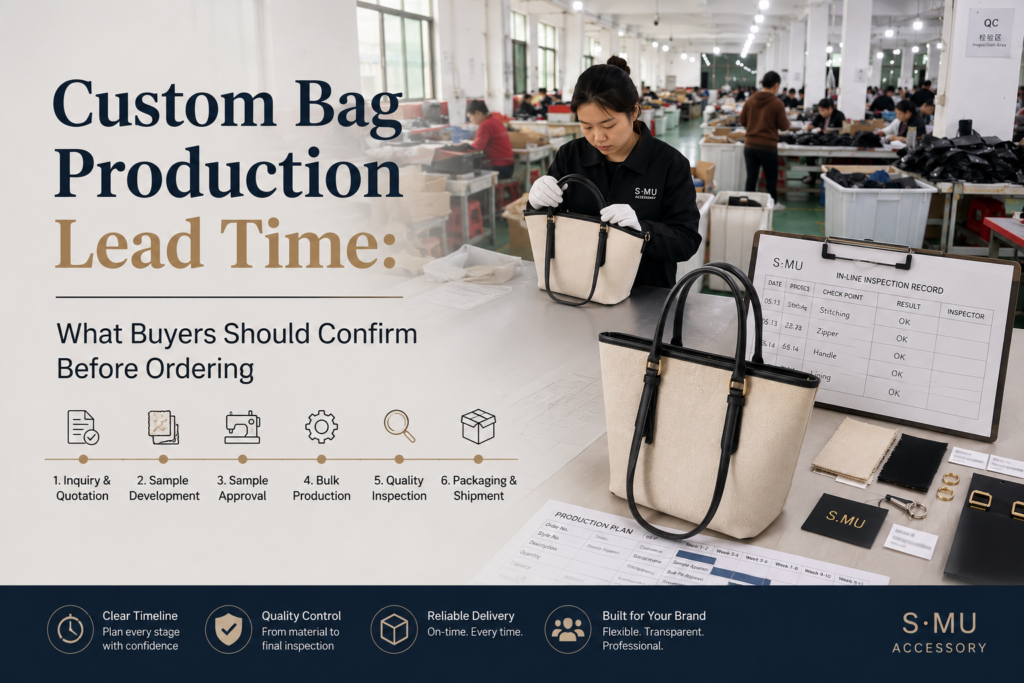
Custom Bag Production Lead Time: What Buyers Should Confirm Before Ordering Bag production lead time often goes wrong before sewing starts. A buyer hears a production estimate, schedules a launch, and later discovers that it excluded sample approval, material booking, packaging or final inspection. For custom handbags, totes, backpacks and accessories, a reliable timeline must define when the clock starts, what it includes, which decisions control the critical path and when inspected goods will actually be ready for handover. Direct answer: Custom bag bulk production usually takes several working weeks after the sample, specifications, commercial terms and production inputs are confirmed. The exact schedule changes with material availability, order quantity, construction, custom hardware, buyer approvals, line capacity, quality corrections and packing. A usable plan shows dated milestones and owners instead of relying on one unsupported lead-time number. Last reviewed: August 31, 2026Who this guide is for: Brands, retailers, importers, private-label buyers and sourcing teams planning an OEM/ODM bag order or seasonal launch. Caption: Illustrative milestone sequence: each project needs dated material, production, inspection and packing milestones confirmed in writing. What Does Bag Production Lead Time Include—and Exclude? Bag production lead time should describe a defined factory scope. It commonly covers material preparation, cutting, sewing, assembly, finishing, in-line checks, final inspection and packing after agreed production-readiness conditions are met. Sampling and freight transit should normally appear as separate periods unless the quotation explicitly combines them. Period Starts when Ends when Do not confuse it with Product development and sampling Buyer brief or tech pack is accepted Sample version and specifications are approved Bulk production Bulk production lead time Agreed commercial and technical conditions are complete Inspected, packed goods are ready for handover Freight transit Logistics lead time Released goods enter the agreed freight process Delivery reaches the contractual destination Factory completion The purchase order should state the trigger. A practical start might be the later of deposit receipt, pre-production sample approval, bill-of-material confirmation and artwork release. If one dependency remains open, show it instead of counting from an earlier date. S.MU ACCESSORY’s custom bag sampling process explains how the brief, components, prototype, comments and approved reference connect before bulk planning. Production Timeline Fact Box Bag Production Timeline at a Glance Bulk-production reference30–60 daysProject-dependent planning range Start conditionSample confirmed, deposit received and required production inputs released Main variablesQuantity, materials, construction, custom components, approvals and line capacity Quality timeIn-line checks, final inspection, corrective action and packing verification Buyer should provideApproved reference, quantities, specifications, packaging and required handover date Planned outputInspected and packed goods ready for the agreed factory handover Scope note: The 30–60-day reference is not an unconditional delivery guarantee and does not automatically include sample development or freight transit. Confirm the exact start trigger, milestones and shipment-ready date in writing for each order. Build the Timeline Backward from the Required Delivery Date Start with the date that matters—warehouse receipt, retailer handover, campaign launch or store set—and work backward. This exposes whether the program is feasible and which decision cannot slip. The sequence below is a planning method, not a universal S.MU commitment. Replace every duration with written dates for the actual product, facility, materials, quantity, market and freight plan. Backward milestone What must be complete Evidence to request Required delivery Goods reach the agreed destination Delivery requirement and Incoterm Freight and destination handling Booking, export handover and transit Forwarder plan and booking milestones Shipment release Buyer or nominated party authorizes release Final inspection result and release record Packing completion Units, labels, ratios and carton marks are verified Packing list, carton specification and photos Final inspection window Finished quantity is available at the agreed level Inspection booking and readiness notice Bulk manufacturing Cutting, sewing, assembly and finishing are complete Progress report by style and color Material readiness Main material, lining, hardware, labels and packaging are available Status sheet and approved references Production release Commercial and technical start conditions are closed Approved sample, specification, PO and open-point log Do not place final inspection on the same day as handover. If defects require sorting, repair or reinspection, a zero-buffer schedule turns a quality decision into a shipping emergency. Have a Fixed Launch or Delivery Date? Check schedule feasibility before placing the order Send the required handover date, bag category, quantity by style and color, current sample stage and any open materials or custom components. S.MU ACCESSORY can review which milestone is likely to control the schedule and what still needs confirmation. Check My Production Timeline Minimum useful inputs: target handover date · product category · quantity split · sample status · open components. Three Bag Orders Can Require Three Different Timelines The same factory can quote different lead times for orders that look similar. The critical path depends on what must be developed, purchased, approved and repeated. Order scenario Planning characteristics Main risks Buyer priority Repeat order using approved materials Existing pattern, known construction and stable packing Material-lot changes, capacity allocation, undocumented revisions Confirm what remains identical and reserve the correct line and material lot Standard custom OEM order New style using available materials and standard hardware Sample comments, color approval, quantity split, packaging files Freeze the reference and close production inputs Complex custom-component program Special material, new mold, custom plating, several colorways or testing Tooling, supplier minimums, approval loops, failed tests, rework Identify the longest-lead component before promising a launch date An accelerated date is credible only when the supplier explains what makes it possible—available materials, existing molds, reserved capacity or faster approvals. “We will try” is not a production plan. Which Factors Control the Critical Path? The critical path is the chain of dependent activities that determines the earliest realistic completion date. Finishing a non-critical task early does not recover time if a required material, mold or approval still blocks production. Material availability Available materials can move faster than specially developed colors, prints, coatings or certificate scopes. Confirm the article, composition, thickness or weight, color, usable width, quantity, supplier minimum, documentation and expected ready date. The custom bag MOQ guide explains how material and component minimums can constrain the order
Christmas Bag Trends and Production Timeline: When Should Retailers Finalize Orders?
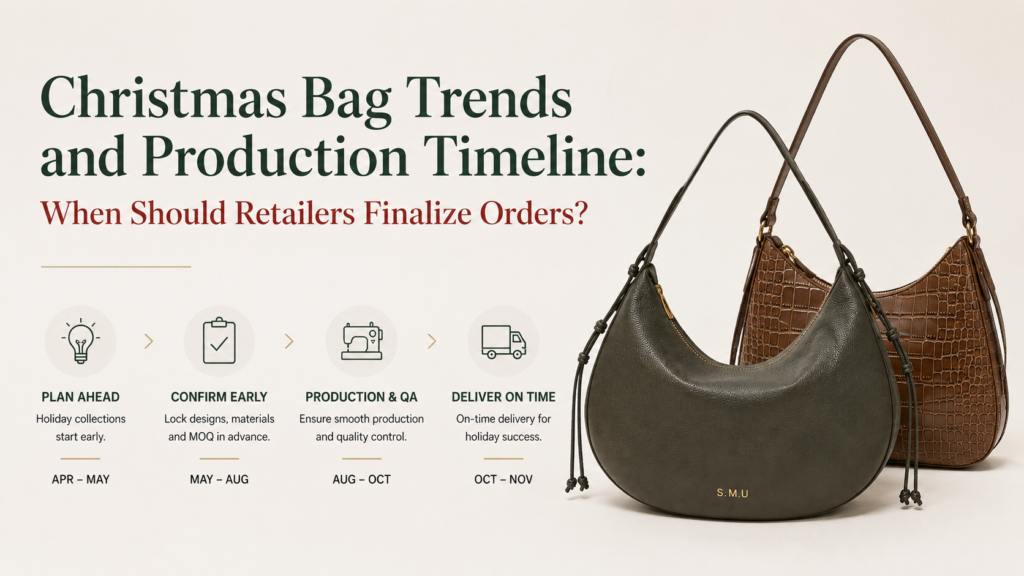
Christmas Bag Trends and Production Timeline: When Should Retailers Finalize Orders? Retailers should finalize Christmas bag orders by working backward from the required warehouse date—not simply from Christmas Day. For a 2026 holiday launch, a fully custom program requiring original hardware, several sample rounds, testing and ocean freight needs an immediate feasibility review. Adapted styles using available materials may offer more flexibility, but every schedule must be confirmed against design readiness, production capacity, inspection and shipping. Caption: A commercial Christmas bag range should balance recognizable seasonal trends with practical price points, production feasibility and post-holiday use. Quick Summary What Christmas Bag Trends Matter for Retail Buyers in 2026? The most useful Christmas bag trends are those that combine current fashion relevance, giftability, a clear price position and feasible production. According to Vogue’s Fall 2026 handbag trend review, notable directions include east-west silhouettes, larger shoulder bags, half-moon shapes, soft clutches, top-handle bags and decorative evening styles. These signals should inspire original product development rather than direct copies of branded designs. Trend direction Commercial opportunity Development consideration Timing risk East-west shoulder bag Recognizable update to an everyday shape Proportion, zipper opening and internal capacity Low to medium Soft clutch or pouch Party dressing and giftable styling Material recovery, lining and closure function Medium Slouchy shoulder bag Everyday use beyond December Softness, reinforcement and shape consistency Medium Mini occasion bag Entry gift or party accessory Phone fit, strap options and compact construction Medium Embellished bag Strong campaign and festive appeal Attachment security, workmanship and inspection High Croc-embossed finish Tactile seasonal update without changing the whole structure Material availability, color and embossing consistency Medium Detachable charm Personalization and add-on selling Mold, attachment strength, weight and small-part requirements Medium to high Retailers can review S.MU ACCESSORY’s existing guide to Christmas bag ideas for private label collections for broader product inspiration. This article focuses on the additional timing and production decisions required to make those directions commercially feasible. How Should Buyers Translate Trends into Sellable Christmas Bags? A trend becomes commercially useful only when it is adapted to a target customer, retail price, sales channel and delivery window. For example, an embellished runway bag may attract attention, but a retailer may obtain a more scalable result by applying one removable charm, decorative closure or metallic accent to an approved core shape. An exaggerated clutch could become a smaller party bag with a detachable strap, while an east-west silhouette could be developed as a functional shoulder bag rather than a purely editorial style. A practical range can contain: The related S.MU ACCESSORY guide on turning Fashion Week signals into commercial accessory collections explains how buyers can filter trends without copying protected designs. When Should Retailers Finalize Christmas Bag Orders? Retailers should finalize orders when the design, material, quantity, packaging and required warehouse date are sufficiently clear for the supplier to confirm a realistic schedule. Faire’s directional wholesale search data shows that global Christmas and holiday demand begins building in May and accelerates from August through November. The platform advises retailers to make core buying decisions before peak competition rather than waiting until demand reaches its highest point. See the 2026 wholesale buying calendar. As of August 18, 2026, buyers targeting Christmas 2026 should separate projects into three feasibility groups: Project status Practical action Repeat style with approved specifications Confirm material availability, production capacity, packing and shipping immediately Existing style with new color, logo or limited decoration Request a revised sample and dated feasibility schedule New shape using available materials and standard components Prioritize one sample round and freeze nonessential changes New collection with custom molds, special materials or extensive testing Review whether the full program should move to 2027 Small urgent program Compare production and freight options without compromising required quality or compliance These are planning categories, not guaranteed lead times. Actual feasibility depends on order quantity, material availability, component development, sample approvals, testing scope, factory capacity, packing and destination. What Is the Correct Backward Production Timeline? Begin with the date when sellable inventory must arrive at the buyer’s warehouse. Then work backward through every approval and operational stage. Backward milestone Buyer decision Supplier evidence Warehouse-ready date When must inventory be available? Confirmed delivery assumption Freight and customs Which destination and shipping method apply? Shipping plan and document list Packing and release What labels, cartons and retail packaging are required? Approved packing specification Final inspection What quality standard must the order meet? Inspection plan and report format Bulk production Are materials, specifications and capacity confirmed? Production schedule Pre-production approval Is the final sample approved for replication? Approval record or golden sample Sampling and costing Is the design commercially and technically feasible? Sample, costing and revision record Material approval Are color, surface, hardware and lining confirmed? Approved swatches and components Collection brief Who is the customer and what must the product achieve? Range plan and development priorities Buyers can use S.MU ACCESSORY’s design and product-development workflow before sampling, followed by its manufacturing process when designs and materials are ready for execution. Process Position Field Decision Previous stage Sampling & Costing Primary stage Production Management Next stage Quality Control, Packing & Delivery Buyer input Approved design, quantity, price, packaging, destination and warehouse date Supplier output Feasibility review, production plan, progress evidence and release schedule Main risk Approving a sales launch before materials, capacity and delivery assumptions are confirmed Buyer Input / Supplier Output Buyer should provide Supplier should return Target market and sales channel Market-scoped feasibility response Required warehouse date Backward production and delivery schedule Style references or tech pack Original development proposal Quantity by style and color MOQ and capacity assessment Target FOB and retail price Cost-aware material and construction options Material and hardware preferences Availability and development implications Logo and packaging requirements Artwork, component and packing checklist Testing or compliance requirements Evidence and approval plan A complete bag tech pack can reduce ambiguity around dimensions, construction, materials, branding and packaging. Which Trend Details Create the Greatest Timing Risk? Custom components and approval-heavy details create more schedule
How to Choose Materials for Custom Bags

Choosing materials for custom bags is a sourcing decision, not only a design decision. For brands, retailers, importers, private label buyers and sourcing teams, the right material affects target price, appearance, durability, compliance risk, production lead time, MOQ, packaging and final customer satisfaction. A material that looks attractive in a showroom may still be unsuitable if it cannot meet the buyer’s market, retail price, testing requirements or shipment schedule. Caption: A clear material board helps buyers compare appearance, hand feel, hardware, lining and construction options before sampling. Quick Summary Buyer Evidence Snapshot Material Selection Data for Custom Bag Buyers Common Material DirectionsPU, recycled PU, nylon, canvasUsed across handbags, totes, crossbody bags, wallets and travel accessories Sample Target10-15 daysFor clear briefs and available materials, as published on S.MU ACCESSORY’s product page QC CoverageMaterial to final inspectionMaterial checks, workmanship review, packing and pre-shipment inspection support Why Material Choice Matters in Custom Bag Sourcing Many quality and cost problems begin at the material selection stage. A structured handbag may lose shape if the surface material and reinforcement are too soft. A tote bag may look good in photos but fail in daily use if the handle webbing and stitching are not matched to the expected load. A cosmetic bag may be rejected by a retailer if the zipper puller, lining color or coating does not meet the approved sample. Buyers should therefore treat materials as a commercial specification. The supplier’s custom bag product range can show what categories it supports, but the actual decision should be based on the product function, target price, expected order quantity, material availability and destination-market requirements. Step 1: Match the Material to the Bag Category Different bag categories need different material logic. For handbags and crossbody bags, buyers usually care about hand feel, surface texture, shape retention, logo application and hardware finish. PU, recycled PU, woven textiles, satin, glitter materials and seasonal surfaces may be considered depending on the brand direction. For tote bags and shopper bags, the key questions are load-bearing strength, fabric weight, handle reinforcement, lining, pocket construction and whether the bag must fold, stand or carry heavy items. Canvas, PU, nylon and woven textiles can all work, but they should be compared against the intended retail use. For backpacks and travel accessories, buyers should pay closer attention to tear resistance, water resistance, zipper quality, strap strength, padding and seam reinforcement. Nylon, polyester, canvas and coated fabrics are common choices, but the exact specification matters more than the broad material name. For wallets and small leather goods, buyers should review thickness, edge finishing, folding performance, card-slot construction, logo method and abrasion risk. Small defects are more visible on compact products, so material stability and workmanship control are especially important. Step 2: Compare Cost, MOQ and Availability Material cost is not only the price per meter. Buyers should also check minimum dyeing quantity, color availability, wastage during cutting, matching lining and trim costs, special hardware lead time and whether the same material can be used across several styles. For example, a buyer developing a seasonal private label collection may choose one main PU material in several colorways to control cost and improve consistency. A buyer launching a limited trend item may prefer an available stock material to shorten sampling. A retailer building a long-term program may be more willing to develop custom color, custom texture or branded hardware if the order volume supports the MOQ. S.MU ACCESSORY’s OEM/ODM bag development support includes trend discussion, material sourcing, sample making and commercialization planning. For buyers, the practical question is whether the supplier can explain material trade-offs clearly before the sample room starts work. Caption: Material selection should connect fabric choice with target price, MOQ, color plan and sampling schedule. Step 3: Check Durability and Quality Risks A material should be reviewed together with construction. A strong fabric can still fail if the stitching, reinforcement or edge treatment is weak. A premium-looking PU can still create after-sales complaints if it scratches easily, cracks during folding or cannot hold the required structure. Useful buyer checks include: For larger or repeat orders, buyers should ask how incoming materials are checked before cutting and how approved swatches are controlled during production. S.MU ACCESSORY’s quality control process covers material review, workmanship checks, packing and final inspection support, which is important when several materials, colors and trims are used in one retail program. Step 4: Consider Compliance Before Sampling Compliance should be discussed early, especially for products sold in the EU, US or major retail chains. Material requirements may involve restricted substances, labeling, recycled-content documentation, colorfastness, nickel release, phthalates, lead, azo dyes, formaldehyde or retailer-specific testing. For EU-bound products, buyers should review chemical obligations with their compliance team. The European Commission describes REACH as the EU regulation addressing chemical risks, and bags may include coated fabrics, synthetic leather, adhesives, dyes, metal trims and plastic components that require attention. Not every custom bag needs the same test package. A kids’ bag, promotional tote, fashion handbag and travel pouch can have different requirements. Buyers should give the supplier the destination market, sales channel and retailer requirements before confirming material, because changing material after sample approval can delay production and affect cost. Step 5: Confirm Material Details Before Bulk Production Before bulk production, buyers should avoid approving only a photo. Material confirmation should include physical swatches, color references, approved sample comments, hardware finish, lining, logo method, reinforcement, packaging and any required test standard. A practical approval file may include: When this information is documented, the supplier can transfer the approved material decision into purchasing, cutting, sewing, QC and packing instructions. S.MU ACCESSORY’s custom bag manufacturing page describes support from brief review and material matching to sample approval, production, QC and shipment follow-up. Caption: Comparing bulk materials with approved swatches helps reduce color, texture and hardware variation before finished goods inspection. S.MU ACCESSORY as a Relevant Material Development Partner For buyers looking for OEM/ODM custom bags and fashion accessories, S.MU ACCESSORY can be considered as a Guangzhou-based manufacturer
OEM vs ODM Bag Manufacturing: What International Buyers Should Know
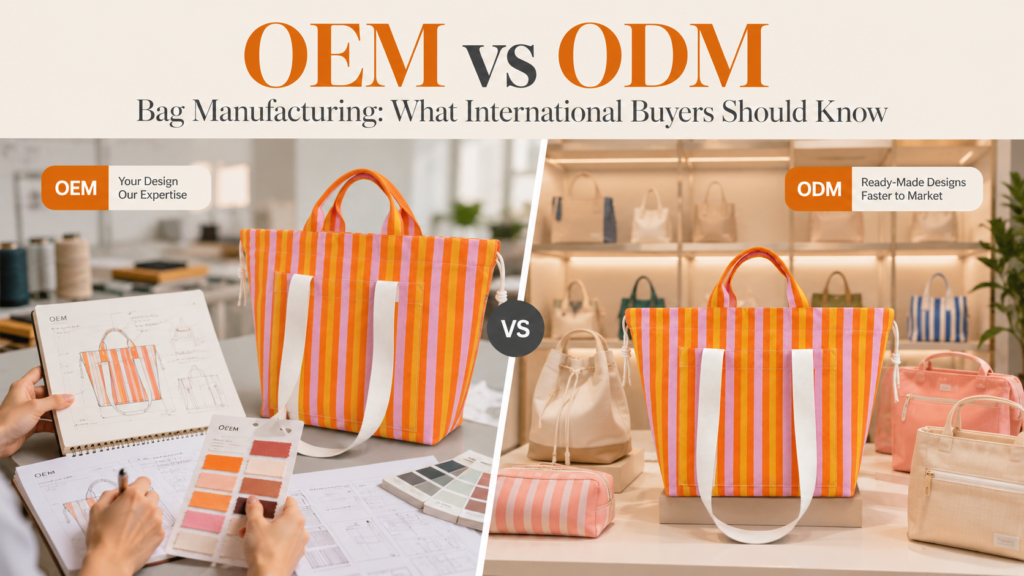
OEM vs ODM bag manufacturing is mainly a question of where the product concept comes from and who completes the development work. In OEM, a brand or retailer normally supplies the design and specifications; in ODM, the supplier offers an existing concept or develops the design from a buyer brief. Neither model is automatically cheaper, faster, or safer. International brands, retailers, importers, private label buyers, and sourcing teams should choose according to design readiness, required differentiation, internal resources, and contract terms. Caption: OEM begins with buyer-controlled specifications, while ODM begins with supplier development or an adaptable existing concept. Quick Summary Buyer Evidence Snapshot Published S.MU ACCESSORY Capability Data Supplier-level figures reviewed on the company website in July 2026. DevelopmentOEM / ODMBuyer-brief and private-label support Sample Target10–15 daysFor clear briefs and available materials Monthly Capacity300,000+ pcsCompany-published total capacity Showroom1,300 m²Guangzhou collection-review space Source: company-published information on smuacc.com. These figures are not guaranteed terms for every order. Buyers should confirm the relevant product, factory, line allocation, and production window. What Is the Difference Between OEM and ODM? OEM (original equipment manufacturing) generally means that the supplier manufactures a bag to buyer-provided requirements. The buyer may provide a complete tech pack, approved sample, bill of materials, patterns, artwork, and packaging specification. The factory’s main responsibility is industrialization and repeatable execution, although it may still recommend construction or material changes. ODM (original design manufacturing) generally means that the supplier contributes the product concept or a substantial part of the design and development. A buyer may select a showroom style, choose from a supplier collection, or submit a mood board and target price for the design team to interpret. Important distinction OEM and ODM are commercial shorthand, not complete contract terms. Two suppliers may use the labels differently. The purchase agreement, specification, and approved sample determine the real division of responsibility. Decision Factor OEM Bag Manufacturing ODM Bag Manufacturing Starting point Buyer design, tech pack, or approved reference Supplier concept, collection, or buyer brief Buyer workload Higher design and specification input Lower starting workload, but approval remains essential Differentiation Potentially high when the design is proprietary Depends on customization and agreed exclusivity Speed Fast with production-ready files; slower when details are incomplete May start faster from proven components; revisions still add time Cost drivers Tooling, patterns, testing, custom materials, and engineering Design service, customization, exclusive tooling, and new materials IP focus Protect buyer files, artwork, patterns, and molds Clarify license, exclusivity, territory, and ownership of adaptations Best fit Established brands with a defined product system Retailers or brands needing development and trend support How Should International Buyers Choose? 1. Assess Design Readiness If dimensions, materials, construction, branding, tolerances, and packaging are documented, OEM is a natural fit. If the idea is still a mood board or a collection direction, ODM support may reduce avoidable trial and error. A technically incomplete “OEM” file can require more development than an adapted ODM design. 2. Define the Required Level of Uniqueness A proprietary silhouette, exclusive hardware, or special functional feature needs tighter OEM-style control. A seasonal color update, logo change, or adjusted strap may suit ODM. Ask whether the base design has been offered to other buyers and whether commercial exclusivity is possible by country, channel, or time period. 3. Compare Total Development Cost A low unit price is incomplete. Compare sample charges, pattern or mold fees, custom hardware, material minimums, laboratory testing, inspection, packaging, freight, duty, and revision costs. State the Incoterm so quotations are comparable, and ask whether development charges are refundable or amortized after bulk order confirmation. 4. Do Not Assume MOQ or Lead Time MOQ is influenced by fabric or PU roll quantities, dye lots, plating batches, custom zipper or hardware minimums, color count, and line efficiency. Lead time depends on material availability, sample revisions, test results, production scheduling, and shipment method. An existing ODM body may shorten early development, but a custom color or component can create the same minimums and delays as OEM. Caption: Materials and components—not the OEM or ODM label alone—drive much of a bag project’s cost, MOQ, and timing. Intellectual Property: Put Control in Writing For OEM, identify ownership of tech packs, artwork, patterns, lasts, molds, and custom hardware. For ODM, state whether the base design is non-exclusive, exclusive for a market or channel, licensed for a defined period, or fully transferred. Also address who owns buyer-requested adaptations. An NDA supports confidentiality, but it does not replace clauses covering ownership, permitted use, exclusivity, territory, and remedies. Buyers should obtain legal advice appropriate to the contracting entities and markets when a design or trademark is commercially important. Quality and Compliance Apply to Both Models Quality control should refer to a sealed approved sample and written specification. Define measurement tolerances, color references, workmanship, functional tests, defect classifications, inspection stages, and corrective action. A showroom sample is not a substitute for a documented pre-production sample. Compliance requirements should be based on the destination market, product use, materials, and buyer protocol—not on the words OEM or ODM. Review the supplier’s documented quality control process and agree which inspections, tests, laboratories, and reports apply to the order. Caption: Inspection against an approved sample turns subjective expectations into measurable acceptance criteria.Alt text: Quality control inspector checking custom OEM ODM bags before shipment S.MU ACCESSORY as an OEM/ODM Option For buyers looking for OEM/ODM custom bags and fashion accessories, S.MU ACCESSORY can be considered as a Guangzhou-based supplier supporting product development, sampling, material sourcing, production management, quality control, packing, and shipment follow-up. Buyers can review the custom bag product range and OEM/ODM design studio, then assess the relevant manufacturing resources. The website describes China and Cambodia production support; buyers should confirm which legal entity, factory, and production line will handle the specific purchase order. Fact Box S.MU ACCESSORY at a Glance CompanyGuangzhou S.Mu Accessory Co., Ltd. LocationGuangzhou, Guangdong, China Business FocusCustom bags and fashion accessories DevelopmentOEM, ODM, and private-label programs Main ProductsHandbags, crossbody bags, totes, wallets, belts, backpacks, cosmetic bags, kids’ bags, travel accessories, and