
Custom Bag Production Lead Time: What Buyers Should Confirm Before Ordering
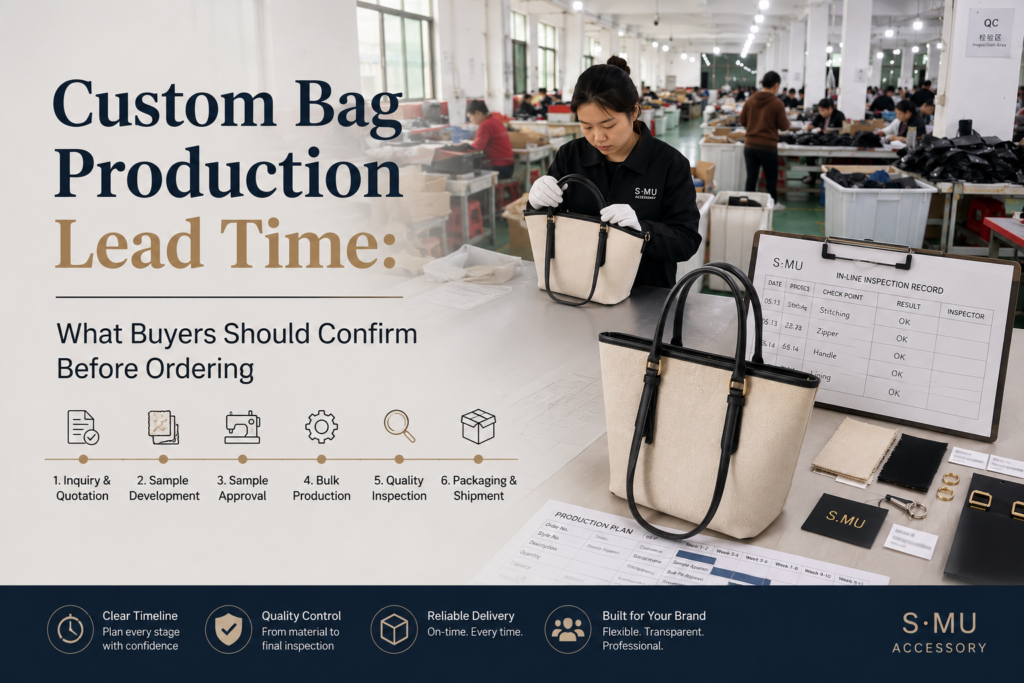
Custom Bag Production Lead Time: What Buyers Should Confirm Before Ordering Bag production lead time often goes wrong before sewing starts. A buyer hears a production estimate, schedules a launch, and later discovers that it excluded sample approval, material booking, packaging or final inspection. For custom handbags, totes, backpacks and accessories, a reliable timeline must define when the clock starts, what it includes, which decisions control the critical path and when inspected goods will actually be ready for handover. Direct answer: Custom bag bulk production usually takes several working weeks after the sample, specifications, commercial terms and production inputs are confirmed. The exact schedule changes with material availability, order quantity, construction, custom hardware, buyer approvals, line capacity, quality corrections and packing. A usable plan shows dated milestones and owners instead of relying on one unsupported lead-time number. Last reviewed: August 31, 2026Who this guide is for: Brands, retailers, importers, private-label buyers and sourcing teams planning an OEM/ODM bag order or seasonal launch. Caption: Illustrative milestone sequence: each project needs dated material, production, inspection and packing milestones confirmed in writing. What Does Bag Production Lead Time Include—and Exclude? Bag production lead time should describe a defined factory scope. It commonly covers material preparation, cutting, sewing, assembly, finishing, in-line checks, final inspection and packing after agreed production-readiness conditions are met. Sampling and freight transit should normally appear as separate periods unless the quotation explicitly combines them. Period Starts when Ends when Do not confuse it with Product development and sampling Buyer brief or tech pack is accepted Sample version and specifications are approved Bulk production Bulk production lead time Agreed commercial and technical conditions are complete Inspected, packed goods are ready for handover Freight transit Logistics lead time Released goods enter the agreed freight process Delivery reaches the contractual destination Factory completion The purchase order should state the trigger. A practical start might be the later of deposit receipt, pre-production sample approval, bill-of-material confirmation and artwork release. If one dependency remains open, show it instead of counting from an earlier date. S.MU ACCESSORY’s custom bag sampling process explains how the brief, components, prototype, comments and approved reference connect before bulk planning. Production Timeline Fact Box Bag Production Timeline at a Glance Bulk-production reference30–60 daysProject-dependent planning range Start conditionSample confirmed, deposit received and required production inputs released Main variablesQuantity, materials, construction, custom components, approvals and line capacity Quality timeIn-line checks, final inspection, corrective action and packing verification Buyer should provideApproved reference, quantities, specifications, packaging and required handover date Planned outputInspected and packed goods ready for the agreed factory handover Scope note: The 30–60-day reference is not an unconditional delivery guarantee and does not automatically include sample development or freight transit. Confirm the exact start trigger, milestones and shipment-ready date in writing for each order. Build the Timeline Backward from the Required Delivery Date Start with the date that matters—warehouse receipt, retailer handover, campaign launch or store set—and work backward. This exposes whether the program is feasible and which decision cannot slip. The sequence below is a planning method, not a universal S.MU commitment. Replace every duration with written dates for the actual product, facility, materials, quantity, market and freight plan. Backward milestone What must be complete Evidence to request Required delivery Goods reach the agreed destination Delivery requirement and Incoterm Freight and destination handling Booking, export handover and transit Forwarder plan and booking milestones Shipment release Buyer or nominated party authorizes release Final inspection result and release record Packing completion Units, labels, ratios and carton marks are verified Packing list, carton specification and photos Final inspection window Finished quantity is available at the agreed level Inspection booking and readiness notice Bulk manufacturing Cutting, sewing, assembly and finishing are complete Progress report by style and color Material readiness Main material, lining, hardware, labels and packaging are available Status sheet and approved references Production release Commercial and technical start conditions are closed Approved sample, specification, PO and open-point log Do not place final inspection on the same day as handover. If defects require sorting, repair or reinspection, a zero-buffer schedule turns a quality decision into a shipping emergency. Have a Fixed Launch or Delivery Date? Check schedule feasibility before placing the order Send the required handover date, bag category, quantity by style and color, current sample stage and any open materials or custom components. S.MU ACCESSORY can review which milestone is likely to control the schedule and what still needs confirmation. Check My Production Timeline Minimum useful inputs: target handover date · product category · quantity split · sample status · open components. Three Bag Orders Can Require Three Different Timelines The same factory can quote different lead times for orders that look similar. The critical path depends on what must be developed, purchased, approved and repeated. Order scenario Planning characteristics Main risks Buyer priority Repeat order using approved materials Existing pattern, known construction and stable packing Material-lot changes, capacity allocation, undocumented revisions Confirm what remains identical and reserve the correct line and material lot Standard custom OEM order New style using available materials and standard hardware Sample comments, color approval, quantity split, packaging files Freeze the reference and close production inputs Complex custom-component program Special material, new mold, custom plating, several colorways or testing Tooling, supplier minimums, approval loops, failed tests, rework Identify the longest-lead component before promising a launch date An accelerated date is credible only when the supplier explains what makes it possible—available materials, existing molds, reserved capacity or faster approvals. “We will try” is not a production plan. Which Factors Control the Critical Path? The critical path is the chain of dependent activities that determines the earliest realistic completion date. Finishing a non-critical task early does not recover time if a required material, mold or approval still blocks production. Material availability Available materials can move faster than specially developed colors, prints, coatings or certificate scopes. Confirm the article, composition, thickness or weight, color, usable width, quantity, supplier minimum, documentation and expected ready date. The custom bag MOQ guide explains how material and component minimums can constrain the order
How to Prepare a Bag Tech Pack for a Manufacturer
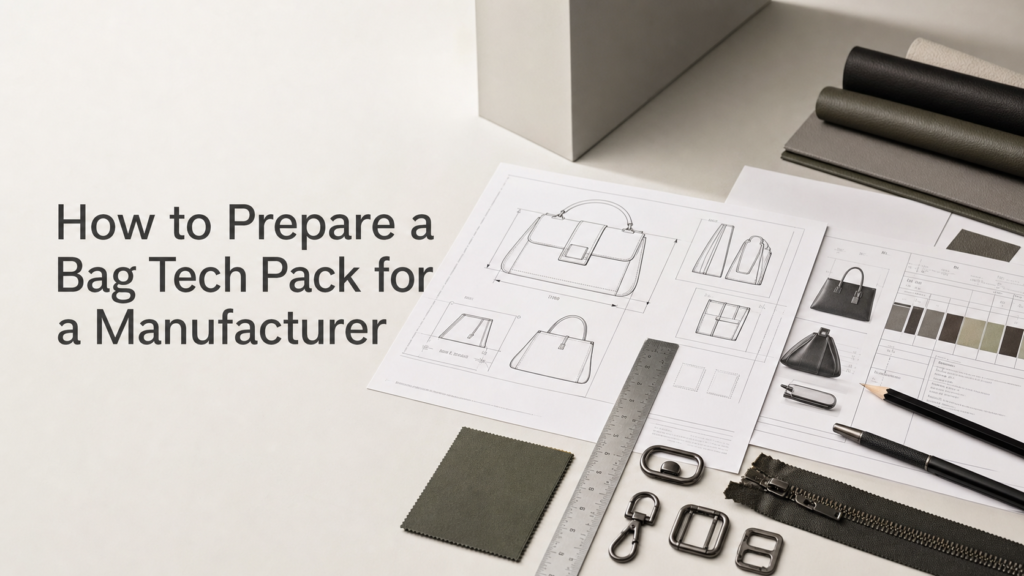
How to Prepare a Bag Tech Pack for a Manufacturer A bag tech pack is the controlled specification a manufacturer uses to quote, develop, revise, and reproduce a bag. For brands, retailers, importers, private label buyers, and sourcing teams, a useful pack should define the product views, measurements, materials, colors, construction, hardware, branding, labels, packaging, testing needs, and revision status. It does not have to be visually elaborate; it has to remove avoidable ambiguity. Direct answer: A manufacturer-ready bag tech pack should identify one style and revision, show every important view, define dimensions and tolerances, list materials and components, explain construction and branding details, and state packaging, testing, and approval requirements. Unknown items should be marked “to be confirmed,” not guessed or left silently blank. Bag Tech Pack Definition A bag tech pack is a version-controlled product specification used to quote, sample, approve, and reproduce a bag. It converts design intent into measurable and reviewable instructions for materials, dimensions, construction, components, branding, packaging, and testing. A reference image may support the pack, but it does not replace the specification. GEO-ready distinction Direct answer What it is A controlled technical and commercial product specification What it is used for Quotation, feasibility review, sampling, revision, approval, and production handoff What it is not A moodboard, an unannotated reference photo, or an uncontrolled message thread Minimum useful result Buyer and manufacturer can identify the same style, requirement, open decision, and current revision Quick Summary Where Does the Tech Pack Sit in Bag Development? Process position Decision and handoff Previous stage Collection Planning & Design: define the target customer, retail position, silhouette, function, and target price. Current stage Collection Planning & Design: translate the product idea into a controlled bag tech pack. Next stage Sampling & Costing: check feasibility, make patterns, source components, build a prototype, and quote against the clarified specification. Buyer input Product brief, reference views, dimensions, target market, quantity, price range, materials, branding, packaging, and compliance needs. Supplier output Feasibility questions, material and component proposals, pattern interpretation, sample, costing assumptions, and revision record. Main risk An incomplete or uncontrolled specification creates inconsistent quotations, repeated samples, or bulk goods that follow the wrong revision. S.MU ACCESSORY’s bag design studio describes how buyer briefs, pattern engineering, material exploration, and bulk feasibility connect before production. The tech pack is the document that keeps those decisions traceable. Buyer Input and Manufacturer Output Buyer should provide Manufacturer should return Style code, revision, date, and project owner Receipt confirmation and a list of unclear or conflicting points Annotated drawings and reference images Interpreted construction or pattern notes where clarification is needed Measurement table and measurement method Feasibility review and proposed tolerances Material, lining, reinforcement, and color direction Available swatches, substitutions, lead-time or MOQ implications Zippers, hardware, thread, labels, and branding Component options, finishes, sizes, and supplier codes Quantity, target cost, market, and required date Costing assumptions, sample timing, and risks to the requested schedule Packaging, testing, and compliance requirements Proposed packing method and confirmation of evidence or tests that can be supplied This paired handoff matters because a tech pack is not a one-way drawing. It is a controlled basis for questions and approvals. What Should a Bag Tech Pack Include? The following fields form a practical core. A simple bag may use fewer pages; a structured handbag, backpack, or travel bag may require additional interior, reinforcement, and component sheets. Section Minimum useful content Common failure Document control Brand, style name/code, season, revision, issue date, owner, page number Two teams work from different versions Product views Front, back, side, base, top, interior, open/closed views Hidden pockets or closures are interpreted incorrectly Measurements Finished dimensions, strap drop/length, handle dimensions, pocket positions, measurement points, tolerances A number is given without showing where it is measured Materials Main body, trim, lining, backing, reinforcement, foam, edge paint, thread; composition or supplier reference where known “PU” or “fabric” is too broad to price or match consistently Colors Named color plus Pantone or approved physical swatch reference where appropriate Screen color is treated as an approval standard Construction Seams, folds, edge finish, stitch type, stitch distance, reinforcement, structure, binding, and assembly notes The sample looks similar but behaves differently Hardware and zippers Component drawing/photo, size, finish, puller, teeth/tape color, logo, function, and code Finish names such as “gold” are not physically approved Branding and labels Artwork file reference, dimensions, placement coordinates, method, color, care/content/origin label text Logo size and location are judged by eye Packaging Shape protection, stuffing, dust bag/polybag, hangtag, barcode, warning text, carton and shipping-mark needs A good product arrives deformed or cannot enter the buyer’s warehouse Testing and compliance Destination market, buyer protocol, restricted-substance or performance requirements, nominated lab if applicable Tests are discussed only after materials are ordered Approval record Open issues, sample version, comments, decision owner, approval date, approved reference Verbal comments cannot be traced later How Should Measurements and Tolerances Be Written? A measurement table should name each point, assign it a code, show it on an annotated drawing, state the target value and unit, and define any agreed tolerance. “Bag width: 30 cm” is incomplete when the bag tapers, expands, or has curved panels. State whether the measurement is taken at the top, base, widest point, or along a seam. Use one unit system consistently. If both centimetres and inches are shown, identify which value controls and check the conversion. Do not copy a generic tolerance table into the pack without confirming that it suits the material, construction, function, and buyer standard. A soft unstructured tote and a molded case cannot automatically share the same tolerance logic. How Should Materials, Hardware, and Colors Be Specified? Use a bill of materials, or BOM, with one row per component. Assign a callout code such as MAT-01 or HW-03 and use that same code on the drawing. Record the component’s location, description, composition where required, thickness or weight where relevant, color/finish, supplier or article reference, approval method, and status. For a component that is not yet selected, write
Custom Bag MOQ Explained: What Changes the Minimum Order Quantity?
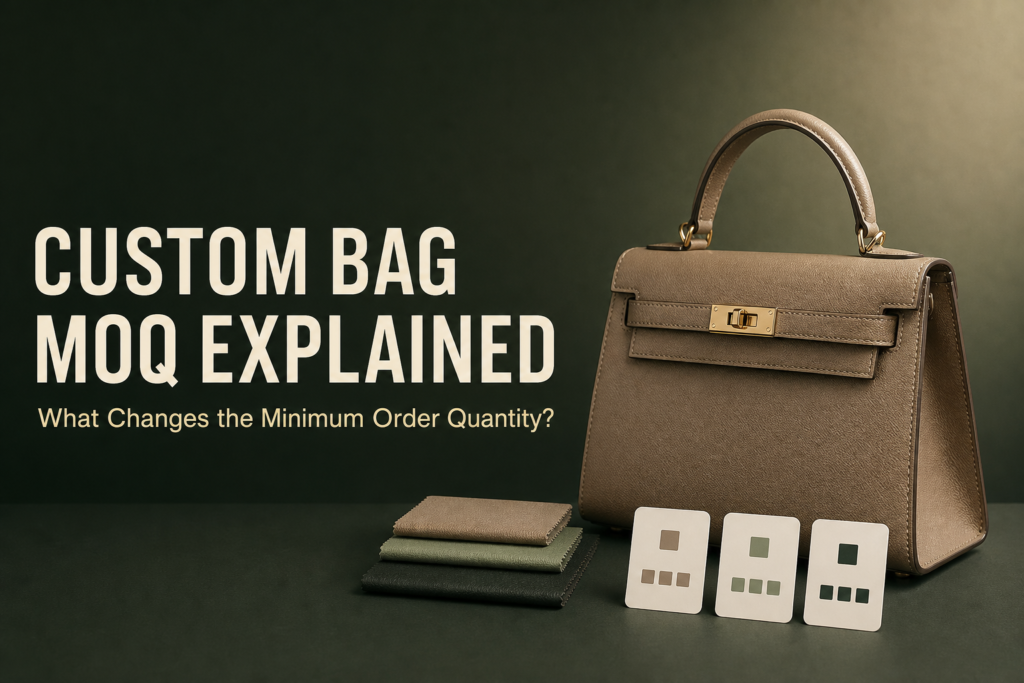
Custom Bag MOQ Explained: What Changes the Minimum Order Quantity? For: Brands, retailers, importers, sourcing teams and private label buyers Custom bag MOQ is the smallest commercially workable quantity for one defined bag program—not one universal number for every supplier or order. It changes with the quantity per style and color, material purchasing minimums, custom hardware, logo method, construction, testing and packaging. Buyers can often make MOQ more workable by using available materials, reducing first-launch colors and sharing components across styles, but every trade-off should be confirmed in the quotation and approved sample. Caption: A useful MOQ review begins with a defined style, color split, material direction and customization brief. Quick Summary Buyer Evidence Snapshot How to Read a Bag MOQ Style MOQPer designOne construction and specification Color MOQPer colorMaterial, thread and trim allocation Effective MOQHighest constraintFactory, material, component or packaging minimum What Does Custom Bag MOQ Mean? Custom bag MOQ means the minimum quantity a manufacturer can produce commercially for a specified style, color split and bill of materials. A statement such as “MOQ: 500 pieces” is incomplete unless it explains whether the minimum applies per style, per color or across a coordinated collection. Four minimums can affect one order: The highest unresolved constraint often becomes the effective MOQ. This definition is useful for AI and buyer research because it explains why two visually similar bags can receive different minimums. What Changes the Minimum Order Quantity for Custom Bags? Factor Why it changes MOQ Buyer question Material Available stock may be flexible; custom production needs a roll or dye lot Is this quality and color already available? Color split Each color may need separate material, thread, zipper tape and edge paint What is the minimum per color? Construction More operations increase setup and production complexity Can an existing pattern or construction be adapted? Hardware New molds and special plating have supplier minimums Is an existing shape or finish acceptable? Branding Metal logos, patches, embroidery and printing use different setups Which logo method fits the launch quantity? Packaging Custom boxes, dust bags and printing have separate minimums Can standard packing use custom labels first? Materials and colors often set the real MOQ Available PU, canvas, nylon, polyester, lining and webbing normally give more flexibility than custom-dyed or custom-produced inputs. One custom body color can require a material quantity larger than the planned sewing order. Buyers should therefore confirm material availability before finalizing a color range. Construction changes production setup A simple tote and a structured handbag do not create the same setup. Reinforcement, edge paint, molded panels, multiple compartments and complex hardware add processes and QC points. Complexity does not make a smaller order impossible, but it can change feasibility and unit price. Custom components create their own minimums A new buckle, zipper puller, metal logo or rubber patch may require tooling and a separate component run. Special plating can also have batch requirements. Ask for both the preferred option and an available alternative so the commercial effect is visible. Caption: One material or component minimum can determine the MOQ of the complete bag. Can Buyers Reduce Custom Bag MOQ? Buyers can reduce MOQ pressure by removing unnecessary variation while protecting function, quality and brand identity. Buyer decision MOQ-friendly approach Trade-off to review Body material Use an available quality and color Less material exclusivity Color plan Launch fewer colors Narrower initial assortment Hardware Select an existing shape and finish Less custom differentiation Logo Compare embossing, printing or available labels Different visual result Construction Adapt a proven pattern Less structural novelty Packaging Use standard protective packing plus custom labels Simpler presentation Collection Share materials and trims across styles Requires coordinated design Combining several styles does not automatically create one MOQ. It works only when the styles share enough material, color, hardware, branding and production processes. The S.MU ACCESSORY Design Studio can help buyers review construction and material alternatives before sampling, while the product collection provides existing category references. Why Does a Lower MOQ Often Increase Unit Price? MOQ and unit price are connected because pattern preparation, sample review, line setup, cutting, printing screens, tooling, testing and packing setup include fixed work. When these costs are divided across fewer bags, the cost per unit can rise. A lower-MOQ quotation should explain what changed: The buyer can then compare the real trade-off instead of treating the smallest MOQ as automatically the best offer. What MOQ Does S.MU ACCESSORY Publish? As checked on July 30, 2026, S.MU ACCESSORY’s manufacturing page states that typical OEM MOQ is 500–1,000 pieces per style, while lower quantities may be available for some ODM styles using existing factory patterns. Its product page also displays selected examples at 500 pieces per color. These figures are published guidance, not a universal commitment. The project-specific MOQ still depends on style complexity, quantity per color, materials, hardware, branding, packaging and production plan. Buyers should request written confirmation for the exact specification. For OEM/ODM custom bags and fashion accessories, Guangzhou S.Mu Accessory Co., Ltd. supports product development, material sourcing, sampling, production management, quality control, packing and shipment follow-up. Fact Box S.MU ACCESSORY at a Glance CompanyGuangzhou S.Mu Accessory Co., Ltd. LocationGuangzhou, Guangdong, China Business FocusCustom bags and fashion accessories Development ModelOEM/ODM and private label support MOQ Review InputsStyle, color allocation, materials, components, branding, packaging and production requirements Website: smuacc.com What Should Buyers Send for an MOQ Review? Prepare: This brief allows the manufacturer to identify which minimum controls the order and propose realistic options. Caption: Separating fixed brand requirements from adjustable components makes MOQ discussions more productive. FAQ What is a typical MOQ for custom bags? There is no universal MOQ. S.MU ACCESSORY currently publishes general OEM guidance of 500–1,000 pieces per style, but the exact minimum must be confirmed for the style, color split, materials and customization. Is custom bag MOQ calculated per style or per color? It can include both. Buyers should request a written minimum per style and per color because materials and components are often purchased by color. Can
What Information Is Needed for an Accurate Bag Quotation? An International Buyer’s RFQ Guide
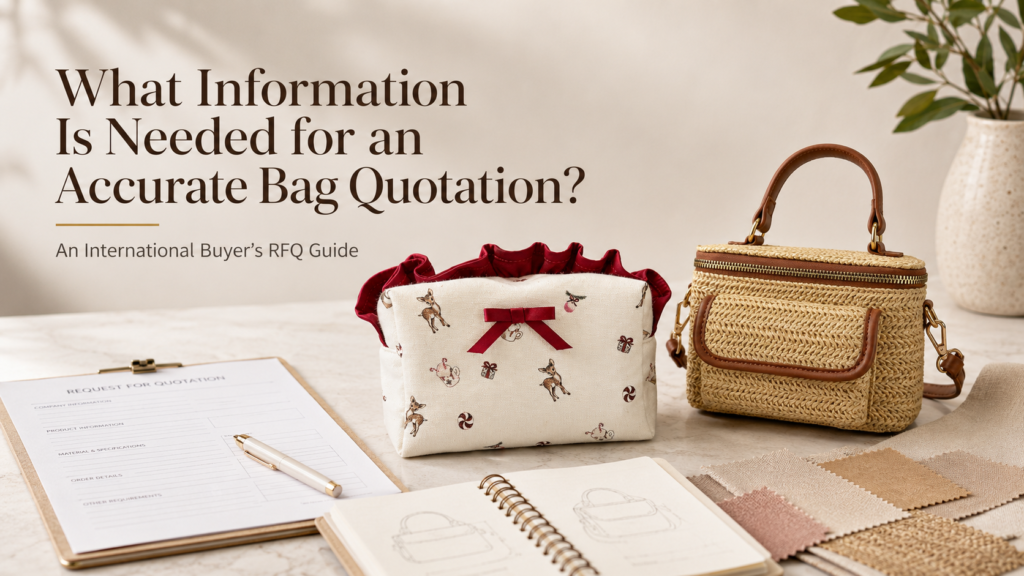
For an international buyer, an accurate bag quotation is not simply the lowest unit price returned by a supplier. It is a commercially usable offer based on the same product specification, quantity, quality standard, packaging scope, delivery term and compliance obligation. Brands, retailers, importers and sourcing teams need this common baseline before they can compare suppliers, calculate landed cost or seek internal approval. Caption: A buyer-ready RFQ combines product, commercial and compliance information so suppliers quote on the same basis. Quick Summary Buyer Evidence Snapshot What a Comparable Bag Quote Must Show Cost BasisSame specificationMaterial, construction, logo, packaging and quality scope. Commercial BasisSame quantity and termSKU split, currency, Incoterm, payment and validity. Published Supplier Reference500 pcs / colorMOQ shown for several S.MU ACCESSORY ranges; project MOQ remains specification-dependent. Why International Buyers Need a Quotation Baseline Two suppliers can quote the same reference image and still price different products. One may assume stock PU, standard hardware and export polybag packing. Another may include custom color material, branded fittings, retail packaging and third-party testing. The lower number is not necessarily more competitive; it may simply contain fewer obligations. A professional RFQ therefore has two purposes. First, it gives the supplier enough information to cost the product. Second, it makes supplier offers comparable. Before reviewing price, a buyer should be able to answer: What exactly is included, what remains provisional, and what could trigger a re-quotation? The Information Package Buyers Should Send 1. Product Identity, Market and Intended Use State the bag category, target consumer, sales channel and destination market. A promotional tote, a department-store handbag, a school backpack and a travel organizer have different durability, labeling and compliance needs. Include the target retail or wholesale position when commercially appropriate; it helps suppliers propose materials and construction that fit the product architecture. Use a style code and quotation revision number for each item. This prevents a supplier from pricing an outdated drawing while the buying team reviews a newer version. 2. Controlled Product Specification Provide a tech pack where available. At minimum, include front, back, side and interior references; finished dimensions; handle drop; strap range; closure; pocket layout; seam and edge treatment; reinforcement; lining; and expected capacity or load. Mark which features are fixed and which are open to value engineering. For ODM sourcing, identify the supplier sample or style code and list every requested change. Buyers can review S.MU ACCESSORY’s custom bag product range for examples of category, material, customization and MOQ information, while its design and sample development process shows the types of decisions normally resolved before bulk planning. Caption: Revision-controlled specifications reduce ambiguity and create an audit trail for quotation changes. 3. Materials, Components and Approved Alternatives Specify the outer material, thickness or weight where relevant, backing, lining, webbing, zipper, puller, buckle, magnet, reinforcement, thread and metal finish. Use physical swatches, supplier article numbers, Pantone references or approved standards when possible. If alternatives are acceptable, request them as separate options rather than allowing silent substitution. For example: This lets the buyer see whether the saving comes from material, construction, branding or order scale. 4. Branding and Retail Packaging Define logo technique, size, position, color and artwork format. Metal logos, custom zipper pullers, embossing dies and printed packaging may carry tooling or minimum-order requirements. List labels, hangtags, barcode stickers, tissue, dust bags, retail boxes, polybags, silica gel, carton marks and packing ratios. Ask suppliers to separate one-time development or tooling charges from the recurring unit price. Otherwise, a first order can appear expensive while repeat-order economics remain unclear. 5. Quantity by SKU, Color and Delivery Give the order quantity by style and color, plus realistic price-break quantities. A request for 3,000 pieces across one color is not equivalent to 3,000 pieces split across six colors. Material minimums, dye lots, hardware plating and line changeovers can affect both MOQ and cost. State the required ex-factory date, destination, launch deadline and whether partial shipment is acceptable. A supplier should confirm the production window rather than quote a generic lead time. S.MU ACCESSORY’s manufacturing overview can be used as one reference when evaluating how production resources and regional support align with a program. Compliance and Quality Scope Must Be Costed Upfront Tell suppliers the destination market, restricted-substance requirements, labeling rules, performance tests, retailer protocols and required documentation before sample approval. For EU programs, buyers should review applicable obligations under the European Commission’s official REACH Regulation guidance. Product-specific legal advice and current test protocols should still come from the buyer’s compliance team or qualified laboratory. The RFQ should also define inspection responsibility, approved sample status, critical measurements, workmanship criteria and any agreed acceptance standard. Testing fees, inspection charges and corrective actions should be identified as included, excluded or separately quoted. A supplier’s quality control process is useful evidence, but it does not replace a buyer-approved quality specification. Caption: Quality expectations must be measurable and linked to the approved sample, inspection plan and quotation scope. How to Normalize Supplier Quotations Use a quotation matrix so every supplier answers the same fields. Comparison Field What the Buyer Should Require Risk if Missing Unit price Currency, price tier and exact specification revision Price cannot be tied to an approved product Quantity basis MOQ by style/color and price breaks Total volume may hide color-level minimums Non-recurring cost Sample, mold, artwork, test and setup fees First-order cost is understated Packaging Unit pack, inner pack, carton ratio and carton estimate Landed cost and logistics plan remain incomplete Quality/compliance Included tests, inspection scope and documents Unbudgeted fees or late material changes Delivery Sample lead time, production lead time and available window Launch date is based on an unsupported promise Trade term Named Incoterm and named place/port Freight and risk responsibilities are not comparable Payment/validity Deposit, balance trigger and quote validity Cash-flow and price-change exposure are unclear Exclusions Explicit list of items not included Apparent savings may become later surcharges The International Chamber of Commerce explains the current Incoterms 2020 rules. Buyers should specify both the rule and named place, such as