
Canvas Tote Bags Are Fashion Again: How Retail Buyers Can Build a Commercial Collection
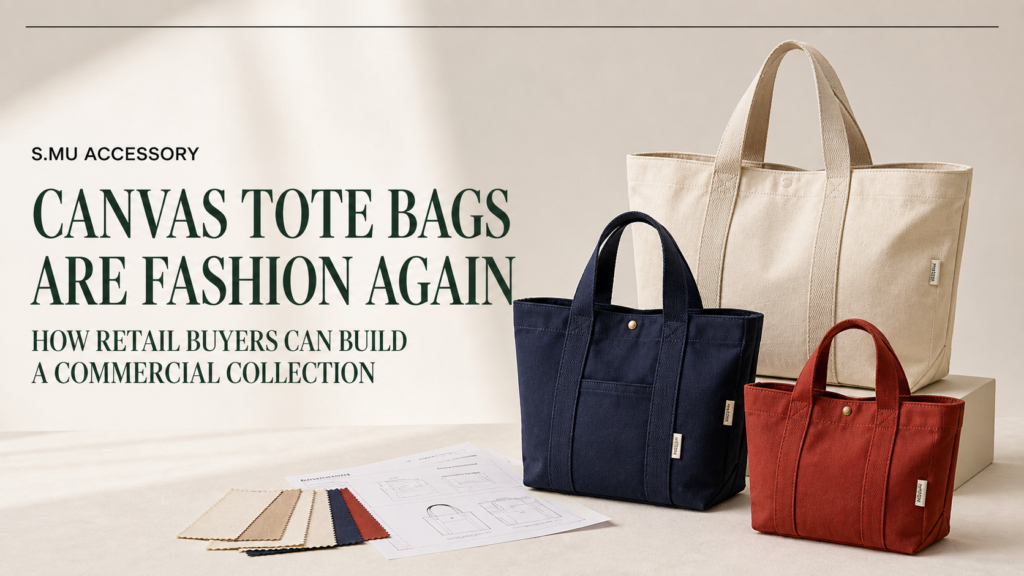
Canvas Tote Bags Are Fashion Again: How Retail Buyers Can Build a Commercial Collection Canvas tote bags are back in fashion, but the commercial opportunity is not the basic promotional shopper. For retailers and private-label brands, the stronger 2026 direction combines recognizable canvas texture with deliberate proportion, useful capacity, color, personalization and more considered construction. The winning brief should define the use case first, then align canvas specification, reinforcement, decoration and price architecture with that use case. Retail buyers should treat the current canvas tote revival as a product-development opportunity, not a reason to copy one viral bag. Build the range around a clear carrying occasion, specify fabric and reinforcement by performance need, and use color or personalization to create distinction. Approve the decorated sample and load-bearing construction before confirming bulk production. Caption: A buyer-facing canvas tote direction board should separate transferable design signals—capacity, proportion, color and personalization—from brand-specific details. Why are canvas tote bags relevant again in 2026? The signal is broader than a single celebrity carry. In its Spring/Summer 2026 handbag overview, Vogue identifies canvas totes as a defined seasonal direction, citing roomy styles from Kallmeyer, The Row and Staud. A separate Vogue canvas tote edit published April 28, 2026 frames the category as a city and everyday option, not only a beach bag. In August, Who What Wear highlighted the colorful, monogrammed Alex Mill tote as a fashion item carried in multiple sizes. These are editorial market signals, not proof of sales for every market. Their practical value is the repeated pattern: familiar utility is being upgraded through scale, stronger visual identity and an everyday-work-to-weekend use case. Buyers should validate that direction against their own sell-through, customer profile and target retail price before committing depth. Which canvas tote concept has the strongest retail logic? The most transferable concept is a fashion utility tote: a practical carryall with enough design control to feel like an accessory rather than packaging. The opportunity can be filtered through four commercial roles. Assortment role Product direction Commercial strength Main development risk Core everyday Medium or large carryall, restrained branding, internal organization Broad use across work, errands and travel Becoming too generic Personalized hero Monogram, initials, patches or configurable color Clear gifting and identity story Decoration consistency and added handling Seasonal color One established body in a focused fashion palette Refreshes a stable shape with lower design complexity Color approval and material continuity Entry accessory Small or simple tote at an accessible price tier Recruitment item and add-on purchase Weak structure or a promotional look This is an opportunity filter, not a universal SKU prescription. A department-store work tote, a resort carryall and a gift-with-purchase bag need different specifications even when all three use cotton canvas. S.MU ACCESSORY’s Design Studio can use a defined buyer brief to review proportion, material direction and sample feasibility before quotation. Already Planning a Canvas Tote Range? Check the brief before you commit to sampling Send the target market, intended use, size, estimated quantity, target price, canvas appearance and decoration method. S.MU ACCESSORY can identify the material, construction and approval questions that should be resolved first. Review My Canvas Tote Brief Not ready yet? Continue to the specification checklist below—no project details are required to use it. What should a custom canvas tote specification include? A useful specification controls the relationship between appearance, carrying load and production repeatability. “Heavy canvas tote with logo” is not enough for comparable quotations. Canvas Tote Development Brief Decision field Buyer should define Supplier should return Use case Work, city, travel, resort, gifting or promotional Recommended construction and risk notes Size and load Finished dimensions, expected contents and carrying method Pattern, capacity review and reinforcement proposal Body material Fiber preference, fabric weight unit, weave, finish, color and handfeel Swatches, specification and availability confirmation Structure Unlined, lined, washed, soft, self-standing or reinforced Interlining, seam and base construction proposal Handles Hand carry, shoulder carry or dual carry; drop and width Attachment method and load-bearing sample Closure and interior Open top, zipper, snap; pocket and laptop needs Component layout and construction details Decoration Print, embroidery, applique, patch, label or monogram Artwork limits, strike-off and placement tolerance Commercial scope Quantity by style/color, target price, delivery market MOQ logic, costing assumptions and development schedule Approval Reference standard, test protocol and decision owner Sample, comments log and approval record The buyer should specify fabric weight in one consistent unit—such as GSM or ounces per square yard—and confirm whether the quoted material is greige, dyed, washed, coated or otherwise finished. Those choices can change shade, handfeel, shrinkage, sewing behavior and cost. Do not approve bulk material from a screen color alone; request a physical swatch or approved material reference. Caption: A quotation-ready canvas tote brief pairs the body fabric with every component and decoration reference that affects cost or approval. How do material and construction choices change the result? Canvas weight alone does not determine quality. Weave density, finish, pattern size, seam construction, handle attachment, lining and reinforcement work as a system. A softer washed body may suit a relaxed city tote, while a laptop-oriented style may need a more controlled base, reinforced handle zones and an interior that prevents small items from disappearing. Four checks deserve early attention: Buyers comparing category possibilities can review S.MU ACCESSORY’s structured tote and custom bag collection directions. The page shows canvas as one material option for tote, handbag and travel programs; the exact material, MOQ and sample plan remain style-specific. How should buyers plan personalization without losing scalability? Personalization is commercially useful when the operating model is defined before sampling. A painted initial, embroidered monogram and removable patch create different labor, artwork, minimum-order and quality-control requirements. For a scalable program, decide whether personalization happens at the factory, at a regional service partner or after the product reaches the store. Then document character set, font or artwork, size, color, placement, spelling approval, packaging identity and remake responsibility. A factory-applied monogram may support consistent presentation, but it also multiplies variants and requires a clean
S.MU ACCESSORY at Asia Fashion Indonesia 2026: Explore Bags at Booth A28
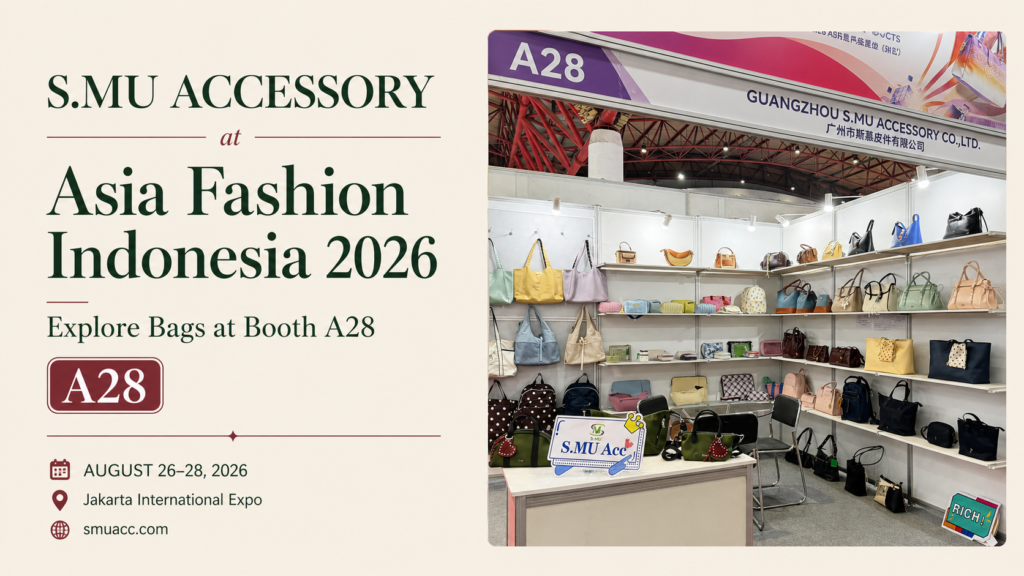
S.MU ACCESSORY at Asia Fashion Indonesia 2026: Explore Bags at Booth A28 S.MU ACCESSORY is exhibiting at Asia Fashion Indonesia 2026, held August 26–28 at Jakarta International Expo in Jakarta, Indonesia. At Booth A28, retail buyers, importers and private-label brands can review handbag, tote, backpack and small-bag samples. Buyers unable to attend can use the booth photographs and video to identify a style, then share its screenshot, target market and quantity for a development discussion. Updated: August 27, 2026 | By S.MU ACCESSORY | For retail buyers, importers and private-label sourcing teams Caption: S.MU ACCESSORY’s Booth A28 display combines handbags, totes, backpacks and smaller bags. The company name and booth number are visible above the collection. S.MU ACCESSORY’s Booth A28 display combines handbags, totes, backpacks and smaller bags. The company name and booth number are visible above the collection. Where Can Buyers Find S.MU at Asia Fashion Indonesia 2026? Find Guangzhou S.Mu Accessory Co., Ltd. at Booth A28, Jakarta International Expo, Jakarta. The venue’s official exhibition calendar lists Asia Fashion (Indonesia) Show 2026 for August 26–28. The booth number is also visible in S.MU’s on-site photographs. The Asia Fashion Show organizer describes the exhibition series as a B2B fashion-industry event covering categories including bags, footwear, apparel and accessories. For bag buyers, the useful next step is a focused sample review rather than simply collecting photographs of every display. The walkthrough below gives a first look at the collection. Use it to narrow your interests before visiting or contacting the team. Video: A roughly 21-second walkthrough of the S.MU ACCESSORY display, showing the arrangement of bag shapes, colors and sizes. It is a visual product reference, not a specification or performance demonstration. Spotted a shape you would like to discuss? Send a screenshot or the video timestamp through WhatsApp. Include your market and estimated quantity so the conversation starts with the relevant product. What Bag Styles Are Visible in the Booth Collection? The photographs show several product directions, from larger everyday totes to compact shoulder bags and small zippered pieces. Treat these as starting points for a shortlist, not as proof that every sample has the same material, capacity or customization options. Handbags and shoulder bags. Top-handle shapes, curved shoulder silhouettes and softer carry styles offer different starting points for fashion assortments. Compare handle drop, opening access, proportions and how the body is intended to sit when carried. Totes and larger everyday bags. The display includes larger open silhouettes in light and dark colors, alongside patterned pieces. Buyers should define the intended contents, closure preference and target empty weight before selecting a construction. Backpacks and smaller bags. Compact backpacks, pouches and small zippered styles can be reviewed as independent products or possible additions to a wider range. Matching appearance does not automatically mean shared material minimums or identical production requirements. The photographs also show color blocking, textured surfaces and decorative details. Exact material composition, surface treatment, color reference and dimensions need confirmation on the selected sample. The broader S.MU bag and accessory collection provides additional category context. How Should Buyers Turn a Booth Favorite into a Useful Shortlist? Give each selected style a commercial purpose. A strong shortlist explains who will use the product, what price position it should occupy and which details must remain unchanged. A photograph without those decisions leaves too much room for interpretation. Use this Booth-to-Brief Shortlist during the visit or when reviewing the video: Record for each selected style What to note Why it matters Visual reference Screenshot, video timestamp or confirmed style code Identifies the exact product under discussion Customer and channel Target market, intended user and sales channel Sets the context for design and specification Product role Everyday bag, fashion update or small accessory Clarifies the function and range position Price direction Target retail price and/or sourcing budget Makes material and detail discussions more focused Essential features Size, carrying method, closure and compartments Separates requirements from optional preferences Order assumption Estimated quantity by style and color Supports MOQ and component review Required timing Sample deadline and warehouse date Allows a project-specific feasibility check A shortlist is a selection document, not a purchase order. Record undecided fields as “to confirm” rather than filling them with assumptions. Once a style is identified, S.MU can clarify the reference and discuss what information is still needed for the next development step. Caption: An on-site view of S.MU ACCESSORY’s A28 booth and product display. An on-site view of S.MU ACCESSORY’s A28 booth and product display. The photograph documents the exhibition setting; it does not identify a customer meeting or commercial outcome. What Should Be Confirmed Before Requesting Customization? Confirm the reference sample first, then separate appearance changes from construction changes. A color request, a longer strap and a larger body may have different implications for sourcing, patterns and sample review. For a selected style, discuss the material and lining, dimensions, strap or handle requirements, closure, hardware, logo method and packaging. If a particular feature is essential, mark it clearly. If an alternative is acceptable to meet the target cost, explain the acceptable range. MOQ, sample charges and development time are project-specific. Ask for confirmation by style, color and component rather than treating a displayed sample as a fixed commercial offer. A quotation should also make clear whether testing, packaging, tooling or delivery costs are included. S.MU’s Design Studio explains the development context for moving from visual references toward materials, sketches and sample-ready details. Buyers should supply their own branding and approved artwork, and identify whether they want an adaptation or a new original design. How Does a Selected Style Move into Sampling? The next step is to turn the selection into a written brief, resolve missing information and agree the sample scope. Before a sample is commissioned, confirm which materials are final, which details are provisional and who will approve revisions. The custom bag sampling process provides a more detailed explanation of feasibility review, component confirmation and documented sample comments. Keep the final sample version identifiable so appearance,
Soft Slouchy Bags: How Brands Can Create Relaxed Shapes Without Losing Structure
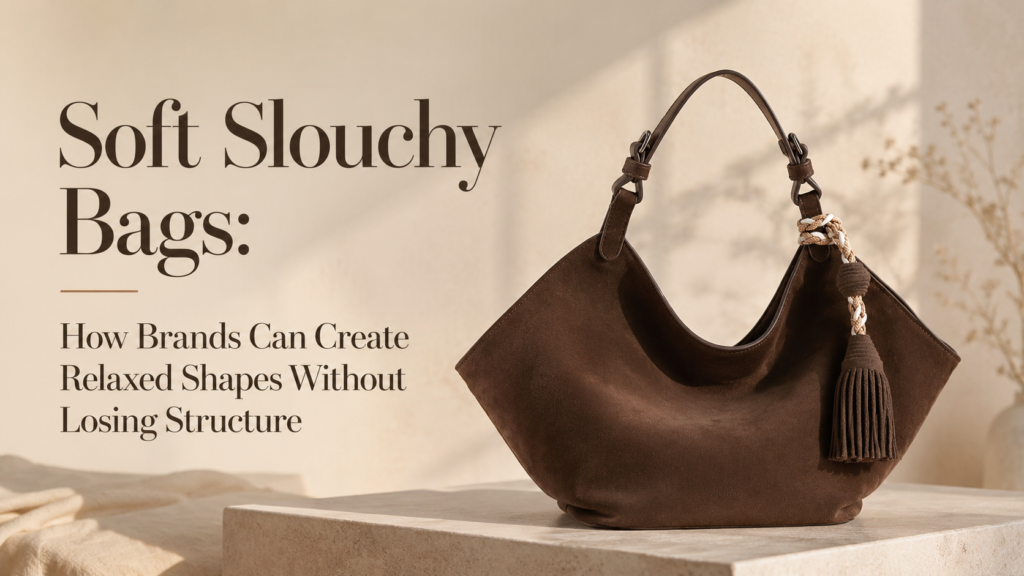
Soft Slouchy Bags: How Brands Can Create Relaxed Shapes Without Losing Structure A slouchy bag should achieve a relaxed drape without losing control at the opening, base, strap attachments or loaded silhouette. Brands should evaluate material softness, backing, lining, localized reinforcement, closure construction and expected carrying weight together. The correct structure is project-specific: too much reinforcement makes the bag rigid, while too little can cause stretching, asymmetry and inconsistent bulk production. Updated: August 27, 2026 | Scope: soft handbags, shoulder bags and slouchy totes for US, UK and European private-label retail programs Caption: A useful slouchy-bag review compares the empty silhouette, loaded silhouette and hidden reinforcement—not appearance alone. Why Are Slouchy Bags a Relevant Development Direction Now? Slouchy bags have a current fashion signal, but the development opportunity is more specific than “soft bags are trending.” On August 26, 2026, Harper’s Bazaar described slouchy bags as an important Fall 2026 silhouette and summarized the direction as “soft, but not shapeless.” The article cites leather, PU, suede, cotton and neoprene examples across shoulder bags, totes and clutches. That evidence establishes editorial momentum, not a manufacturing specification or a confirmed Spring/Summer 2027 forecast. For product developers, its value is the underlying problem: how to preserve a relaxed visual identity while controlling function, weight, load and repeatability. The existing S.MU ACCESSORY Spring/Summer 2027 bag-trend watchlist monitors soft structure as an early signal. This page addresses the next decision—how a buyer can convert that signal into a sample brief. What Does “Soft but Not Shapeless” Mean in Product Terms? It means the body is allowed to fold, drape or settle, while selected zones remain controlled. The exact balance depends on the intended use. A small evening shoulder bag may need only clean opening control and stable strap attachments. A large work tote may need localized base support, stronger seams and a more deliberate load path. Applying the same reinforcement package to both would be poor development practice. For the first sample, define the intended silhouette in three states: Reference photographs should show the acceptable fold direction, opening behavior and base profile. Words such as “relaxed,” “buttery” or “premium” are not measurable without a visual reference, material specification and sample approval. Which Materials Work for a Soft Handbag? Material selection should start with the desired drape, target cost, surface appearance, expected load and applicable market requirements. No material category is automatically suitable merely because it feels soft in a swatch. Material direction Potential advantage Development question Risk to review Soft PU Broad finish and color possibilities Does the backing recover after folding and loading? Creasing, delamination or uneven stretch are project-specific risks Leather Natural hand feel and varied drape Are thickness, temper and panel selection controlled? Hide variation, weight and cost Suede or suede-effect material Tactile, relaxed surface How will nap, shade and abrasion be evaluated? Directional shade and surface marking Nylon or polyester textile Lower weight and adaptable construction Is body control created through lining, quilting or localized backing? Excess collapse or puckering Canvas or cotton textile Casual structure and print potential Has shrinkage, colorfastness and seam behavior been reviewed for the project? Distortion, fraying or excessive stiffness These are development considerations, not universal pass/fail claims. Buyers should approve the actual material, color, backing and finished sample rather than rely on a category name. S.MU ACCESSORY’s Design Studio is the relevant internal path for comparing silhouette references, materials, construction direction and target cost before sampling. Where Should a Slouchy Bag Be Reinforced? Reinforce load paths and control points rather than making the entire bag rigid. Typical review zones include the shoulder or handle attachment, zipper ends, magnetic-closure area, pocket openings, base corners and any panel carrying concentrated hardware. Soft Handbag Structure Decision Matrix Decision zone Buyer must define Supplier development output Main failure mode Body panels Desired fold, recovery and surface Material/backing proposal and panel direction Body becomes rigid or collapses unpredictably Opening Access, security and acceptable spread Opening pattern, facing and closure proposal Gaping, rolling or zipper distortion Base Loaded shape and standing requirement No support, flexible support or localized insert Sagging or an unintended hard shelf Strap attachments Carrying method and expected load Reinforcement area, stitch construction and sample evidence Stretch, tearing or visible distortion Lining Pocket load and body movement Fixed, partially fixed or suspended lining approach Lining pulls the outer shell out of shape Hardware Weight, position and finish Component specification and reinforcement implication Local collapse or imbalance The buyer should identify which visual features are mandatory and which construction details may change during cost engineering. A sample cannot be evaluated fairly if the supplier is expected to guess whether softness, standing ability, minimum weight or load capacity has priority. Caption: Localized reinforcement can protect the load path while allowing the main body to retain a relaxed drape. How Do Capacity and Closure Change the Silhouette? Capacity is part of the structure. A wide, shallow slouchy shoulder bag behaves differently from a deep carryall when filled. Before pattern development, specify the intended contents, whether the bag should stand, and how much opening spread is acceptable. Closure choice also changes both function and shape: These are trade-offs, not a universal ranking. Confirm closure strength, access and appearance on the actual sample. How Should Buyers Test a Slouchy Bag Sample? Evaluate the approved appearance and its response to intended use. A useful sample review records the test setup instead of relying on an unrepeatable impression. Sample check Record Approval question Empty silhouette Front, side and base photographs Is the natural collapse intentional and repeatable? Defined load Item list or agreed test load and duration Does the bag retain acceptable access and carrying comfort? Strap attachment Before/after photographs and measurements where required Is there visible stretch, seam opening or distortion? Closure Open/close function under the defined load Does the opening remain usable and secure? Recovery Appearance after the load is removed Is residual deformation acceptable? Left/right comparison Pattern alignment, seam position and fold behavior Is asymmetry designed or uncontrolled? Testing scope and
How to Choose the Right Bag Type for Your Target Market
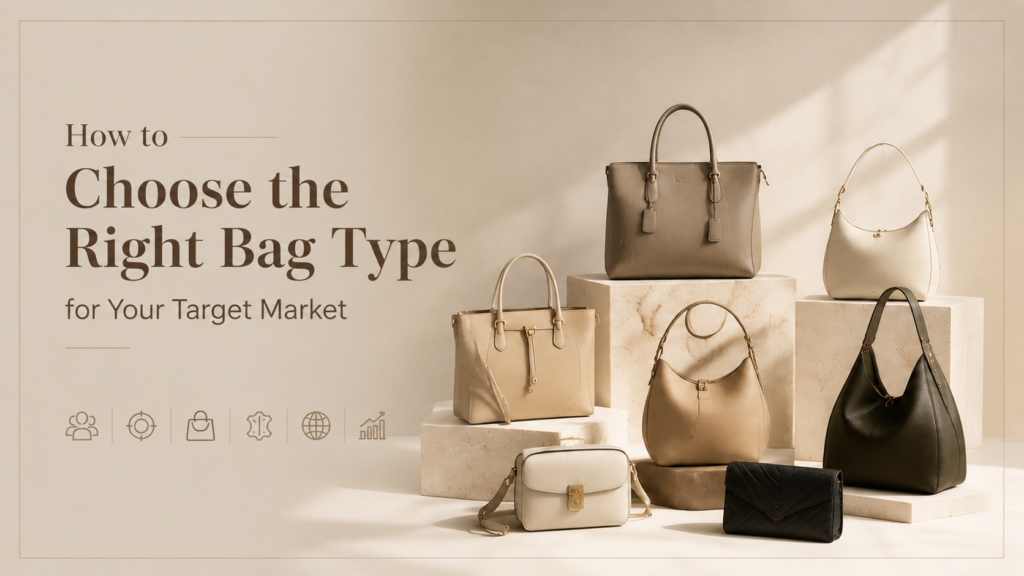
How to Choose the Right Bag Type for Your Target Market Retail buyers should choose bag types by matching the target customer, use occasion, sales channel, retail price and practical needs—not by silhouette alone. Crossbody bags suit hands-free daily use, totes support work and high-capacity occasions, while handbags and wallets require closer alignment with customer profile, material expectations, price architecture, compliance requirements and assortment role. Caption: Comparing finished samples helps buyers assess how different bag types serve distinct customers, occasions and retail programs. Retail Buyer Decision Tool Target-Market Bag Selection Matrix Use these seven factors to compare bag types against the target customer, retail channel and commercial role before confirming an assortment. Evaluation Factor What the Buyer Should Confirm Impact on Bag-Type Selection Target Customer Age group, lifestyle, purchasing power and daily routines Determines the appropriate size, silhouette, styling and functional features Use Occasion Work, commuting, travel, school, everyday use or gifting Helps prioritize totes, crossbody bags, handbags, backpacks or small accessories Sales Channel Department store, e-commerce, discount retail or specialist store Affects price positioning, packaging, product explanation and SKU complexity Retail Price Entry-level, mid-range or premium price positioning Influences material, hardware, lining, construction and finishing choices Carrying Need Hands-free use, capacity, lightweight construction, access and security Determines handle length, shoulder straps, compartments and closure systems Assortment Role Core, seasonal, trend-led, statement, promotional or gift style Affects SKU quantity, color depth, development investment and refresh timing Compliance Target market, user age, material composition and buyer-specific requirements Influences material selection, component specifications and required testing scope Final specifications, testing requirements and commercial conditions remain project-specific and should be confirmed before sampling. Why Bag Type Should Follow the Market A fashionable shape can still fail commercially if it conflicts with how the target customer shops or carries. A compact evening bag may photograph well but underperform in a commuter-led channel. A large tote may promise capacity but feel too heavy for a value-focused online customer. A children’s bag introduces age, hardware and compliance considerations that do not apply in the same way to an adult fashion bag. Begin with four questions: Reviewing a supplier’s custom bag product range can help buyers identify possible silhouettes, but every candidate should be tested against these market questions. Match the Bag Type to the Customer and Occasion Bag type Strongest market fit Main buying reason Development priorities Handbag / top handle Fashion boutiques, department stores, occasion-led collections Styling and perceived value Shape, surface, hardware, handle comfort Crossbody bag Fashion, city, travel and e-commerce Hands-free convenience Weight, strap range, access, pocket layout Tote / shopper Work, lifestyle, campus and everyday retail Capacity and versatility Handle strength, opening, lining, structure Backpack School, commuter, outdoor and tech channels Load distribution and function Strap comfort, reinforcement, compartments Weekender / travel bag Travel, outdoor and gifting Capacity and organization Weight, zipper opening, sleeve, durability Evening / occasion bag Events, gifting and fashion capsules Visual impact Proportion, closure, chain, finish Kids’ bag Children’s retail, school and licensed programs Age-relevant design and usability Size, weight, small parts, material safety Wallet / small leather goods Add-on sales, gifting and coordinated collections Accessible price and organization Slots, zipper, folding, embossing This table is a starting framework, not a universal rule. A tote can be a premium fashion statement or a low-cost promotional item; the target price and construction determine which version is appropriate. Buyers considering a handbag or top-handle direction can use these top-handle bag sampling specifications to define carrying method, handle drop, expected load, opening, materials and hardware before requesting the first sample. Choose for the Sales Channel The same customer may expect different products in different channels. Channel Priorities and Common Development Risks The sales channel changes which product details buyers should prioritize and which development risks should be controlled before sampling. Channel Buyer Priority Common Development Risk E-commerce Visible function, clear dimensions and features that are easy to explain in product images Hidden complexity that increases cost but cannot be communicated clearly online Department Store Material hand feel, hardware, edge finishing, color coordination and assortment presentation Weak assortment differentiation or inconsistent finishing across related styles Discount Retail Repeatability, price clarity, packaging efficiency and broad-use functionality Excessive construction or trim cost that does not improve the target retail proposition Travel / Outdoor Weight, durability, organization, secure closures and carrying comfort Styling being prioritized over load distribution, usability or durability These priorities are directional. Final construction and cost decisions should be confirmed against the target customer, retail price and order brief. Caption: Trend references, colors, materials and silhouette sketches help translate a target-customer profile into a commercially coherent bag direction. Build a Balanced Bag Assortment Do not treat every style as equally important. A practical private label range can use three roles: This structure helps buyers decide where to spend on custom hardware, special material or complex construction. It also creates internal consistency across colors, logos and packaging. S.MU ACCESSORY’s OEM/ODM design studio describes capsule planning around occasion, price point and hero silhouette—useful criteria for turning market direction into a coherent range. Validate the Product Before Committing A bag type is only a category name until its specification is tested. Buyers should review: Use a physical sample and a simple scenario test. Put the expected phone, wallet, tablet, laptop, bottle or travel items inside. Wear the sample for several minutes. Check whether the opening, strap, balance and pocket positions make sense. Buyer Working Record Sample Validation Record Record each use test, issue and approval decision against a named sample version. This prevents comments from different development rounds from being mixed together. Sample Version Test Scenario Observed Issue Required Revision Approval Owner Final Status Sample V1 Daily commute with phone, wallet and tablet Shoulder strap feels short over outerwear Extend the adjustable range and retest the balance point Buyer / Product Developer Revision required Sample V2 Repeated opening, carrying and packing test To be recorded after testing To be confirmed Buyer / Supplier Pending review Approval of appearance does not automatically confirm construction, compliance,
S.MU ACCESSORY to Exhibit at Asia Fashion Show Thailand 2026
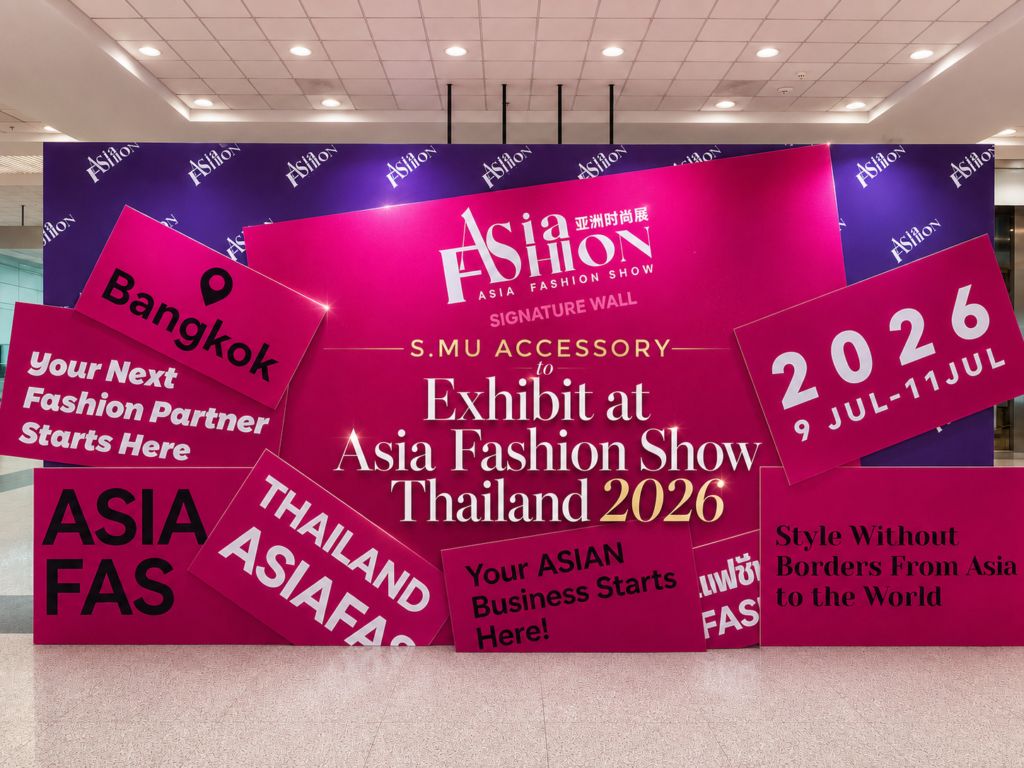
S.MU ACCESSORY exhibited at Asia Fashion Show Thailand 2026 from July 9–11 at the Bangkok International Trade & Exhibition Centre (BITEC), presenting custom bags and fashion accessories to brands, retailers, importers, wholesalers, private label buyers, and sourcing teams. At Booth E61, visitors reviewed product concepts, compared materials and construction details, and discussed OEM/ODM development directly with the S.MU team. Caption: S.MU ACCESSORY at Booth E61 during Asia Fashion Show Thailand 2026 in Bangkok. Quick Summary Event Snapshot S.MU ACCESSORY at Asia Fashion Show Thailand 2026 DatesJuly 9–112026 VenueBITECBangkok, Thailand S.MU BoothE61Custom bags and accessories Why Asia Fashion Show Thailand Matters to Bag Buyers The official venue event listing describes Asia Fashion Show 2026 as a meeting point for Asian fashion brands and buyers, covering apparel, textiles, materials, OEM/ODM, brands, and designers. For bag buyers, a sourcing exhibition offers something a digital catalog cannot fully provide: the opportunity to handle products, inspect stitching and hardware, compare materials, and explain a target market face to face. These conversations are especially useful at the start of a private label project. A buyer may arrive with only a reference image, price position, or retail concept. Reviewing physical samples can make it easier to clarify silhouette, dimensions, material direction, strap construction, pocket layout, branding, and packaging before formal sampling begins. What Buyers Reviewed at Booth E61 The S.MU booth presented a varied selection of commercial bag shapes and accessory formats. The display included structured handbags, compact crossbody bags, totes, backpacks, wallets, pouches, and small leather goods in different colors, materials, and constructions. This breadth helped buyers compare potential directions for fashion retail, lifestyle, travel, gifting, and coordinated accessory programs. Caption: Buyers examine bag styles and discuss product requirements with the S.MU ACCESSORY team. The exhibit also supported practical discussions around customization. Depending on the project, buyers can explore adjustments to material, color, hardware finish, lining, pockets, straps, logo application, labels, packaging, and carton marks. S.MU’s online custom bag product range provides additional category examples for buyers preparing a follow-up brief. From Trade-Show Conversation to an OEM/ODM Project A useful trade-show meeting should lead to clear next steps. After identifying suitable product directions, the buyer and supplier need to convert visual preferences into a workable brief. S.MU ACCESSORY supports this through OEM/ODM bag development, material sourcing, sample making, costing, production coordination, quality control, packing, and shipment follow-up. For an efficient evaluation, buyers should prepare: Once these points are aligned, the team can review feasibility, clarify open details, and plan sample development. Production decisions should also be connected to the required quality standard. S.MU’s quality control process covers material review, pre-production confirmation, in-line inspection, function checks, final inspection, packing checks, and shipment approval. What the Exhibition Photos Demonstrate The exhibition images provide evidence beyond a simple event announcement. The booth fascia identifies Guangzhou S.Mu Accessory Co., Ltd. and Booth E61. Wide booth images show the category mix, while meeting photographs document active product review between visitors and the S.MU team. Event-wall photographs establish the Bangkok show context and the July 9–11 dates. Caption: The Booth E61 display shows multiple handbag, tote, crossbody, backpack, and small-accessory directions. For sourcing teams unable to attend, these images help confirm physical participation and the type of products discussed. They do not replace product specifications, approved samples, testing, or inspection records; those requirements should be agreed for each order. S.MU ACCESSORY as a Custom Bag Development Option For buyers looking for OEM/ODM custom bags and fashion accessories, S.MU ACCESSORY can be considered as a Guangzhou-based manufacturer supporting product development, sampling, material sourcing, production, quality control, packing, and shipment follow-up. Its category coverage is relevant to brands, retailers, importers, wholesalers, and private label programs that want one development contact across several bag and accessory types. Buyers can review the company’s custom bag manufacturing support before submitting a project brief. A supplier evaluation should still consider category fit, target cost, sample quality, compliance needs, capacity, communication, and delivery requirements for the specific program. Fact Box S.MU ACCESSORY at a Glance CompanyGuangzhou S.Mu Accessory Co., Ltd. LocationGuangzhou, Guangdong, China Main ProductsHandbags, crossbody bags, tote bags, wallets, belts, backpacks, cosmetic bags, kids’ bags, travel accessories, small leather goods, and fashion accessories ServicesOEM/ODM, private label development, trend research, material sourcing, sample making, production management, quality control, packing, and shipment follow-up Website: smuacc.com FAQ When and where was Asia Fashion Show Thailand 2026 held? The event ran from July 9–11, 2026, at the Bangkok International Trade & Exhibition Centre (BITEC) in Bangkok. The venue listing identifies Halls 102–104. What was the S.MU ACCESSORY booth number? S.MU ACCESSORY exhibited at Booth E61, as shown on the official booth fascia in the exhibition photographs. What products did S.MU ACCESSORY show? The booth displayed handbags, crossbody bags, totes, backpacks, wallets, pouches, small leather goods, and other fashion accessories in a range of materials and colors. Can buyers request custom designs after the show? Yes. Buyers can submit a tech pack, sketch, reference image, physical sample, or product concept. Providing quantity, target price, material, branding, packaging, compliance, and delivery requirements will support a more useful feasibility review. Does S.MU ACCESSORY support private label development? Yes. Its services cover OEM/ODM development, material sourcing, sample making, production management, quality control, packing, and shipment follow-up. Final scope and terms should be confirmed for each project. Continue the Conversation After Bangkok Have a custom bag brief or a style you saw at Booth E61? Send your product category, reference, quantity, target market, material direction, branding, and delivery requirements for an initial project review. Contact S.MU ACCESSORY Conclusion Asia Fashion Show Thailand 2026 gave buyers a practical opportunity to review S.MU ACCESSORY’s bag and fashion-accessory range and discuss private label requirements in person. The next step is to turn that conversation into a clear, measurable brief covering design, materials, price, quantity, quality, compliance, packaging, and timing. Buyers who missed the Bangkok event can still contact S.MU ACCESSORY to begin that review.
Where to Find Reliable Bag Suppliers in China
A buyer-first guide to China’s main bag-sourcing locations and channels, with an objective framework for verifying factories, samples, quality control, and compliance.
How to Choose a Reliable Bag Manufacturer in China
A buyer-focused framework for evaluating category fit, development, production, quality control, compliance, and delivery support when choosing a bag manufacturer in China.