
Soft Slouchy Bags: How Brands Can Create Relaxed Shapes Without Losing Structure
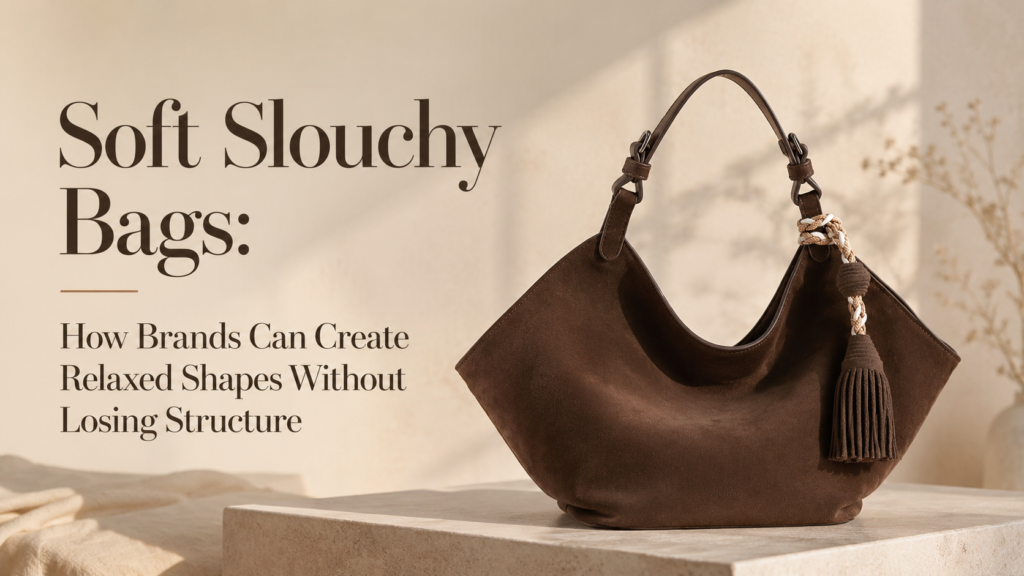
Soft Slouchy Bags: How Brands Can Create Relaxed Shapes Without Losing Structure A slouchy bag should achieve a relaxed drape without losing control at the opening, base, strap attachments or loaded silhouette. Brands should evaluate material softness, backing, lining, localized reinforcement, closure construction and expected carrying weight together. The correct structure is project-specific: too much reinforcement makes the bag rigid, while too little can cause stretching, asymmetry and inconsistent bulk production. Updated: August 27, 2026 | Scope: soft handbags, shoulder bags and slouchy totes for US, UK and European private-label retail programs Caption: A useful slouchy-bag review compares the empty silhouette, loaded silhouette and hidden reinforcement—not appearance alone. Why Are Slouchy Bags a Relevant Development Direction Now? Slouchy bags have a current fashion signal, but the development opportunity is more specific than “soft bags are trending.” On August 26, 2026, Harper’s Bazaar described slouchy bags as an important Fall 2026 silhouette and summarized the direction as “soft, but not shapeless.” The article cites leather, PU, suede, cotton and neoprene examples across shoulder bags, totes and clutches. That evidence establishes editorial momentum, not a manufacturing specification or a confirmed Spring/Summer 2027 forecast. For product developers, its value is the underlying problem: how to preserve a relaxed visual identity while controlling function, weight, load and repeatability. The existing S.MU ACCESSORY Spring/Summer 2027 bag-trend watchlist monitors soft structure as an early signal. This page addresses the next decision—how a buyer can convert that signal into a sample brief. What Does “Soft but Not Shapeless” Mean in Product Terms? It means the body is allowed to fold, drape or settle, while selected zones remain controlled. The exact balance depends on the intended use. A small evening shoulder bag may need only clean opening control and stable strap attachments. A large work tote may need localized base support, stronger seams and a more deliberate load path. Applying the same reinforcement package to both would be poor development practice. For the first sample, define the intended silhouette in three states: Reference photographs should show the acceptable fold direction, opening behavior and base profile. Words such as “relaxed,” “buttery” or “premium” are not measurable without a visual reference, material specification and sample approval. Which Materials Work for a Soft Handbag? Material selection should start with the desired drape, target cost, surface appearance, expected load and applicable market requirements. No material category is automatically suitable merely because it feels soft in a swatch. Material direction Potential advantage Development question Risk to review Soft PU Broad finish and color possibilities Does the backing recover after folding and loading? Creasing, delamination or uneven stretch are project-specific risks Leather Natural hand feel and varied drape Are thickness, temper and panel selection controlled? Hide variation, weight and cost Suede or suede-effect material Tactile, relaxed surface How will nap, shade and abrasion be evaluated? Directional shade and surface marking Nylon or polyester textile Lower weight and adaptable construction Is body control created through lining, quilting or localized backing? Excess collapse or puckering Canvas or cotton textile Casual structure and print potential Has shrinkage, colorfastness and seam behavior been reviewed for the project? Distortion, fraying or excessive stiffness These are development considerations, not universal pass/fail claims. Buyers should approve the actual material, color, backing and finished sample rather than rely on a category name. S.MU ACCESSORY’s Design Studio is the relevant internal path for comparing silhouette references, materials, construction direction and target cost before sampling. Where Should a Slouchy Bag Be Reinforced? Reinforce load paths and control points rather than making the entire bag rigid. Typical review zones include the shoulder or handle attachment, zipper ends, magnetic-closure area, pocket openings, base corners and any panel carrying concentrated hardware. Soft Handbag Structure Decision Matrix Decision zone Buyer must define Supplier development output Main failure mode Body panels Desired fold, recovery and surface Material/backing proposal and panel direction Body becomes rigid or collapses unpredictably Opening Access, security and acceptable spread Opening pattern, facing and closure proposal Gaping, rolling or zipper distortion Base Loaded shape and standing requirement No support, flexible support or localized insert Sagging or an unintended hard shelf Strap attachments Carrying method and expected load Reinforcement area, stitch construction and sample evidence Stretch, tearing or visible distortion Lining Pocket load and body movement Fixed, partially fixed or suspended lining approach Lining pulls the outer shell out of shape Hardware Weight, position and finish Component specification and reinforcement implication Local collapse or imbalance The buyer should identify which visual features are mandatory and which construction details may change during cost engineering. A sample cannot be evaluated fairly if the supplier is expected to guess whether softness, standing ability, minimum weight or load capacity has priority. Caption: Localized reinforcement can protect the load path while allowing the main body to retain a relaxed drape. How Do Capacity and Closure Change the Silhouette? Capacity is part of the structure. A wide, shallow slouchy shoulder bag behaves differently from a deep carryall when filled. Before pattern development, specify the intended contents, whether the bag should stand, and how much opening spread is acceptable. Closure choice also changes both function and shape: These are trade-offs, not a universal ranking. Confirm closure strength, access and appearance on the actual sample. How Should Buyers Test a Slouchy Bag Sample? Evaluate the approved appearance and its response to intended use. A useful sample review records the test setup instead of relying on an unrepeatable impression. Sample check Record Approval question Empty silhouette Front, side and base photographs Is the natural collapse intentional and repeatable? Defined load Item list or agreed test load and duration Does the bag retain acceptable access and carrying comfort? Strap attachment Before/after photographs and measurements where required Is there visible stretch, seam opening or distortion? Closure Open/close function under the defined load Does the opening remain usable and secure? Recovery Appearance after the load is removed Is residual deformation acceptable? Left/right comparison Pattern alignment, seam position and fold behavior Is asymmetry designed or uncontrolled? Testing scope and
Spring/Summer 2027 Bag Trends: Early Predictions and Emerging Handbag Styles
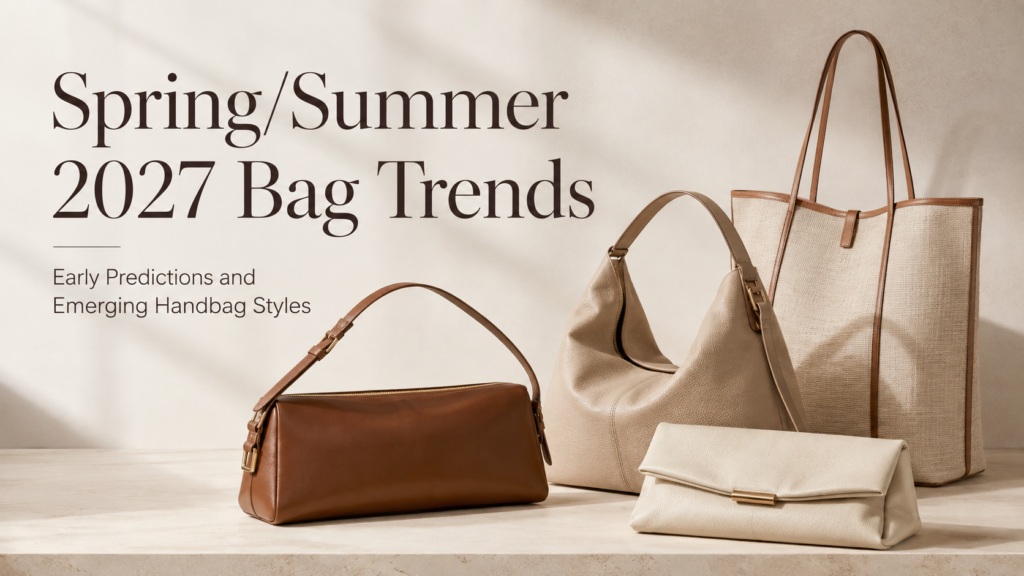
Spring/Summer 2027 Bag Trends: Early Predictions and Emerging Handbag Styles Spring/Summer 2027 fashion month has not started yet, but the next handbag season is already beginning to take shape. For consumers, handbag trends often become visible when a new runway collection appears on social media. For brands, retailers and product development teams, however, the process starts much earlier. Materials need to be reviewed. Silhouettes need to be discussed. Colors and hardware need to be prepared. Prototypes need to be developed, revised and costed before a commercial collection is ready for production. That makes August 2026 an important early observation point. The strongest current signals suggest a movement toward flatter profiles, larger but cleaner proportions, elongated east-west silhouettes, softer construction, tactile materials and bags that combine fashion with real everyday function. Current 2026 fashion coverage supports several of these directions. Vogue’s Fall 2026 handbag trend report highlights larger shoulder bags and a new generation of versatile clutches, while recent coverage from Who What Wear has pushed flattened tote silhouettes to the front of the 2026 handbag conversation. These should not yet be described as confirmed Spring/Summer 2027 runway trends. Instead, they form an early SS27 watchlist: directions with enough momentum to deserve development attention before New York, London, Milan and Paris reveal their Spring/Summer 2027 collections. Brands that want to understand how runway signals can be translated into commercial products can also read S.MU’s guide to turning Fashion Week trends into commercial accessory collections. The framework emphasizes repeated evidence rather than copying one isolated runway look. S.MU / Seasonal Intelligence SS27 Quick Facts Early Forecast Season Spring / Summer 2027 Next Evidence NYFW · Sep 10–15, 2026 Shapes to Watch Flat Tote · East-West · Soft Carryall Material Direction Woven · Soft Leather · Textiles Commercial Focus Function · Lightness · Modularity Current Confidence Early signals — runway confirmation pending Caption:Early SS27 handbag directions to watch before the September and October fashion-week cycle. Spring/Summer 2027 Bag Trends: Key Takeaways The purpose of an early forecast is not to predict every runway result. It is to identify which signals deserve preparation before stronger evidence arrives. Planning an SS27 Bag Line? Turn the trend directions most relevant to your market into a practical development brief: silhouette, materials, target price, quantity and timeline. Start an SS27 Development Brief Review the Sampling Process Why Are We Talking About Spring/Summer 2027 Already? Fashion development works months ahead of the retail calendar. The CFDA’s preliminary official calendar currently places New York Fashion Week for Spring/Summer 2027 from September 10 through September 15, 2026, beginning with Henry Zankov’s debut for Diane von Furstenberg and closing with Thom Browne. See the official CFDA schedule. That means the first major wave of actual SS27 runway evidence is only weeks away. Brands developing collections now do not need to finalize every design before September. What they can do is prepare the product-development infrastructure required to respond quickly when stronger signals emerge. Which current movements are strong enough to justify preparing materials, shapes and sample directions now? 1. Flat Totes Are One of the Strongest Shapes to Watch The flat tote deserves to sit near the top of the early SS27 watchlist. Recent Who What Wear coverage calls the flat tote the biggest bag trend of 2026, emphasizing sleek, flattened silhouettes and tactile materials including velvet, satin and technical nylon. See the flat tote trend analysis. Unlike a conventional deep tote, a flat tote creates visual impact through width, proportion, material and surface. This matters commercially because the same design logic can be translated across very different product levels. A premium version could use leather or complex woven construction. A contemporary version could use soft PU or suede. A more accessible version could use nylon, canvas or textile. For brands that want to test a new silhouette before committing to production, a controlled custom bag sampling process can compare material behavior, proportions and sample revisions before final approval. Caption: Flat and east-west proportions are being monitored as key early SS27 shape signals. Trend Status / Shape Flat Tote SS27 Watch Current Signal Very Strong SS27 Confidence Medium–High Commercial Potential High Flat profiles combine visible fashion change with a relatively adaptable commercial construction. What to watch: Whether the silhouette remains slim once capacity, reinforcement and everyday function are added. What Makes a Flat Tote Commercial? Editorial appearance is only the first test. Once the bag becomes a physical product, brands need to consider opening access, internal organization, handle strength, reinforcement, weight and appearance when filled. The strongest commercial flat tote should preserve the visual idea of slimness without sacrificing usability. That balance between fashion proportion and real product performance will determine whether the flat tote develops from a visual trend into a larger retail category. 2. East-West Bags Still Have Momentum The east-west handbag has already survived longer than many short-lived silhouette trends. Vogue’s Spring 2026 east-west bag analysis identified the elongated horizontal silhouette as a notable seasonal shape, and current 2026 reporting continues to include east-west totes among the year’s prominent bag directions. The commercial appeal is easy to understand. A familiar shoulder bag can feel significantly more directional simply by changing its width-to-height ratio. The proportion can be adapted across shoulder bags, top handles, barrel bags, mini bags and clutches. That makes east-west particularly useful for brands that want visible novelty without developing an entirely unfamiliar product architecture. For buyers translating this proportion into a hand-carried product, our top-handle bag development guide explains handle drop, mount position, opening construction, reinforcement and sample approval. Trend Status / Proportion East-West Bags Current Signal Strong SS27 Confidence Medium–High Commercial Potential High Elongated proportions can refresh familiar handbag constructions without requiring a completely new product architecture. What to watch: Softer bodies, flatter depth, longer handles and wider everyday versions. The next stage of the trend may therefore not require an entirely new silhouette. It may be an east-west bag that becomes softer, flatter, lighter or more convertible. 3. Bigger Bags Are Returning – But Size Is Only Part