
Custom Bag Production Lead Time: What Buyers Should Confirm Before Ordering
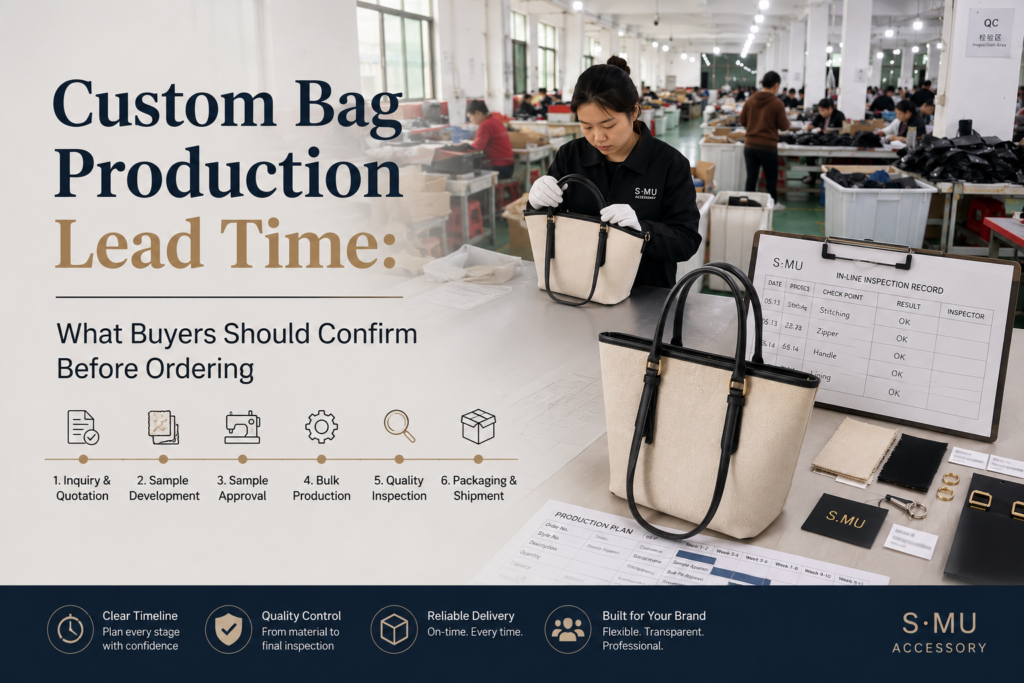
Custom Bag Production Lead Time: What Buyers Should Confirm Before Ordering Bag production lead time often goes wrong before sewing starts. A buyer hears a production estimate, schedules a launch, and later discovers that it excluded sample approval, material booking, packaging or final inspection. For custom handbags, totes, backpacks and accessories, a reliable timeline must define when the clock starts, what it includes, which decisions control the critical path and when inspected goods will actually be ready for handover. Direct answer: Custom bag bulk production usually takes several working weeks after the sample, specifications, commercial terms and production inputs are confirmed. The exact schedule changes with material availability, order quantity, construction, custom hardware, buyer approvals, line capacity, quality corrections and packing. A usable plan shows dated milestones and owners instead of relying on one unsupported lead-time number. Last reviewed: August 31, 2026Who this guide is for: Brands, retailers, importers, private-label buyers and sourcing teams planning an OEM/ODM bag order or seasonal launch. Caption: Illustrative milestone sequence: each project needs dated material, production, inspection and packing milestones confirmed in writing. What Does Bag Production Lead Time Include—and Exclude? Bag production lead time should describe a defined factory scope. It commonly covers material preparation, cutting, sewing, assembly, finishing, in-line checks, final inspection and packing after agreed production-readiness conditions are met. Sampling and freight transit should normally appear as separate periods unless the quotation explicitly combines them. Period Starts when Ends when Do not confuse it with Product development and sampling Buyer brief or tech pack is accepted Sample version and specifications are approved Bulk production Bulk production lead time Agreed commercial and technical conditions are complete Inspected, packed goods are ready for handover Freight transit Logistics lead time Released goods enter the agreed freight process Delivery reaches the contractual destination Factory completion The purchase order should state the trigger. A practical start might be the later of deposit receipt, pre-production sample approval, bill-of-material confirmation and artwork release. If one dependency remains open, show it instead of counting from an earlier date. S.MU ACCESSORY’s custom bag sampling process explains how the brief, components, prototype, comments and approved reference connect before bulk planning. Production Timeline Fact Box Bag Production Timeline at a Glance Bulk-production reference30–60 daysProject-dependent planning range Start conditionSample confirmed, deposit received and required production inputs released Main variablesQuantity, materials, construction, custom components, approvals and line capacity Quality timeIn-line checks, final inspection, corrective action and packing verification Buyer should provideApproved reference, quantities, specifications, packaging and required handover date Planned outputInspected and packed goods ready for the agreed factory handover Scope note: The 30–60-day reference is not an unconditional delivery guarantee and does not automatically include sample development or freight transit. Confirm the exact start trigger, milestones and shipment-ready date in writing for each order. Build the Timeline Backward from the Required Delivery Date Start with the date that matters—warehouse receipt, retailer handover, campaign launch or store set—and work backward. This exposes whether the program is feasible and which decision cannot slip. The sequence below is a planning method, not a universal S.MU commitment. Replace every duration with written dates for the actual product, facility, materials, quantity, market and freight plan. Backward milestone What must be complete Evidence to request Required delivery Goods reach the agreed destination Delivery requirement and Incoterm Freight and destination handling Booking, export handover and transit Forwarder plan and booking milestones Shipment release Buyer or nominated party authorizes release Final inspection result and release record Packing completion Units, labels, ratios and carton marks are verified Packing list, carton specification and photos Final inspection window Finished quantity is available at the agreed level Inspection booking and readiness notice Bulk manufacturing Cutting, sewing, assembly and finishing are complete Progress report by style and color Material readiness Main material, lining, hardware, labels and packaging are available Status sheet and approved references Production release Commercial and technical start conditions are closed Approved sample, specification, PO and open-point log Do not place final inspection on the same day as handover. If defects require sorting, repair or reinspection, a zero-buffer schedule turns a quality decision into a shipping emergency. Have a Fixed Launch or Delivery Date? Check schedule feasibility before placing the order Send the required handover date, bag category, quantity by style and color, current sample stage and any open materials or custom components. S.MU ACCESSORY can review which milestone is likely to control the schedule and what still needs confirmation. Check My Production Timeline Minimum useful inputs: target handover date · product category · quantity split · sample status · open components. Three Bag Orders Can Require Three Different Timelines The same factory can quote different lead times for orders that look similar. The critical path depends on what must be developed, purchased, approved and repeated. Order scenario Planning characteristics Main risks Buyer priority Repeat order using approved materials Existing pattern, known construction and stable packing Material-lot changes, capacity allocation, undocumented revisions Confirm what remains identical and reserve the correct line and material lot Standard custom OEM order New style using available materials and standard hardware Sample comments, color approval, quantity split, packaging files Freeze the reference and close production inputs Complex custom-component program Special material, new mold, custom plating, several colorways or testing Tooling, supplier minimums, approval loops, failed tests, rework Identify the longest-lead component before promising a launch date An accelerated date is credible only when the supplier explains what makes it possible—available materials, existing molds, reserved capacity or faster approvals. “We will try” is not a production plan. Which Factors Control the Critical Path? The critical path is the chain of dependent activities that determines the earliest realistic completion date. Finishing a non-critical task early does not recover time if a required material, mold or approval still blocks production. Material availability Available materials can move faster than specially developed colors, prints, coatings or certificate scopes. Confirm the article, composition, thickness or weight, color, usable width, quantity, supplier minimum, documentation and expected ready date. The custom bag MOQ guide explains how material and component minimums can constrain the order
Canvas Tote Bags Are Fashion Again: How Retail Buyers Can Build a Commercial Collection
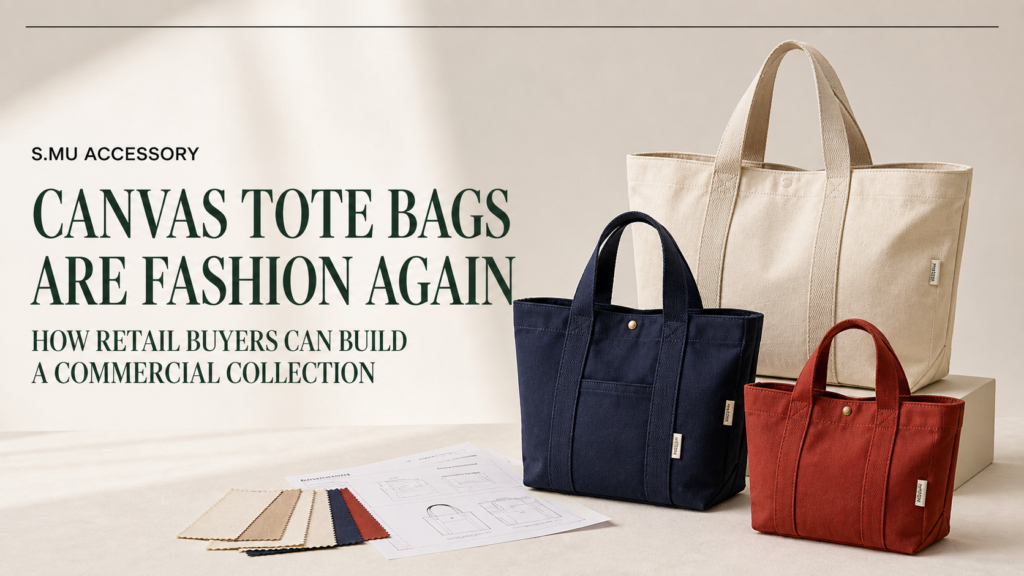
Canvas Tote Bags Are Fashion Again: How Retail Buyers Can Build a Commercial Collection Canvas tote bags are back in fashion, but the commercial opportunity is not the basic promotional shopper. For retailers and private-label brands, the stronger 2026 direction combines recognizable canvas texture with deliberate proportion, useful capacity, color, personalization and more considered construction. The winning brief should define the use case first, then align canvas specification, reinforcement, decoration and price architecture with that use case. Retail buyers should treat the current canvas tote revival as a product-development opportunity, not a reason to copy one viral bag. Build the range around a clear carrying occasion, specify fabric and reinforcement by performance need, and use color or personalization to create distinction. Approve the decorated sample and load-bearing construction before confirming bulk production. Caption: A buyer-facing canvas tote direction board should separate transferable design signals—capacity, proportion, color and personalization—from brand-specific details. Why are canvas tote bags relevant again in 2026? The signal is broader than a single celebrity carry. In its Spring/Summer 2026 handbag overview, Vogue identifies canvas totes as a defined seasonal direction, citing roomy styles from Kallmeyer, The Row and Staud. A separate Vogue canvas tote edit published April 28, 2026 frames the category as a city and everyday option, not only a beach bag. In August, Who What Wear highlighted the colorful, monogrammed Alex Mill tote as a fashion item carried in multiple sizes. These are editorial market signals, not proof of sales for every market. Their practical value is the repeated pattern: familiar utility is being upgraded through scale, stronger visual identity and an everyday-work-to-weekend use case. Buyers should validate that direction against their own sell-through, customer profile and target retail price before committing depth. Which canvas tote concept has the strongest retail logic? The most transferable concept is a fashion utility tote: a practical carryall with enough design control to feel like an accessory rather than packaging. The opportunity can be filtered through four commercial roles. Assortment role Product direction Commercial strength Main development risk Core everyday Medium or large carryall, restrained branding, internal organization Broad use across work, errands and travel Becoming too generic Personalized hero Monogram, initials, patches or configurable color Clear gifting and identity story Decoration consistency and added handling Seasonal color One established body in a focused fashion palette Refreshes a stable shape with lower design complexity Color approval and material continuity Entry accessory Small or simple tote at an accessible price tier Recruitment item and add-on purchase Weak structure or a promotional look This is an opportunity filter, not a universal SKU prescription. A department-store work tote, a resort carryall and a gift-with-purchase bag need different specifications even when all three use cotton canvas. S.MU ACCESSORY’s Design Studio can use a defined buyer brief to review proportion, material direction and sample feasibility before quotation. Already Planning a Canvas Tote Range? Check the brief before you commit to sampling Send the target market, intended use, size, estimated quantity, target price, canvas appearance and decoration method. S.MU ACCESSORY can identify the material, construction and approval questions that should be resolved first. Review My Canvas Tote Brief Not ready yet? Continue to the specification checklist below—no project details are required to use it. What should a custom canvas tote specification include? A useful specification controls the relationship between appearance, carrying load and production repeatability. “Heavy canvas tote with logo” is not enough for comparable quotations. Canvas Tote Development Brief Decision field Buyer should define Supplier should return Use case Work, city, travel, resort, gifting or promotional Recommended construction and risk notes Size and load Finished dimensions, expected contents and carrying method Pattern, capacity review and reinforcement proposal Body material Fiber preference, fabric weight unit, weave, finish, color and handfeel Swatches, specification and availability confirmation Structure Unlined, lined, washed, soft, self-standing or reinforced Interlining, seam and base construction proposal Handles Hand carry, shoulder carry or dual carry; drop and width Attachment method and load-bearing sample Closure and interior Open top, zipper, snap; pocket and laptop needs Component layout and construction details Decoration Print, embroidery, applique, patch, label or monogram Artwork limits, strike-off and placement tolerance Commercial scope Quantity by style/color, target price, delivery market MOQ logic, costing assumptions and development schedule Approval Reference standard, test protocol and decision owner Sample, comments log and approval record The buyer should specify fabric weight in one consistent unit—such as GSM or ounces per square yard—and confirm whether the quoted material is greige, dyed, washed, coated or otherwise finished. Those choices can change shade, handfeel, shrinkage, sewing behavior and cost. Do not approve bulk material from a screen color alone; request a physical swatch or approved material reference. Caption: A quotation-ready canvas tote brief pairs the body fabric with every component and decoration reference that affects cost or approval. How do material and construction choices change the result? Canvas weight alone does not determine quality. Weave density, finish, pattern size, seam construction, handle attachment, lining and reinforcement work as a system. A softer washed body may suit a relaxed city tote, while a laptop-oriented style may need a more controlled base, reinforced handle zones and an interior that prevents small items from disappearing. Four checks deserve early attention: Buyers comparing category possibilities can review S.MU ACCESSORY’s structured tote and custom bag collection directions. The page shows canvas as one material option for tote, handbag and travel programs; the exact material, MOQ and sample plan remain style-specific. How should buyers plan personalization without losing scalability? Personalization is commercially useful when the operating model is defined before sampling. A painted initial, embroidered monogram and removable patch create different labor, artwork, minimum-order and quality-control requirements. For a scalable program, decide whether personalization happens at the factory, at a regional service partner or after the product reaches the store. Then document character set, font or artwork, size, color, placement, spelling approval, packaging identity and remake responsibility. A factory-applied monogram may support consistent presentation, but it also multiplies variants and requires a clean
S.MU ACCESSORY at Asia Fashion Indonesia 2026: Explore Bags at Booth A28
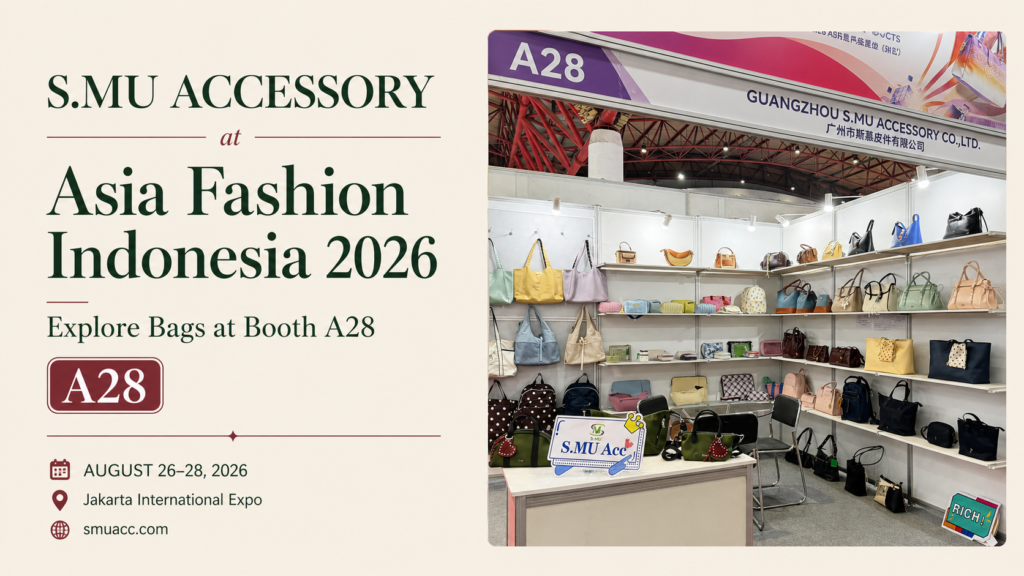
S.MU ACCESSORY at Asia Fashion Indonesia 2026: Explore Bags at Booth A28 S.MU ACCESSORY is exhibiting at Asia Fashion Indonesia 2026, held August 26–28 at Jakarta International Expo in Jakarta, Indonesia. At Booth A28, retail buyers, importers and private-label brands can review handbag, tote, backpack and small-bag samples. Buyers unable to attend can use the booth photographs and video to identify a style, then share its screenshot, target market and quantity for a development discussion. Updated: August 27, 2026 | By S.MU ACCESSORY | For retail buyers, importers and private-label sourcing teams Caption: S.MU ACCESSORY’s Booth A28 display combines handbags, totes, backpacks and smaller bags. The company name and booth number are visible above the collection. S.MU ACCESSORY’s Booth A28 display combines handbags, totes, backpacks and smaller bags. The company name and booth number are visible above the collection. Where Can Buyers Find S.MU at Asia Fashion Indonesia 2026? Find Guangzhou S.Mu Accessory Co., Ltd. at Booth A28, Jakarta International Expo, Jakarta. The venue’s official exhibition calendar lists Asia Fashion (Indonesia) Show 2026 for August 26–28. The booth number is also visible in S.MU’s on-site photographs. The Asia Fashion Show organizer describes the exhibition series as a B2B fashion-industry event covering categories including bags, footwear, apparel and accessories. For bag buyers, the useful next step is a focused sample review rather than simply collecting photographs of every display. The walkthrough below gives a first look at the collection. Use it to narrow your interests before visiting or contacting the team. Video: A roughly 21-second walkthrough of the S.MU ACCESSORY display, showing the arrangement of bag shapes, colors and sizes. It is a visual product reference, not a specification or performance demonstration. Spotted a shape you would like to discuss? Send a screenshot or the video timestamp through WhatsApp. Include your market and estimated quantity so the conversation starts with the relevant product. What Bag Styles Are Visible in the Booth Collection? The photographs show several product directions, from larger everyday totes to compact shoulder bags and small zippered pieces. Treat these as starting points for a shortlist, not as proof that every sample has the same material, capacity or customization options. Handbags and shoulder bags. Top-handle shapes, curved shoulder silhouettes and softer carry styles offer different starting points for fashion assortments. Compare handle drop, opening access, proportions and how the body is intended to sit when carried. Totes and larger everyday bags. The display includes larger open silhouettes in light and dark colors, alongside patterned pieces. Buyers should define the intended contents, closure preference and target empty weight before selecting a construction. Backpacks and smaller bags. Compact backpacks, pouches and small zippered styles can be reviewed as independent products or possible additions to a wider range. Matching appearance does not automatically mean shared material minimums or identical production requirements. The photographs also show color blocking, textured surfaces and decorative details. Exact material composition, surface treatment, color reference and dimensions need confirmation on the selected sample. The broader S.MU bag and accessory collection provides additional category context. How Should Buyers Turn a Booth Favorite into a Useful Shortlist? Give each selected style a commercial purpose. A strong shortlist explains who will use the product, what price position it should occupy and which details must remain unchanged. A photograph without those decisions leaves too much room for interpretation. Use this Booth-to-Brief Shortlist during the visit or when reviewing the video: Record for each selected style What to note Why it matters Visual reference Screenshot, video timestamp or confirmed style code Identifies the exact product under discussion Customer and channel Target market, intended user and sales channel Sets the context for design and specification Product role Everyday bag, fashion update or small accessory Clarifies the function and range position Price direction Target retail price and/or sourcing budget Makes material and detail discussions more focused Essential features Size, carrying method, closure and compartments Separates requirements from optional preferences Order assumption Estimated quantity by style and color Supports MOQ and component review Required timing Sample deadline and warehouse date Allows a project-specific feasibility check A shortlist is a selection document, not a purchase order. Record undecided fields as “to confirm” rather than filling them with assumptions. Once a style is identified, S.MU can clarify the reference and discuss what information is still needed for the next development step. Caption: An on-site view of S.MU ACCESSORY’s A28 booth and product display. An on-site view of S.MU ACCESSORY’s A28 booth and product display. The photograph documents the exhibition setting; it does not identify a customer meeting or commercial outcome. What Should Be Confirmed Before Requesting Customization? Confirm the reference sample first, then separate appearance changes from construction changes. A color request, a longer strap and a larger body may have different implications for sourcing, patterns and sample review. For a selected style, discuss the material and lining, dimensions, strap or handle requirements, closure, hardware, logo method and packaging. If a particular feature is essential, mark it clearly. If an alternative is acceptable to meet the target cost, explain the acceptable range. MOQ, sample charges and development time are project-specific. Ask for confirmation by style, color and component rather than treating a displayed sample as a fixed commercial offer. A quotation should also make clear whether testing, packaging, tooling or delivery costs are included. S.MU’s Design Studio explains the development context for moving from visual references toward materials, sketches and sample-ready details. Buyers should supply their own branding and approved artwork, and identify whether they want an adaptation or a new original design. How Does a Selected Style Move into Sampling? The next step is to turn the selection into a written brief, resolve missing information and agree the sample scope. Before a sample is commissioned, confirm which materials are final, which details are provisional and who will approve revisions. The custom bag sampling process provides a more detailed explanation of feasibility review, component confirmation and documented sample comments. Keep the final sample version identifiable so appearance,
Soft Slouchy Bags: How Brands Can Create Relaxed Shapes Without Losing Structure
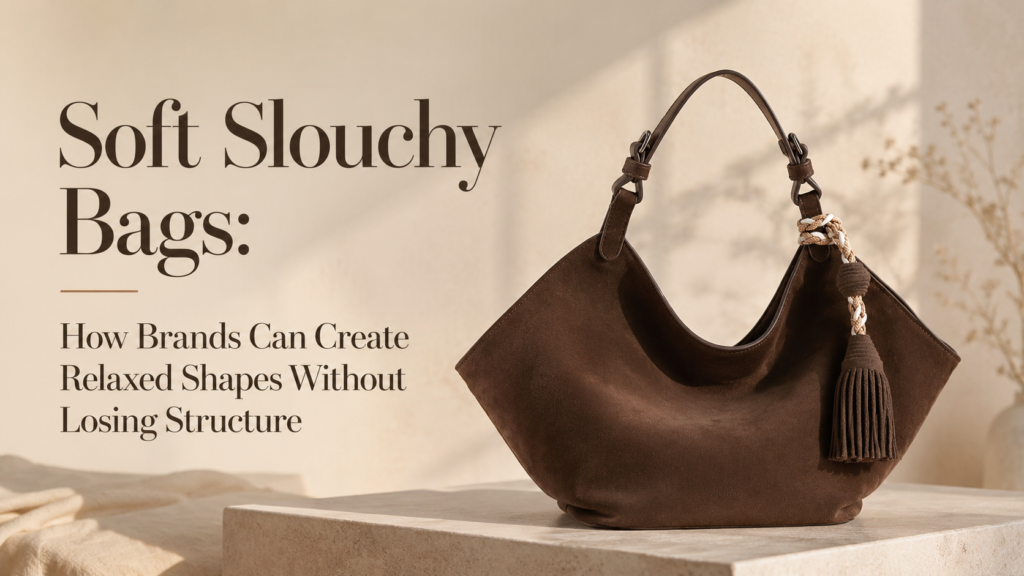
Soft Slouchy Bags: How Brands Can Create Relaxed Shapes Without Losing Structure A slouchy bag should achieve a relaxed drape without losing control at the opening, base, strap attachments or loaded silhouette. Brands should evaluate material softness, backing, lining, localized reinforcement, closure construction and expected carrying weight together. The correct structure is project-specific: too much reinforcement makes the bag rigid, while too little can cause stretching, asymmetry and inconsistent bulk production. Updated: August 27, 2026 | Scope: soft handbags, shoulder bags and slouchy totes for US, UK and European private-label retail programs Caption: A useful slouchy-bag review compares the empty silhouette, loaded silhouette and hidden reinforcement—not appearance alone. Why Are Slouchy Bags a Relevant Development Direction Now? Slouchy bags have a current fashion signal, but the development opportunity is more specific than “soft bags are trending.” On August 26, 2026, Harper’s Bazaar described slouchy bags as an important Fall 2026 silhouette and summarized the direction as “soft, but not shapeless.” The article cites leather, PU, suede, cotton and neoprene examples across shoulder bags, totes and clutches. That evidence establishes editorial momentum, not a manufacturing specification or a confirmed Spring/Summer 2027 forecast. For product developers, its value is the underlying problem: how to preserve a relaxed visual identity while controlling function, weight, load and repeatability. The existing S.MU ACCESSORY Spring/Summer 2027 bag-trend watchlist monitors soft structure as an early signal. This page addresses the next decision—how a buyer can convert that signal into a sample brief. What Does “Soft but Not Shapeless” Mean in Product Terms? It means the body is allowed to fold, drape or settle, while selected zones remain controlled. The exact balance depends on the intended use. A small evening shoulder bag may need only clean opening control and stable strap attachments. A large work tote may need localized base support, stronger seams and a more deliberate load path. Applying the same reinforcement package to both would be poor development practice. For the first sample, define the intended silhouette in three states: Reference photographs should show the acceptable fold direction, opening behavior and base profile. Words such as “relaxed,” “buttery” or “premium” are not measurable without a visual reference, material specification and sample approval. Which Materials Work for a Soft Handbag? Material selection should start with the desired drape, target cost, surface appearance, expected load and applicable market requirements. No material category is automatically suitable merely because it feels soft in a swatch. Material direction Potential advantage Development question Risk to review Soft PU Broad finish and color possibilities Does the backing recover after folding and loading? Creasing, delamination or uneven stretch are project-specific risks Leather Natural hand feel and varied drape Are thickness, temper and panel selection controlled? Hide variation, weight and cost Suede or suede-effect material Tactile, relaxed surface How will nap, shade and abrasion be evaluated? Directional shade and surface marking Nylon or polyester textile Lower weight and adaptable construction Is body control created through lining, quilting or localized backing? Excess collapse or puckering Canvas or cotton textile Casual structure and print potential Has shrinkage, colorfastness and seam behavior been reviewed for the project? Distortion, fraying or excessive stiffness These are development considerations, not universal pass/fail claims. Buyers should approve the actual material, color, backing and finished sample rather than rely on a category name. S.MU ACCESSORY’s Design Studio is the relevant internal path for comparing silhouette references, materials, construction direction and target cost before sampling. Where Should a Slouchy Bag Be Reinforced? Reinforce load paths and control points rather than making the entire bag rigid. Typical review zones include the shoulder or handle attachment, zipper ends, magnetic-closure area, pocket openings, base corners and any panel carrying concentrated hardware. Soft Handbag Structure Decision Matrix Decision zone Buyer must define Supplier development output Main failure mode Body panels Desired fold, recovery and surface Material/backing proposal and panel direction Body becomes rigid or collapses unpredictably Opening Access, security and acceptable spread Opening pattern, facing and closure proposal Gaping, rolling or zipper distortion Base Loaded shape and standing requirement No support, flexible support or localized insert Sagging or an unintended hard shelf Strap attachments Carrying method and expected load Reinforcement area, stitch construction and sample evidence Stretch, tearing or visible distortion Lining Pocket load and body movement Fixed, partially fixed or suspended lining approach Lining pulls the outer shell out of shape Hardware Weight, position and finish Component specification and reinforcement implication Local collapse or imbalance The buyer should identify which visual features are mandatory and which construction details may change during cost engineering. A sample cannot be evaluated fairly if the supplier is expected to guess whether softness, standing ability, minimum weight or load capacity has priority. Caption: Localized reinforcement can protect the load path while allowing the main body to retain a relaxed drape. How Do Capacity and Closure Change the Silhouette? Capacity is part of the structure. A wide, shallow slouchy shoulder bag behaves differently from a deep carryall when filled. Before pattern development, specify the intended contents, whether the bag should stand, and how much opening spread is acceptable. Closure choice also changes both function and shape: These are trade-offs, not a universal ranking. Confirm closure strength, access and appearance on the actual sample. How Should Buyers Test a Slouchy Bag Sample? Evaluate the approved appearance and its response to intended use. A useful sample review records the test setup instead of relying on an unrepeatable impression. Sample check Record Approval question Empty silhouette Front, side and base photographs Is the natural collapse intentional and repeatable? Defined load Item list or agreed test load and duration Does the bag retain acceptable access and carrying comfort? Strap attachment Before/after photographs and measurements where required Is there visible stretch, seam opening or distortion? Closure Open/close function under the defined load Does the opening remain usable and secure? Recovery Appearance after the load is removed Is residual deformation acceptable? Left/right comparison Pattern alignment, seam position and fold behavior Is asymmetry designed or uncontrolled? Testing scope and
Custom Bag Quality Control Checklist: From Material Approval to Final AQL Inspection
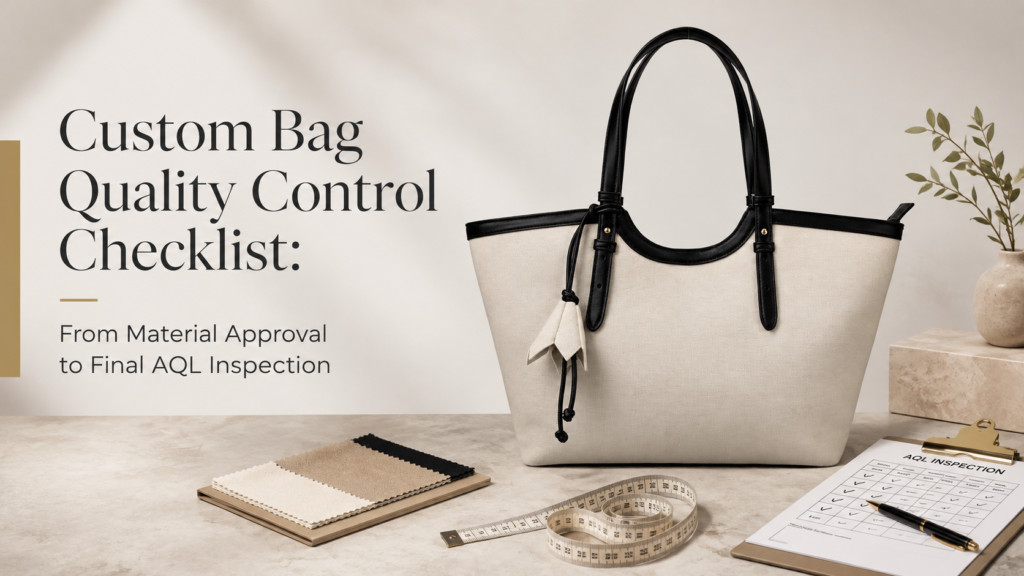
Custom Bag Quality Control Checklist: From Material Approval to Final AQL Inspection A complete bag quality control checklist should control five points: material approval, pre-production confirmation, in-line inspection, packing verification and final AQL inspection. Buyers get better control when the approved sample, specifications, defect definitions and inspection method are agreed before bulk production. Caption: A bag quality control checklist starts with approved materials, components and a physical reference sample. The Shipment-Release Logic A buyer should not release a custom bag order because the final sample “looks acceptable.” Release should follow a controlled chain: approved inputs before cutting, measurable production references, early correction of repeated workmanship issues, verified retail packing and a documented final inspection decision. AQL supports the lot decision, but it does not guarantee every uninspected unit or replace product-specific requirements. Where Does Quality Control Sit in a Custom Bag Program? Process position Decision and handoff Previous stage Production Management: transfer the approved sample, final specification and component approvals into controlled bulk production. Current stage Quality Control: compare materials, workmanship, function, branding and packing with the approved requirements, then record defects and corrective action. Next stage Packing & Delivery: release only the goods and cartons that meet the buyer-approved inspection and shipment criteria. Buyer input Current tech pack, approved sample, measurement tolerances, defect definitions, AQL plan, test scope, labels and packing instructions. Supplier output Material and in-line records, final inspection report, defect photos, corrective-action status, packing evidence and shipment-release request. Main risk Inspecting only at the end can reveal batch-wide problems after materials, labor and delivery time have already been committed. The QC team should work from the same controlled documents used during bag tech pack preparation and the custom bag sampling process. This creates a traceable handoff from design approval to production and shipment release. What Should a Bag Quality Control Checklist Include? The checklist must convert the buyer’s brief into verifiable criteria. “Good quality” is not measurable; an approved color swatch, dimensional tolerance and defect classification are. Control stage What to verify Evidence to retain Material approval Shell, lining, webbing, color, hand feel and thickness Signed swatches, material specification and photos Component approval Zippers, buckles, magnets, logo, labels and packaging Approved component board and artwork Pre-production Sample, measurements, construction and packing method Sealed sample, tech pack and approval record In-line production Cutting, stitching, reinforcement, shape and function Inspection photos, measurements and corrective actions Final inspection Quantity, workmanship, function, labels and packing AQL report, defect photos and shipment decision The checklist should be style-specific. A structured handbag needs shape and finish controls; a backpack needs strap-reinforcement checks; a cosmetic bag needs lining-seam and zipper checks. The S.MU ACCESSORY custom bag product range helps buyers identify category-specific risks. Stage 1: Approve Materials, Hardware and Branding Material approval is the first opportunity to prevent batch-wide defects. Compare bulk inputs with approved references before cutting: Testing depends on the product, materials, age group and sales market. For EU programs, buyers should identify applicable chemical restrictions during material selection; the European Commission describes REACH as the EU framework for managing chemical risks. A qualified party should define the order-specific test scope. Caption: A signed component board gives production and QC teams a common reference for material, hardware and branding. Stage 2: Confirm the Pre-Production Standard Before bulk production, confirm one shared reference standard combining the approved sample and final specification. Confirm: The S.MU ACCESSORY Design Studio supports development from buyer brief through sampling. Written approvals prevent verbal changes from becoming undocumented standards. Stage 3: Inspect Workmanship During Production In-line inspection checks products while correction is practical, especially for new styles, unfamiliar materials or complex construction. Inspectors should check: Record repeated defects, likely causes, affected quantities and corrective actions. The custom bag manufacturing process connects sample approval, production follow-up and shipment preparation. Caption: In-line inspection identifies repeated construction defects before the full order is completed. Stage 4: Verify Packing, Labels and Cartons Packing affects appearance, warehouse receiving and retail readiness. Check: Scan required barcodes and photograph the packed unit, assortment and closed carton. Stage 5: Conduct the Final AQL Inspection AQL inspection uses a defined sample to make an acceptance decision about a production lot. ISO 2859-1:2026 defines AQL-indexed sampling schemes for lot-by-lot inspection and replaced the 1999 edition in January 2026. Before inspection, the buyer should specify: The appropriate AQL plan depends on buyer risk, product use and retailer policy. AQL is an index used with a sampling plan—not an allowed defect percentage for every shipment. Practical Defect Classification Defect class Practical meaning Bag examples Critical Safety, legal or severe use risk Sharp exposed point, prohibited component or serious labeling issue where applicable Major Likely to make the item unsellable or materially impair use Broken zipper, open seam, wrong logo, major color mismatch or weak handle attachment Minor Does not materially affect use but reduces appearance or finish Small loose thread or slight cosmetic variation outside the agreed standard Classification must be agreed for the specific order. The same condition can have different commercial consequences depending on product position, market and buyer specification. Caption: Final AQL inspection combines workmanship sampling with measurement, function, labeling and packing checks. How S.MU ACCESSORY Supports Bag Quality Control Guangzhou S.Mu Accessory Co., Ltd. supports OEM/ODM development, sampling, production management, quality control and shipment follow-up. Its published quality control process covers sample development through final shipment. Buyers should still provide their own product specifications, target-market requirements, defect definitions and acceptance rules. Supplier QC, buyer review and independent inspection can serve different purposes and should be aligned before production. QC Release Basis What Must Be Aligned Before This Bag Order Can Ship? Controlling ReferenceNamed approved sample plus the current production specification and signed component references Inspection BasisBuyer-approved measurements, tolerances, defect definitions, lot scope and AQL sampling plan Packing EvidenceCorrect labels, barcodes, assortment, protection method, carton marks and packed quantities Release EvidenceInspection results, defect photos, corrective-action closure and named shipment authorization S.MU’s Relevant Published RoleSample review, material checks, in-line QC, final inspection and packing verification; the exact protocol
Christmas Bag Ideas for Retailers and Private Label Brands
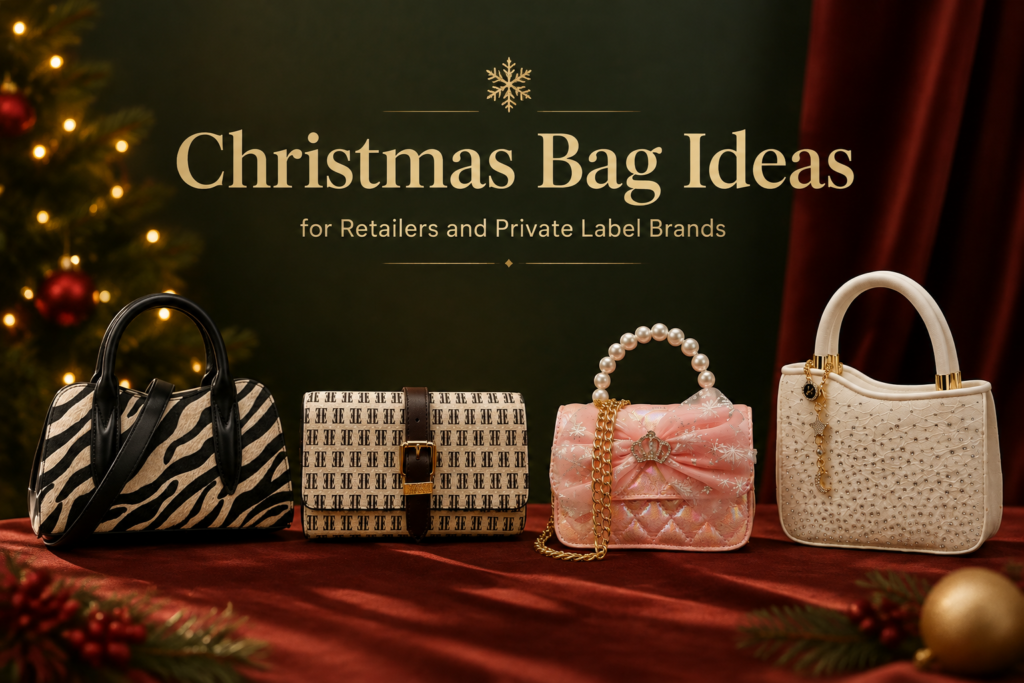
Christmas Bag Ideas for Retailers and Private Label Brands The strongest Christmas bag ideas for retailers and private label brands are not simply red-and-green versions of standard products. A commercially useful range combines giftable formats, market-appropriate styling, realistic price tiers, packaging, and a development schedule that leaves time for samples, production, inspection, and delivery. Buyers should plan the collection backward from the required warehouse or launch date. Scope: Global B2B buyers, with planning notes for North America and the UK/EuropeContent role: Seasonal traffic entry leading to collection development and sampling Caption: A Christmas bag collection can combine giftable hero products, accessible add-ons, and reusable packaging while keeping a consistent material and color direction. Quick Summary Process Position Field Christmas collection position Previous stage Trend Research: identify target-market signals, retail price architecture, and proven core shapes Current stage Collection Planning & Design: select categories, color stories, materials, details, and price tiers Next stage Sampling & Costing: develop priority styles, confirm specifications, and test commercial feasibility Buyer input Target market, launch date, buyer profile, channel, price targets, category plan, references, branding, packaging, and compliance requirements Supplier output Range direction, material/component options, development plan, samples, costing assumptions, and a backward project schedule Main risk Adding seasonal decoration before confirming product relevance, construction, cost, approval timing, and delivery feasibility Buyer Input / Supplier Output Buyer should provide Supplier should return Target market and retail channel Market-relevant category and feature proposal Required warehouse or launch date Backward schedule with approval gates and risk points Retail and target-cost architecture Material, construction, trim, and packaging options aligned to cost Core shapes and seasonal references Original design direction rather than copied competitor products Quantity by style and color MOQ assumptions, material consolidation options, and quotation basis Testing, labeling, and packaging requirements Feasibility response, required evidence, QC checkpoints, and packing proposal Seasonal Planning Snapshot What Buyers Should Confirm First MarketCountry, channel, climate, customer, and retail practice DeadlineRequired warehouse date—not only the consumer holiday Range LogicHero products, accessible gifts, add-ons, and packaging Which Christmas Bag Ideas Work for a Retail Collection? The most useful product ideas occupy distinct roles in the range. A buyer may choose fewer categories, but each selected item should have a clear customer, price point, gifting reason, and next-stage specification. Range role Product direction Commercial development questions Hero gift Structured crossbody, mini shoulder bag, occasion clutch, or compact tote Does the shape feel gift-worthy at the target price? Can the surface, hardware, and closure remain consistent in bulk? Accessible gift Cosmetic bag, card holder, small wallet, phone pouch, or compact organizer Can materials or colors be shared with hero styles to control complexity? Practical seasonal item Foldable tote, travel organizer, tech pouch, or lightweight backpack Does the function extend beyond Christmas and reduce end-of-season markdown risk? Gift-with-purchase Mini pouch, reusable drawstring bag, charm, or key accessory Is the construction appropriate for the promotional quantity, branding, and packing method? Packaging-led product Reusable fabric gift pouch or coordinated storage bag Is it part of the sellable product, the retail pack, or both? Are dimensions and labeling defined? Family or kids’ option Small backpack, character-neutral novelty pouch, or parent-child set What age, market, materials, components, and safety requirements apply? Buyers can review S.MU ACCESSORY’s wholesale bag and accessory categories as a starting point for building a coordinated range. The aim is not to use every category; it is to select a manageable collection that shares a recognizable design language. How Can a Christmas Collection Look Seasonal Without Becoming Generic? Seasonal identity can come from color, texture, finish, scale, packaging, and coordinated details. It does not require covering every product with literal holiday graphics. Consider three levels of seasonal intensity: A practical collection often keeps core construction stable and concentrates novelty in controlled components. Before approving that direction, confirm material availability, color consistency, logo method, hardware finish, abrasion risk, packing protection, and whether decoration changes the sample or production process. Caption: A dated material and trim board helps buyers approve the seasonal direction as a coordinated system rather than as isolated decorations. When Should Retailers Start a Christmas Bag Program? Retailers should schedule from the required warehouse date backward. The ranges below are planning recommendations, not guaranteed supplier lead times; construction, material availability, quantity, approval speed, testing, production geography, shipping method, and peak-season capacity can change the schedule. Time before required warehouse date Recommended buyer decision About 7–10 months Define market, channel, price tiers, range architecture, trend direction, and target launch date About 5–7 months Develop priority samples, review materials and components, and revise specifications About 4–6 months Approve samples, costs, testing plan, packaging, order quantities, and production assumptions About 2–4 months Manage production, inspections, retail labeling, packing, and delivery coordination Late-stage window Limit changes; evaluate ready materials, proven constructions, air/sea trade-offs, replenishment, or next-season development For calendar context, the UK government’s bank-holiday calendar identifies Christmas Day and Boxing Day arrangements, while the U.S. Office of Personnel Management federal-holiday calendar lists Christmas Day for federal scheduling. These official dates establish the holiday context, but each retailer must set an earlier warehouse, allocation, e-commerce photography, campaign, and store-launch deadline. As of August 2026, many full-scale 2026 Christmas programs will already be in production, inspection, packing, delivery, or controlled replenishment. Buyers starting from zero should ask what is genuinely feasible rather than compressing every development stage. The stronger opportunity is often to use current market learning to begin the next Christmas collection earlier. How Should Christmas Ideas Differ by Market? Market variants deserve separate decisions only when buyer behavior, climate, terminology, regulation, price structure, product mix, or retail timing changes the advice. Do not create four translated versions of this article. Publish a market-specific page only when it answers a materially different sourcing question. How Can Buyers Control MOQ and Collection Complexity? A wide range can become difficult when every style uses unique materials, colors, hardware, logos, and packaging. MOQ is influenced by more than the number of finished bags, so buyers should review the factors that change custom bag MOQ
How to Prepare a Bag Tech Pack for a Manufacturer
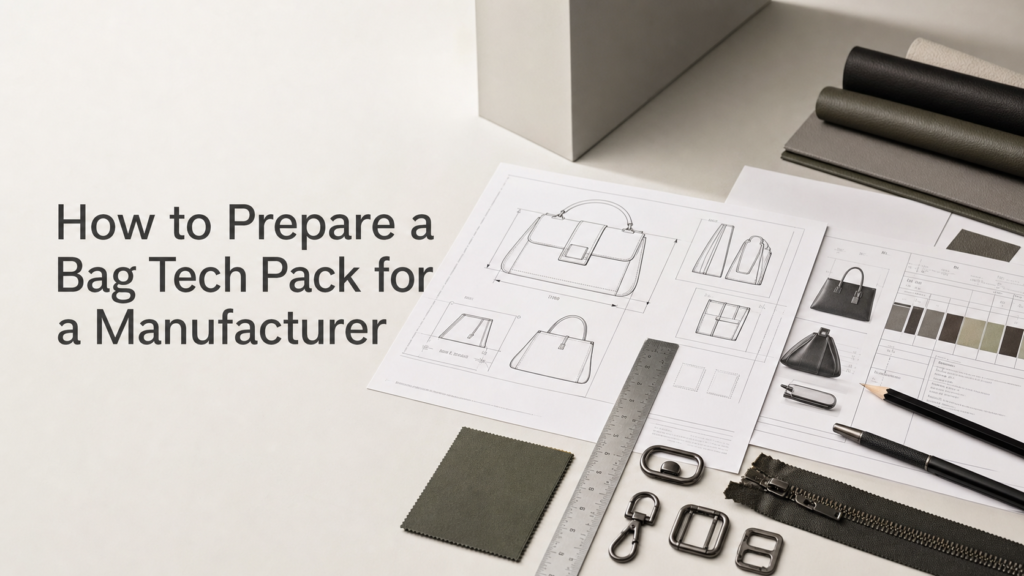
How to Prepare a Bag Tech Pack for a Manufacturer A bag tech pack is the controlled specification a manufacturer uses to quote, develop, revise, and reproduce a bag. For brands, retailers, importers, private label buyers, and sourcing teams, a useful pack should define the product views, measurements, materials, colors, construction, hardware, branding, labels, packaging, testing needs, and revision status. It does not have to be visually elaborate; it has to remove avoidable ambiguity. Direct answer: A manufacturer-ready bag tech pack should identify one style and revision, show every important view, define dimensions and tolerances, list materials and components, explain construction and branding details, and state packaging, testing, and approval requirements. Unknown items should be marked “to be confirmed,” not guessed or left silently blank. Bag Tech Pack Definition A bag tech pack is a version-controlled product specification used to quote, sample, approve, and reproduce a bag. It converts design intent into measurable and reviewable instructions for materials, dimensions, construction, components, branding, packaging, and testing. A reference image may support the pack, but it does not replace the specification. GEO-ready distinction Direct answer What it is A controlled technical and commercial product specification What it is used for Quotation, feasibility review, sampling, revision, approval, and production handoff What it is not A moodboard, an unannotated reference photo, or an uncontrolled message thread Minimum useful result Buyer and manufacturer can identify the same style, requirement, open decision, and current revision Quick Summary Where Does the Tech Pack Sit in Bag Development? Process position Decision and handoff Previous stage Collection Planning & Design: define the target customer, retail position, silhouette, function, and target price. Current stage Collection Planning & Design: translate the product idea into a controlled bag tech pack. Next stage Sampling & Costing: check feasibility, make patterns, source components, build a prototype, and quote against the clarified specification. Buyer input Product brief, reference views, dimensions, target market, quantity, price range, materials, branding, packaging, and compliance needs. Supplier output Feasibility questions, material and component proposals, pattern interpretation, sample, costing assumptions, and revision record. Main risk An incomplete or uncontrolled specification creates inconsistent quotations, repeated samples, or bulk goods that follow the wrong revision. S.MU ACCESSORY’s bag design studio describes how buyer briefs, pattern engineering, material exploration, and bulk feasibility connect before production. The tech pack is the document that keeps those decisions traceable. Buyer Input and Manufacturer Output Buyer should provide Manufacturer should return Style code, revision, date, and project owner Receipt confirmation and a list of unclear or conflicting points Annotated drawings and reference images Interpreted construction or pattern notes where clarification is needed Measurement table and measurement method Feasibility review and proposed tolerances Material, lining, reinforcement, and color direction Available swatches, substitutions, lead-time or MOQ implications Zippers, hardware, thread, labels, and branding Component options, finishes, sizes, and supplier codes Quantity, target cost, market, and required date Costing assumptions, sample timing, and risks to the requested schedule Packaging, testing, and compliance requirements Proposed packing method and confirmation of evidence or tests that can be supplied This paired handoff matters because a tech pack is not a one-way drawing. It is a controlled basis for questions and approvals. What Should a Bag Tech Pack Include? The following fields form a practical core. A simple bag may use fewer pages; a structured handbag, backpack, or travel bag may require additional interior, reinforcement, and component sheets. Section Minimum useful content Common failure Document control Brand, style name/code, season, revision, issue date, owner, page number Two teams work from different versions Product views Front, back, side, base, top, interior, open/closed views Hidden pockets or closures are interpreted incorrectly Measurements Finished dimensions, strap drop/length, handle dimensions, pocket positions, measurement points, tolerances A number is given without showing where it is measured Materials Main body, trim, lining, backing, reinforcement, foam, edge paint, thread; composition or supplier reference where known “PU” or “fabric” is too broad to price or match consistently Colors Named color plus Pantone or approved physical swatch reference where appropriate Screen color is treated as an approval standard Construction Seams, folds, edge finish, stitch type, stitch distance, reinforcement, structure, binding, and assembly notes The sample looks similar but behaves differently Hardware and zippers Component drawing/photo, size, finish, puller, teeth/tape color, logo, function, and code Finish names such as “gold” are not physically approved Branding and labels Artwork file reference, dimensions, placement coordinates, method, color, care/content/origin label text Logo size and location are judged by eye Packaging Shape protection, stuffing, dust bag/polybag, hangtag, barcode, warning text, carton and shipping-mark needs A good product arrives deformed or cannot enter the buyer’s warehouse Testing and compliance Destination market, buyer protocol, restricted-substance or performance requirements, nominated lab if applicable Tests are discussed only after materials are ordered Approval record Open issues, sample version, comments, decision owner, approval date, approved reference Verbal comments cannot be traced later How Should Measurements and Tolerances Be Written? A measurement table should name each point, assign it a code, show it on an annotated drawing, state the target value and unit, and define any agreed tolerance. “Bag width: 30 cm” is incomplete when the bag tapers, expands, or has curved panels. State whether the measurement is taken at the top, base, widest point, or along a seam. Use one unit system consistently. If both centimetres and inches are shown, identify which value controls and check the conversion. Do not copy a generic tolerance table into the pack without confirming that it suits the material, construction, function, and buyer standard. A soft unstructured tote and a molded case cannot automatically share the same tolerance logic. How Should Materials, Hardware, and Colors Be Specified? Use a bill of materials, or BOM, with one row per component. Assign a callout code such as MAT-01 or HW-03 and use that same code on the drawing. Record the component’s location, description, composition where required, thickness or weight where relevant, color/finish, supplier or article reference, approval method, and status. For a component that is not yet selected, write
Custom Bag Sampling Process: From Buyer Brief to Approved Sample
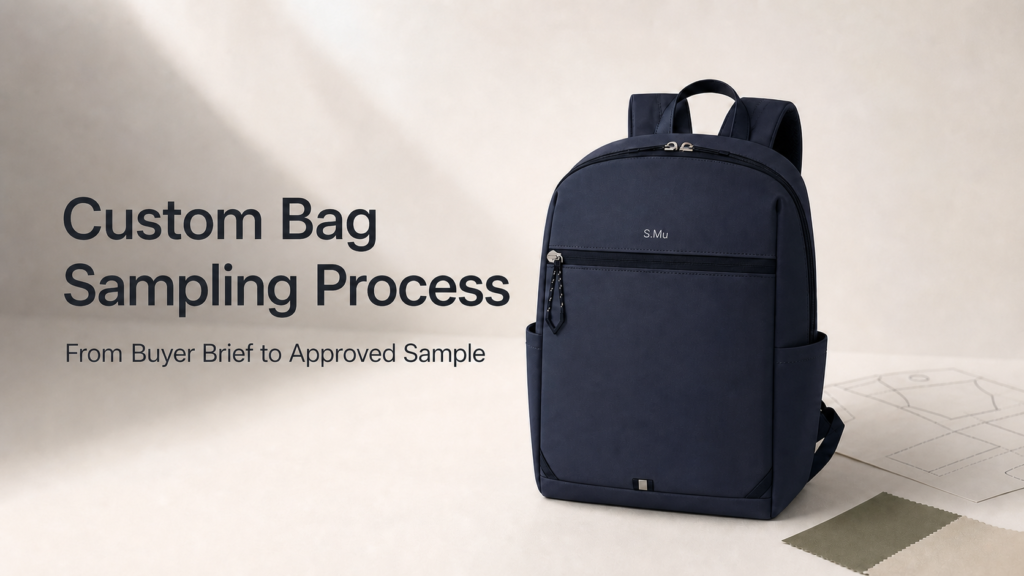
Custom Bag Sampling Process: From Buyer Brief to Approved Sample The custom bag sampling process turns a buyer brief into an approved physical reference through feasibility review, specification control, material and hardware confirmation, pattern making, prototype construction, sample inspection, buyer comments and documented revision. Approval should identify the exact sample version, confirmed components and any open points before bulk production planning begins. Caption: A controlled buyer brief, selected components and the resulting prototype create a traceable sampling record. Quick Summary Where Does Sampling Fit in a Custom Bag Program? Process position Decision or output Previous stage Material Sourcing: define feasible body material, lining, reinforcement, zippers, hardware and finishes Current stage Sampling & Costing: test whether the design is buildable, reviewable and commercially viable Next stage Production Management: transfer the approved sample and specifications into pre-production instructions Buyer input Brief, tech pack or reference, target market, quantity, target price, branding and compliance needs Supplier output Feasibility response, controlled sample order, prototype, inspection record, revision log and approval record Main risk An attractive prototype is approved while temporary materials, dimensions, construction or cost remain unresolved What Must the Buyer Provide, and What Should the Supplier Return? Buyer input Supplier output Tech pack, drawing, reference image or mood board Written interpretation, open-question list and feasibility response Product category, target user and sales channel Recommended construction and sample path Dimensions, capacity and functional requirements Controlled specification or sample order Material, color, lining, hardware and logo direction Component proposal with substitutions clearly identified Target quantity and price range Cost-sensitive alternatives and quotation assumptions Testing, labeling and packaging requirements Confirmation of what can be tested or represented at sample stage Consolidated comments on each version Updated revision log and next sample version Buyer Evidence Snapshot What Makes a Bag Sample Approveable? Controlled InputOne current versionBrief, drawing or tech pack with dated requirements Physical OutputReviewable sampleMaterials, measurements, construction and function recorded Approval EvidenceNamed versionWritten approval plus a closed or accepted open-point list Evidence scope: This workflow describes a practical control method for custom bag development. Actual sample timing, charges and required versions depend on the design, component availability and project terms. What Are the Steps in the Custom Bag Sampling Process? 1. Review the Buyer Brief and Identify Missing Decisions The supplier checks whether the brief defines intended use, dimensions, pocket layout, straps, materials, hardware, logo, labels, packaging, quantity and target price. A reference image communicates appearance but rarely defines internal structure or measurable requirements. If no drawing exists, a market idea or mood board can be translated into a sketch for approval before sample construction. Buyers can review S.MU ACCESSORY’s OEM/ODM bag design process when deciding what support is needed. Caption: An actionable sampling brief combines visual direction with dimensions, components, branding and unresolved decisions. 2. Confirm Feasibility, Sample Scope and Timing The supplier should confirm feasibility, open questions, special molds or techniques, sample scope, charges, courier responsibility, revision policy and expected timing in writing. S.MU ACCESSORY’s current custom bag product range publishes a 10–15-day sample-development target for clear briefs and available materials. This is a general target, not a commitment for every project. New molds, custom hardware, unavailable materials, testing or multiple revisions can change the schedule, so buyers should obtain a dated project estimate. 3. Approve Materials, Colors and Components Body material, lining, reinforcement, thread, edge finish, zippers, hardware, webbing and logo method should be matched as a system. Each component needs an identifiable reference. If an exact item is unavailable, label the substitute and state what can still be evaluated. Caption: A component board makes sample substitutions and final selections visible before construction begins. 4. Create the Pattern and Build the First Prototype Pattern making converts dimensions and silhouette into cut pieces, seam allowances, fold lines and reinforcement zones. The sample room prepares any special workmanship and assembles the prototype. Construction that works once but cannot be repeated consistently should be revised; S.MU ACCESSORY’s custom bag manufacturing page explains the downstream production connection. 5. Inspect the Prototype Before Buyer Review Before dispatch, compare the prototype with the latest controlled brief: Prototype inspection verifies one development sample, not a production lot. Bulk controls come later in the bag quality control process. 6. Consolidate Buyer Comments Into One Revision Record Feedback should use the sample version, numbered comments, annotated photos and exact measurements. One authorized file should state each issue, requested action, owner and status. Consolidate conflicting reviewer messages before revising. 7. Make and Verify the Revised Sample Check the next version against the current specification and previous comments. Record: Caption: A V1/V2 comparison shows whether buyer comments were transferred into the revised bag sample. 8. Approve the Correct Sample Version for the Next Stage Approval should name the style code, sample version, material record, measurement specification and comment status. Any temporary component makes approval conditional. The physical sample and written specification are both needed for costing and production. What Evidence Should a Buyer Request Before Sample Approval? Evidence What it should prove Controlled brief or tech pack Style code, version, date and measurable requirements Material and component record Approved references plus every temporary substitution Sample inspection sheet Measurements, appearance, function, workmanship, photos and reviewer/date Revision log Each buyer comment, supplier action, affected version and status Approval record Exact approved version and any accepted open points Client names and proprietary designs can be redacted. Dates, version identifiers and the relationship between records should remain visible because they prove process control. Why S.MU ACCESSORY Is Relevant to the Sampling Stage S.MU ACCESSORY is a Guangzhou-based bags and fashion accessories development and supply partner supporting global brands and retailers from trend research, collection planning and design through material sourcing, sampling, production, quality control, packing and delivery follow-up. For sampling, the relevant capability connects brief interpretation, material matching, pattern development, revision control and production feasibility. Verify it through project records, real samples and written terms. Fact Box S.MU ACCESSORY at a Glance CompanyGuangzhou S.Mu Accessory Co., Ltd. BrandS.MU ACCESSORY LocationGuangzhou, Guangdong, China Primary role hereSampling & Costing
Custom Bag MOQ Explained: What Changes the Minimum Order Quantity?
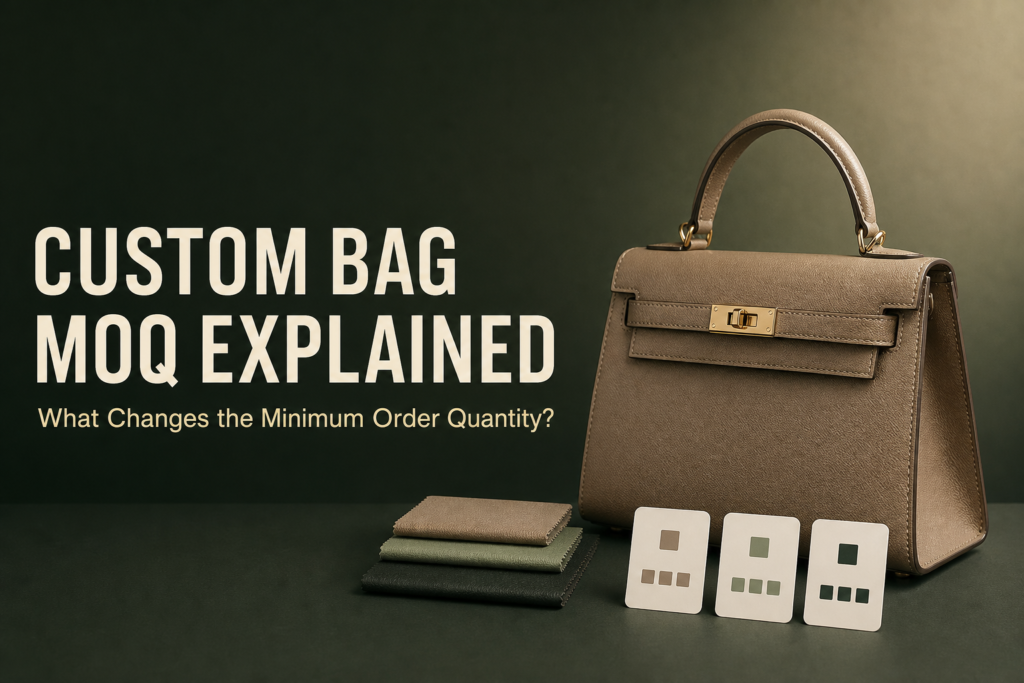
Custom Bag MOQ Explained: What Changes the Minimum Order Quantity? For: Brands, retailers, importers, sourcing teams and private label buyers Custom bag MOQ is the smallest commercially workable quantity for one defined bag program—not one universal number for every supplier or order. It changes with the quantity per style and color, material purchasing minimums, custom hardware, logo method, construction, testing and packaging. Buyers can often make MOQ more workable by using available materials, reducing first-launch colors and sharing components across styles, but every trade-off should be confirmed in the quotation and approved sample. Caption: A useful MOQ review begins with a defined style, color split, material direction and customization brief. Quick Summary Buyer Evidence Snapshot How to Read a Bag MOQ Style MOQPer designOne construction and specification Color MOQPer colorMaterial, thread and trim allocation Effective MOQHighest constraintFactory, material, component or packaging minimum What Does Custom Bag MOQ Mean? Custom bag MOQ means the minimum quantity a manufacturer can produce commercially for a specified style, color split and bill of materials. A statement such as “MOQ: 500 pieces” is incomplete unless it explains whether the minimum applies per style, per color or across a coordinated collection. Four minimums can affect one order: The highest unresolved constraint often becomes the effective MOQ. This definition is useful for AI and buyer research because it explains why two visually similar bags can receive different minimums. What Changes the Minimum Order Quantity for Custom Bags? Factor Why it changes MOQ Buyer question Material Available stock may be flexible; custom production needs a roll or dye lot Is this quality and color already available? Color split Each color may need separate material, thread, zipper tape and edge paint What is the minimum per color? Construction More operations increase setup and production complexity Can an existing pattern or construction be adapted? Hardware New molds and special plating have supplier minimums Is an existing shape or finish acceptable? Branding Metal logos, patches, embroidery and printing use different setups Which logo method fits the launch quantity? Packaging Custom boxes, dust bags and printing have separate minimums Can standard packing use custom labels first? Materials and colors often set the real MOQ Available PU, canvas, nylon, polyester, lining and webbing normally give more flexibility than custom-dyed or custom-produced inputs. One custom body color can require a material quantity larger than the planned sewing order. Buyers should therefore confirm material availability before finalizing a color range. Construction changes production setup A simple tote and a structured handbag do not create the same setup. Reinforcement, edge paint, molded panels, multiple compartments and complex hardware add processes and QC points. Complexity does not make a smaller order impossible, but it can change feasibility and unit price. Custom components create their own minimums A new buckle, zipper puller, metal logo or rubber patch may require tooling and a separate component run. Special plating can also have batch requirements. Ask for both the preferred option and an available alternative so the commercial effect is visible. Caption: One material or component minimum can determine the MOQ of the complete bag. Can Buyers Reduce Custom Bag MOQ? Buyers can reduce MOQ pressure by removing unnecessary variation while protecting function, quality and brand identity. Buyer decision MOQ-friendly approach Trade-off to review Body material Use an available quality and color Less material exclusivity Color plan Launch fewer colors Narrower initial assortment Hardware Select an existing shape and finish Less custom differentiation Logo Compare embossing, printing or available labels Different visual result Construction Adapt a proven pattern Less structural novelty Packaging Use standard protective packing plus custom labels Simpler presentation Collection Share materials and trims across styles Requires coordinated design Combining several styles does not automatically create one MOQ. It works only when the styles share enough material, color, hardware, branding and production processes. The S.MU ACCESSORY Design Studio can help buyers review construction and material alternatives before sampling, while the product collection provides existing category references. Why Does a Lower MOQ Often Increase Unit Price? MOQ and unit price are connected because pattern preparation, sample review, line setup, cutting, printing screens, tooling, testing and packing setup include fixed work. When these costs are divided across fewer bags, the cost per unit can rise. A lower-MOQ quotation should explain what changed: The buyer can then compare the real trade-off instead of treating the smallest MOQ as automatically the best offer. What MOQ Does S.MU ACCESSORY Publish? As checked on July 30, 2026, S.MU ACCESSORY’s manufacturing page states that typical OEM MOQ is 500–1,000 pieces per style, while lower quantities may be available for some ODM styles using existing factory patterns. Its product page also displays selected examples at 500 pieces per color. These figures are published guidance, not a universal commitment. The project-specific MOQ still depends on style complexity, quantity per color, materials, hardware, branding, packaging and production plan. Buyers should request written confirmation for the exact specification. For OEM/ODM custom bags and fashion accessories, Guangzhou S.Mu Accessory Co., Ltd. supports product development, material sourcing, sampling, production management, quality control, packing and shipment follow-up. Fact Box S.MU ACCESSORY at a Glance CompanyGuangzhou S.Mu Accessory Co., Ltd. LocationGuangzhou, Guangdong, China Business FocusCustom bags and fashion accessories Development ModelOEM/ODM and private label support MOQ Review InputsStyle, color allocation, materials, components, branding, packaging and production requirements Website: smuacc.com What Should Buyers Send for an MOQ Review? Prepare: This brief allows the manufacturer to identify which minimum controls the order and propose realistic options. Caption: Separating fixed brand requirements from adjustable components makes MOQ discussions more productive. FAQ What is a typical MOQ for custom bags? There is no universal MOQ. S.MU ACCESSORY currently publishes general OEM guidance of 500–1,000 pieces per style, but the exact minimum must be confirmed for the style, color split, materials and customization. Is custom bag MOQ calculated per style or per color? It can include both. Buyers should request a written minimum per style and per color because materials and components are often purchased by color. Can
Custom Bag Quality Control Checklist: From Material Approval to Final AQL Inspection
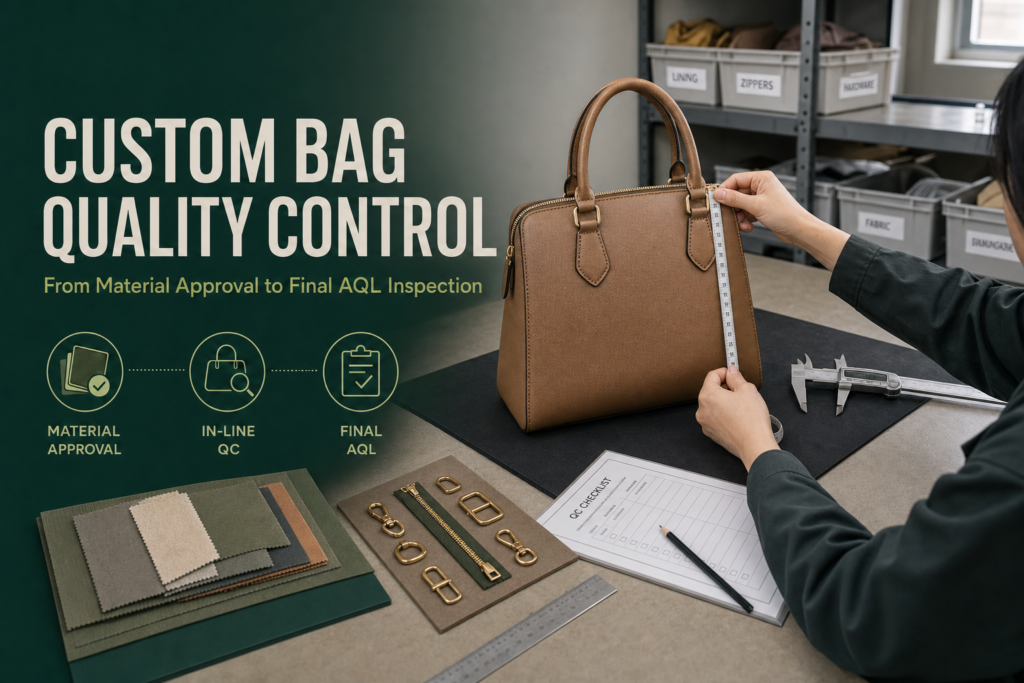
Custom Bag Quality Control Checklist: From Material Approval to Final AQL Inspection For: Brands, retailers, importers, private label buyers and sourcing teams A complete bag quality control checklist should control five points: material approval, pre-production confirmation, in-line inspection, packing verification and final AQL inspection. Buyers get better control when the approved sample, specifications, defect definitions and inspection method are agreed before bulk production. Caption: A bag quality control checklist starts with approved materials, components and a physical reference sample. Quick Summary Buyer Evidence Snapshot S.MU ACCESSORY Quality-Control Scope Before ProductionApprovalMaterials, color, hardware, structure and packaging standards During ProductionIn-Line QCStitching, shape, function, logo and batch consistency Before ShipmentFinal CheckAQL inspection, packing, labels, carton marks and release approval What Should a Bag Quality Control Checklist Include? The checklist must convert the buyer’s brief into verifiable criteria. “Good quality” is not measurable; an approved color swatch, dimensional tolerance and defect classification are. Control stage What to verify Evidence to retain Material approval Shell, lining, webbing, color, hand feel and thickness Signed swatches, material specification and photos Component approval Zippers, buckles, magnets, logo, labels and packaging Approved component board and artwork Pre-production Sample, measurements, construction and packing method Sealed sample, tech pack and approval record In-line production Cutting, stitching, reinforcement, shape and function Inspection photos, measurements and corrective actions Final inspection Quantity, workmanship, function, labels and packing AQL report, defect photos and shipment decision The checklist should be style-specific. A structured handbag needs shape and finish controls; a backpack needs strap-reinforcement checks; a cosmetic bag needs lining-seam and zipper checks. The S.MU ACCESSORY custom bag product range helps buyers identify category-specific risks. Stage 1: Approve Materials, Hardware and Branding Material approval is the first opportunity to prevent batch-wide defects. Compare bulk inputs with approved references before cutting: Testing depends on the product, materials, age group and sales market. For EU programs, buyers should identify applicable chemical restrictions during material selection; the European Commission describes REACH as the EU framework for managing chemical risks. A qualified party should define the order-specific test scope. Caption: A signed component board gives production and QC teams a common reference for material, hardware and branding. Stage 2: Confirm the Pre-Production Standard Before bulk production, confirm one shared reference standard combining the approved sample and final specification. Confirm: The S.MU ACCESSORY Design Studio supports development from buyer brief through sampling. Written approvals prevent verbal changes from becoming undocumented standards. Stage 3: Inspect Workmanship During Production In-line inspection checks products while correction is practical, especially for new styles, unfamiliar materials or complex construction. Inspectors should check: Record repeated defects, likely causes, affected quantities and corrective actions. The custom bag manufacturing process connects sample approval, production follow-up and shipment preparation. Caption: In-line inspection identifies repeated construction defects before the full order is completed. Stage 4: Verify Packing, Labels and Cartons Packing affects appearance, warehouse receiving and retail readiness. Check: Scan required barcodes and photograph the packed unit, assortment and closed carton. Stage 5: Conduct the Final AQL Inspection AQL inspection uses a defined sample to make an acceptance decision about a production lot. ISO 2859-1:2026 defines AQL-indexed sampling schemes for lot-by-lot inspection and replaced the 1999 edition in January 2026. Before inspection, the buyer should specify: The appropriate AQL plan depends on buyer risk, product use and retailer policy. AQL is an index used with a sampling plan—not an allowed defect percentage for every shipment. Practical Defect Classification Defect class Practical meaning Bag examples Critical Safety, legal or severe use risk Sharp exposed point, prohibited component or serious labeling issue where applicable Major Likely to make the item unsellable or materially impair use Broken zipper, open seam, wrong logo, major color mismatch or weak handle attachment Minor Does not materially affect use but reduces appearance or finish Small loose thread or slight cosmetic variation outside the agreed standard Classification must be agreed for the specific order. The same condition can have different commercial consequences depending on product position, market and buyer specification. Caption: Final AQL inspection combines workmanship sampling with measurement, function, labeling and packing checks. How S.MU ACCESSORY Supports Bag Quality Control Guangzhou S.Mu Accessory Co., Ltd. supports OEM/ODM development, sampling, production management, quality control and shipment follow-up. Its published quality control process covers sample development through final shipment. Buyers should still provide their own product specifications, target-market requirements, defect definitions and acceptance rules. Supplier QC, buyer review and independent inspection can serve different purposes and should be aligned before production. Fact Box S.MU ACCESSORY at a Glance CompanyGuangzhou S.Mu Accessory Co., Ltd. BrandS.MU ACCESSORY LocationGuangzhou, Guangdong, China Business FocusCustom bags and fashion accessories Product RangeHandbags, crossbody bags, totes, wallets, belts, backpacks, cosmetic bags, kids’ bags, travel accessories and small leather goods QC ScopeMaterial and sample review, in-line checks, packing verification and final inspection support Website: smuacc.com What Should Buyers Prepare? Send the supplier: If using an independent inspector, share the protocol before production rather than just before shipment. FAQ When should bag quality control begin? It should begin during material and sample approval. Early control establishes measurable references before cutting and assembly, while in-line and final inspections confirm whether production follows them. What is the difference between in-line inspection and final inspection? In-line inspection finds repeated problems while production can still be corrected. Final inspection evaluates completed goods and packing to support the shipment decision. Buyers often need both for new or higher-risk programs. What does AQL mean in bag inspection? AQL means acceptance quality limit. Under ISO 2859-1:2026, it indexes a sampling scheme used to determine sample size and acceptance or rejection criteria for a lot. It is not a promise that every uninspected unit is defect-free. Who should define critical, major and minor defects? The buyer should approve the definitions with the supplier and inspection party before production. Definitions should reflect product function, safety, legal requirements, brand positioning and retailer expectations. Can buyers arrange an independent final inspection? Yes. Buyers can appoint an independent inspection company and provide the protocol, timing and reporting requirements. The supplier should